Click for a full size map Jeff Halper, ICHAD. In the complex situation in which Palestinians and Israelis currently find themselves, two things seems equally evident: First, a viable and truly sovereign Palestinian state alongside Israel is an absolute prerequisite for a just and lasting peace; and second, Israel needs a Palestinian state. Without a Palestine state Israel faces what it considers as two unacceptable options. If it annexes the Occupied Territories and grants citizenship to their three million Palestinian inhabitants, it creates de facto a bi-national state of 5 million Jews and 4 million Palestinians (not counting the refugees), an option that would end the Zionist enterprise. If it continues its Occupation, it inevitably creates a system of outright apartheid, an untenable option in the long run. A Palestinian state thus appears to be indispensable for both Israel and the Palestinians. So what's the problem? Why did a decade of negotiations from Madrid and Oslo to Camp David and Taba end in such dismal failure, indeed, in an Intifada? What, indeed, must be done, not only to "restart the peace process," but to ensure that it concludes with a just peace offering not simply security for Israel but also a truly sovereign and viable state for the Palestinians?
 Putting the issue of the refugees aside for the moment, the answer to these questions depends on whether the Palestinians succeed in dismantling the Matrix of Control Israel has laid over the Occupied Territories since 1967. The issue before us, the issue separating a just peace from an imposed one, a sovereign Palestinian state from a bantustan, has to do not only with territory but with control. One indisputable fact that has accompanied the entire "peace process" is that Israel will simply not relinquish control voluntarily over the West Bank and East Jerusalem. It will not relinquish the core of its settlement system, or control of the West Bank aquifers, or sway over the area's economy or its "security arrangements" extending over the entire Palestinian area.
From Israel's point of view, then, the trick is to find an arrangement that would leave it in control, but "relieve" it of the Palestinian population -- a kind of occupation-by-consent. This was the essence of the "take it or leave it" offer Barak and Clinton made at Camp David (the Palestinians left it), as well as that of the Taba negotiations in January, 2001. The popular impression has it that Barak made a "generous offer" of 95% of the West Bank, plus considerable parts of East Jerusalem and all of Gaza, and that the Palestinians made an "historic mistake" in rejecting it. This has let Israel off the hook in terms of repressing Palestinian resistance. It has become fashionable, even among the moderate Israeli left, to blame the Palestinians for "spoiling" the peace process. They, after all, spurned Barak's "generous offer" of 95% and reacted with "violence." We, the Israelis, did our part. We were forthcoming. They are not ready for peace, do not want peace, are not "partners" for peace. We are OK; they are to blame for everything. They deserve anything they get. We are not responsible.
The Matrix of Control: Rendering the Occupation Invisible
Before we begin our analysis of Taba, I must define what I mean by a Matrix of Control? It is a system of control designed
- to allow Israel to control every aspect of Palestinian life in the Occupied Territories, while
- lowering Israel's military profile in order to give the impression to the outside that what Palestinians refer to as "occupation" is merely proper administration, and that Israel has a "duty" to defend itself and the status quo, yet
- creating enough space for a dependent Palestinian mini-state that will relieve Israel of the Palestinian population while
- deflecting, through the use of "administrative" image and bureaucratic mechanisms, international opposition and thus to maintain control indefinitely and, in the final analysis,
- to force the Palestinians' to despair of ever achieving a viable and truly sovereign state and to accept any settlement offered by Israeli. ("Time is on our side" is, as Sharon has often said, a cornerstone of Israeli policy.)
Because it operates under a Kafkaesque guise of "proper administration," "upholding the law," "keeping the public order" and, of course, "security," the Matrix of Control renders the Occupation virtually invisible. In "normal" times (when active Palestinian resistance can be stifled), its outward appearance is legal and bureaucratic, the most effective means of control over a long period of time. The Israeli military government over the Occupied Territories is called, for example, the "Civil Administration," even though it is headed by a colonel under the strict authority of the Ministry of Defense, and is bound by the orders of the general commanding the "Central Front."
The control mechanisms of the Matrix are varied and diverse. There are, first of all, active measures to ensure acquiescence:
- Outright military actions, including attacks on civilian population centers and the Palestinian infrastructure;
- Extensive use of collaborators and undercover "mustarabi" army units; administrative detention, arrest, trial and torture; and
- "Orders" issued by the Military Commanders of the West Bank and Gaza (some 2000 in number since 1967), supplemented by Civil Administration policies, that replace local civil law with policies and procedures that cynically further Israeli political control.
A second set of controls derives from Israel's policy of "creating facts on the ground" - virtually all of them in violation of international law (including the Fourth Geneva Convention signed by Israel itself). These include:
- Massive expropriation of Palestinian land;
- Construction of more than 200 settlements and the transfer of 400,000 Israelis across the 1967 boundaries: about 200,000 in the West Bank, 200,000 in East Jerusalem and 6000 in Gaza (the latter occupying a fourth of the land, including most of the coastline);
- Carving the Occupied Territories into areas -- Areas "A," "B," "C," "D" in the West Bank; "H-1" and "H-2" in Hebron; Yellow, Green, Blue and White Areas in Gaza; nature reserves; closed military areas, security zones, and "open green spaces" of restricted housing over more than half of Palestinian East Jerusalem - which confine the Palestinians to some 190 islands all surrounded by Israeli settlements, roads and checkpoints;
- Carving the Occupied Territories into areas -- Areas "A," "B," "C," "D" in the West Bank; "H-1" and "H-2" in Hebron; Yellow, Green, Blue and White Areas in Gaza; nature reserves; closed military areas, security zones, and "open green spaces" of restricted housing over more than half of Palestinian East Jerusalem - which confine the Palestinians to some 190 islands all surrounded by Israeli settlements, roads and checkpoints;
- A massive system of highways and by-pass roads designed to link settlements, to create barriers between Palestinian areas and to incorporate the West Bank into Israel proper;
- Imposing severe controls on Palestinian movement;
- Construction of seven industrial parks that give new life to isolated settlements, exploit cheap Palestinian labor while denying it access to Israel, rob Palestinian cities of their economic vitality, control key locations and ensure Israel's ability to continue dumping its industrial wastes onto the West Bank;
- Maintaining control over aquifers and other vital natural resources;
- Exploiting holy places (Rachel's Tomb in Bethlehem, the Cave of the Patriarchs in Hebron and others in and around Jerusalem) as pretexts for maintaining a "security presence," and hence military control.
Yet a third set of control mechanisms, the most subtle of all, are those of a bureaucratic or "legal" nature. They entangle Palestinians in a tight web of restrictions and trigger sanctions whenever Palestinians try to expand their life space. These include:
- A permanent "closure" of the West Bank and Gaza;
- A discriminatory and often arbitrary system of work, entrance and travel permits system restricting freedom of movement both within the country and abroad;
- The use of diverse methods of active displacement: exile and deportation; the revoking of residency rights; induced emigration through impoverishment; land expropriation, house demolitions and other means of making life in the Occupied Territories unbearable. Schemes of "transfer" have also been suggested (in fact, two parties in Sharon's government -- the National Union Party of the assassinated Tourism Minister Ze'evi and Minister of Infrastructure Lieberman's "Israel Is Our Home" -- have "transfer" as their main political program). Hundreds of thousands of Palestinians have "departed" since 1967, but a core of three million sumud ("steadfast") Palestinians still remains.
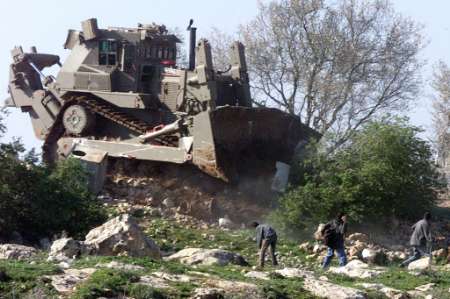
- Zoning policies which, under the guise of planning and the law, serves to freeze the natural development of Palestinian towns and villages. Part of this system involves the restrictive use building permits, enforced by house demolitions, arrests, fines and daily harassment, all designed to confine the population to small enclaves;
- Expansive "master plans" being drawn around the settlements which allow for massive building while contending that settlement building has been "frozen."
- Restrictions on the planting of crops and their sale, together with the wholesale uprooting of hundreds of thousands of olive and fruit trees since 1967; and
- Employing licensing and inspection of Palestinian businesses as a means of political control.
To all of this must be added, of course, the debilitating psychological costs of life under occupation: loss of life, imprisonment, torture, harassment, humiliation, anger and frustration, as well as traumas suffered by tens of thousands of Palestinians (especially children) who witnessed their homes being demolished, saw their loved ones beaten and humiliated, suffered from inadequate housing, and who lost opportunities to actualize their life potentials. These are wounds that will take generations to heal.
Barak's "Generous Offer" and the Matrix of Control
This popular view is based on both false information and false assumptions. First of all, there never was an Israeli "offer," and Israel never proposed to relinquish 95% of the West Bank. At a desperate time when Barak knew he would lose the election, the Israeli delegation came to Taba prepared to talk about conceding 93% of the West Bank - with the Palestinians counter-proposing 97%. But they were not talking about the same land. Because Israel does not consider East Jerusalem and "No Man's Land" around Latrun as part of the West Bank, but does include the part of the Dead Sea falling within the Palestinian territory, Barak's 93% was actually more like 88% of the actual Palestinian territory.
The major fallacy in this view is to equate territory with sovereignty. Although gaining control of 95% or 88% of the territory is important - especially if the territory is contiguous -- it does not necessarily equate with sovereignty. This is where the crucial issue of control enters the picture. The Palestinians could well receive 95% of the West Bank, Gaza and pieces of East Jerusalem and still not have the prerequisites of national self-determination: coherent territory, economic viability and genuine sovereignty. Since 1967 - and increasingly since the Oslo Accords were signed in 1993 -- Israel has laid a "Matrix of Control" over the West Bank, East Jerusalem and Gaza. The Matrix, an intricate and an interlocking series of control mechanisms, resembles the Japanese game of "Go." Instead of defeating your opponent as in chess, in "Go" you win by immobilizing the other side, by gaining control of key points of a matrix, so that every time your opponent moves he or she encounters another obstacle. This strategy was used effectively in Vietnam, where small forces of Viet Cong were able to pin down and virtually paralyze some half-million American soldiers possessing overwhelming fire-power.
In effect Israel has done the same thing to the Palestinians. Laid out strategically, the Matrix of Control paralyzes the Palestinian population even if Israel does not actually occupy large swathes of land. All the settlements and by-pass roads take up less than 5% of the land; "settlement blocs," "security zones" and other forms of control can be expanded to include 12% of the land as in Barak's conception or 56% as in Sharon's. But these 5-12% are what makes the difference between a bantustan and a sovereign, viable state. From the point of view of control, 88% of the West Bank that the Palestinians might receive indeed, sounds "generous," but it must be evaluated in light of the impact the other 5-12% have on Palestinian viability and sovereignty.
Barak's "offer" at Taba deserves to be looked at carefully, not because it was truly an "offer" or because it truly represented the Israeli position or a genuine possibility, but because, as Barak never tired of saying, it is by far the best "deal" the Palestinians will ever be offered, the most "generous," a one-time "take-it-or-leave-it" that would be a "historical mistake" for the Palestinians to reject. If all this is true, would the so-called "95% offer" at Taba have led to a sovereign and viable Palestinian state? Would it have in fact dismantled Israel's Matrix of Control? The answer to this "best case" scenario is "no."
It is true that some significant gains were made at Taba. Israel relinquished claim to the Jordan Valley, much territory was conceded (though not 95%), the settlement blocs were reduced in size, and Israel gave up its extra-territorial control over its by-pass road system. The Palestinians gained a greater degree of territorial contiguity and control of their borders, though not of their water resources. But Taba did not break Israel's hold on the Occupied Territories. On the contrary, it revealed how much Israel could relinquish and still retain control. Taba revealed the essential elements of the Matrix of Control, the minimum "red lines" of any foreseeable Israeli government. Looked at closely, this is what the "generous offer" in fact offered:
- Consolidation of Strategic Settlement Blocs. In the mid-1990s Israel began a major strengthening and consolidation of its settlement presence. In order to avoid international opposition to the establishment of new settlements, the government shifted to building new settlements within the expansive master plans around each settlement. In that way it was able to argue that it was simply "thickening" existing settlements to meet natural population growth (an outright falsification), not establishing new ones. It also began to merge discrete settlements into large settlement blocs. Although the fate of some of these blocs remains uncertain (the Jordan Valley settlements, for example, as well as the Kiryat Arba bloc near Hebron and settlements in heavily populated Palestinian areas), Israel is unmoving in this insistance on retaining three large blocs comprising today some 150,000 Israeli settlers:
- The city of Ariel and its surrounding "Western Samaria" bloc control a strategic area on the western side of the West Bank, seriously compromising territorial contiguity and the coherent flow of people and goods between the major Palestinian towns of Kalkilya, Nablus and Ramallah. It would also severely restrict the urban development of the Kalkilya area. No less important than its strategic location on the ground is Ariel's location vis-a-vis Palestinian resources under the ground: the Ariel bloc sits atop the major aquifer of the West Bank and would control the flow and distribution of water.
- The central Givat Ze'ev-Pisgat Ze'ev-Ma'alei Adumim (and perhaps Beit El) bloc stretches across much of the central West Bank from the Modi'in area to within 20 kilometers of the Jordan River. It effectively divides the West Bank in two, compelling north-south Palestinian traffic (especially from Ramallah to Bethlehem and Hebron areas) to pass through Israeli territory - the funnel-like Eastern Ring Road. It also keeps the Palestinians of the West Bank far from Jerusalem, isolating the 200,000 Palestinians of East Jerusalem from their wider state and society, and cutting the natural urban link between Jerusalem and Ramallah. In terms of viability, this bloc, a main component of Israeli "Greater Jerusalem," constitutes the greatest threat to a coherent Palestinian state.
- The Efrat-Gush Etzion-Beitar Illit bloc to the southwest of Jerusalem (yet connected through Gilo, Har Homa and the Eastern Ring Road/Road #7 complex to the Ma'aleh Adumim bloc) is the other key component of "Greater Jerusalem." It also impacts seriously on the viability and sovereignty of any Palestinian state. The bloc severs any coherent connection between the major cities of Bethlehem and Hebron, as well as traffic using the "safe passage" from Gaza. It forces Palestinians moving between these areas to use Israeli-controlled "security" roads passing through dense areas of settlement, continually exposed to disruption and closure. It locks in Bethlehem to the extent of preventing its normal urban development. And, like the Ariel bloc, it sits astride and brings into Israeli control a major West Bank aquifer.
- The Creation of a "Greater [Israeli] Jerusalem." The Givat Ze'ev-Adumim and Gush Etzion settlement blocs, 250 square kilometers containing some 80,000 settlers, when annexed to Israeli-controlled "Greater Jerusalem," will dominate the entire central region of the West Bank and obstruct the territorial contiguity necessary for a viable Palestinian state. They also function as a buffer, to separate Jerusalem from its wider West Bank surroundings, thus keeping the Palestinians at a considerable distance away. Because some 40% of the Palestinian economy revolves around Jerusalem in the form of tourism, commercial life and industry, removing Jerusalem from the Palestinian realm carries such serious economic consequences as to call the very viability of the Palestinian state into question. And in general the "Greater Jerusalem" concept neutralizes Jerusalem as a major Palestinian urban, religious and cultural center.
- The Emergence of a "Metropolitan [Israeli] Jerusalem." The ring roads and major highways being built through and around Jerusalem are intended to create a regional infrastructure of control, turning Jerusalem from a city into a metropolitan region. "Metropolitan" Jerusalem covers a huge area. Its boundaries, incorporating a full 10% of the West Bank (440 square kilometers), stretch from Beit Shemesh in the west up through Kiryat Sefer until and including Ramallah, then southeast through Ma'aleh Adumim almost to the Jordan River, then turning southwest to encompass Beit Sahour, Bethlehem, Efrat abnd the Etzion Bloc, then west again through Beitar Illit and Tsur Hadassah to Beit Shemesh. It also provides a crucial link to the Kiryat Arba and the settlements in and around Hebron. In many ways "Metropolitan" Jerusalem is the Occupation. Within its limits are found 75% of the West Bank settlers and the major centers of Israeli construction.
By employing a regional approach to the planning of highways, industrial parks and urban settlements, an Israeli-controlled metropolis can emerge whose very power as a center of urban activity, employment and transportation will render political boundaries, such as those between Jerusalem and Ramallah or Jerusalem and Bethlehem, absolutely irrelevant. A good example of how this is already happening is the new industrial park, Sha'ar Binyamin, now being built at the "Eastern Gate" to metropolitan Jerusalem, southeast of Ramallah. In terms of Israeli control this industrial park provides an economic anchor to settlements - Kokhav Ya'akov, Tel Zion, Ma'aleh Mikhmas, Almon, Psagot, Adam, all the way to Beit El and Ofra - that otherwise would be isolated from the Israeli and Jerusalem economy. More to the point, it robs Ramallah of its economic dynamism, providing jobs and perhaps even sites for Palestinian industry that would otherwise be located in or around Ramallah. Again, looking at Israel's strategy from the point of view of control rather than territory, "Metropolitan Jerusalem" virtually empties a Palestinian state of its meaning in terms of viability and sovereignty.
- An East Jerusalem Patchwork. Between the negotiations at Camp David and Taba, various options were explored to give the Palestinians more of a presence in East Jerusalem, which they claim as their capital. The peripheral villages and neighborhoods to the north and south of the city might have been ceded, although the Palestinians might receive less than full sovereignty over them - "functional autonomy," "administrative control" or "limited sovereignty." In Taba Israel considered ceding some parts of the core areas as well: some of the "Holy Basin" between the Old City and the Mount of Olives, downtown East Jerusalem, the Sheikh Jarrah Quarter, and in the Old City the Muslim and Christian Quarters. The Temple Mount/Haram issue remained unresolved, with Israel prepared to cede "functional sovereignty" (though not official) to the "upper" area of the mosques, while retaining sole sovereignty over the "lower" Western Wall.
Regardless of the size of the territorial compromises, Israel will not cede the entire area of East Jerusalem, where Israelis (about 200,000 in number) outnumber Palestinians. Since the settlements there were situated strategically for maximum control of territory and movement, and since they are today in the process of being connected, any Palestinian patches will only have tenuous connections to each other and to the Palestinian capital in Abu Dis. The Palestinian presence in Jerusalem will be fragmented and barely viable as a urban and economic center. Moreover, it would be entirely surrounded by the "outer ring" of Israeli "Greater Jerusalem," hemming it in and preventing East Jerusalem's normal urban and economic development. (Indeed, functionally ceding Palestinian areas of East Jerusalem to the Palestinians - relinquishing an "unwanted" population of some 200,000 people without relinquishing control - while incorporating the surrounding settlements into a "Greater Jerusalem" would increase the majority of Jews in the expanded city from the present 70% to 85%.)
- Israeli Control over Highways and Movement. Over the past decades (and especially during the Oslo "peace process'), Israel has been constructing a system of major highways and "by-pass roads" designed to link its settlements, to create barriers between Palestinian areas and to incorporate the West Bank into Israel proper. Even if physical control over the highways is relinquished, strategic parts will remain under Israeli control - the Eastern Ring Road, Jerusalem-Etzion Bloc highway, Road 45 from Tel Aviv to Ma'aleh Adumim, a section of Highway 60 from Jerusalem to Beit El and Ofra, and the western portion of the Trans-Samaria highway leading to the Ariel bloc. In terms of the movement of people and goods, this will effectively divide the Palestinian entity into at least four cantons: the northern West Bank, the southern portion, East Jerusalem and Gaza. There are other restrictions as well. The "safe passages" from Gaza to the West Bank, crucial to the viability of a Palestinian state, will only be administered by the Palestinians; they will not receive extra-territorial status. And Israel insists on retaining rights of "emergency deployment" to both the highway system and to the Jordan Valley, severely compromising Palestinian sovereignty. Indeed, the highways would retain the status of Israeli "security roads," meaning that Palestinian development along them would remain limited.
To fully understand the role of the highway grid in completing the process of incorporation, one must link these West Bank developments to the ambitious Trans-Israel Highway project. Already in 1977, in his Master Plan for the settlement and incorporation of the West Bank, Sharon presented his "Seven Stars" plan calling for contiguous Israeli urban growth straddling both sides of the "Green Line." The Trans-Israel Highway, which hugs the border of the West Bank, provides a new "central spine" to the country. Hundreds of thousands of Israelis will be resettled in the many towns and cities planned along the length of the highway, especially along the "Green Line" and in areas of the Galilee heavily populated by Arabs. New and expanded Israeli cities, towns and settlements on both sides of the Green Line form a new "metropolitan core-region" in which Metropolitan Tel Aviv (including the Modi'in area settlements, Rosh Ha-ayin and the Ariel bloc) meets Metropolitan Jerusalem (stretching from Modi'in, Kiryat Sefer, Beit Shemesh and the Etzion Bloc across the most of the central West Bank to the settlements east of Ma'aleh Adumim). The Trans-Israel Highway, articulating as it does with the highways and settlement blocs of the West Bank, moves the entire population center of the country eastward, reconfiguring the entire country.
- Industrial Parks for Economic Control. The establishment of industrial parks on the "seam" between Israel and the Palestinian state is a key strategy in subduing popular Palestinian opposition to continued Israeli presence and control in the Occupied Territories. Seven such parks have already been built, with several other in various stages of planning and construction. Yet, while providing employment to the Palestinian workforce, these industrial parks threaten the economic viability of the Palestinian state, maintain a dependency relationship on Israel and present dangers to the environment. They allow Israeli firms continued access to cheap Palestinian labor while denying the workers access to Israel (a key component of the "separation" strategy). Although they pay higher salaries than Palestinians can earn in their own de-developed economy, the wages are still well below Israeli minimum wages and benefits. The proximity of Israeli industrial parks to weaker Palestinian industries nearby creates unfair competition and in the end saps Palestinian cities of their economic vitality. (They also provide crucial economic anchors to the settlements whose residents manage the parks and the factories, as the Sha'ar Binyamin project illustrates.) Just as serious, the lax environmental standards and low costs means that these industrial parks attract Israel's most polluting industries - chemical, aluminum, plastics, metalworks, batteries. Though established in Palestinian areas (or specially-created Industrial zones), these parks ensure Israel's ability to continue dumping its industrial wastes into the West Bank.
- Meeting Israeli "Security" Concerns. "Security" is defined by Israel in such maximalist terms that it ensures Israeli political, military and economic control. Israel insists that a Palestinian state will be demilitarized and forbidden to enter into military pacts with other states, that Israel controls Palestinian airspace, and that it reserves the right to deploy forces in the Jordan Valley in the indeterminate event that it perceived "a threat" of invasion. Controlling Palestinian labor and commercial movement through the imposition of "security borders," part of Israel's declared policy of "separation" from the Palestinians, constitutes additional constraints on Palestinian development, locking the less that 20% of Palestine that is the state from the other more than 80% that is Israel.
- Limited Palestinian Sovereignty. A Palestinian state would possess limited sovereignty only. It would be demilitarized and unable to form military alliances not approved by Israel. It would have jurisdiction over its borders, but would have certain restrictions as to who may enter (especially vis-a-vis the refugee issue). And the restrictions regarding military contingencies (defined by Israel) would apply.
Dismantling the Matrix of Control: The Only Way Out
If Israel can force or induce the Palestinians to accept the Camp David formula (or find a post-Arafat quisling to sign the bottom line), it will have succeeded in securing control over the Greater Land of Israel while having relieved itself of the Palestinian population of the Occupied Territories. This is also true of Barak's "generous offer" at Taba - Israel's "best deal" (though it never really approached a concrete "offer" or "deal"). Again, it is not hard to understand why the Palestinians rejected it. Taba would have given Israel title to more than 80% of Palestine and control over the rest. The Palestinians would have had to cede the elements essential to their self-determination: economic viability and developmental potential, territorial contiguity, true independence, a normal and sovereign civil society, recognized borders under their own control. Indeed, they were already skating on the thin edge of viability and sovereignty. At Oslo the Palestinians gave up political claim to 78% of their country, and agreed to a mini-state of limited sovereignty: no army, no military alliances not approved by Israel, certain Israeli economic controls and even limitations on who may enter Palestine. Barak's "take it or leave it" approach also prevented agreement. The Palestinians feared they would be doomed forever to a truncated, dependent, semi-sovereign mini-state, their hopes for a real country and the resolution of the refugee issue frozen within the parameters of Oslo, Camp David and Taba - and ultimately within the Matrix of Control.
Taba did show that peace was possible, but only if Israel truly dismantled its Matrix of Control. Although it represents Israeli's "best case" scenario, it may not even have been "real." In articles and interviews Barak has given since leaving office, he has reiterated his old pre-Taba, Camp David positions -- 80% of the settlers must remain under Israeli sovereignty; "separation;" Israel retains 15% of the West Bank, etc. Or did he agree knowing full well that any Taba agreement had no chance passing the Knesset? We will never know. What we do have now is a Sharon-Peres government determined to break Palestinian resistance once and for all. Refusing to even consider picking up the negotiations from where they left off at Taba, Sharon has offered the Palestinians 42-56% of the West Bank (the present extent of Areas A and B with some corridors), none of East Jerusalem and a truncated Gaza.
The Matrix of Control represents Israel's success in establishing a system of control over the Occupied Territories that has lasted decades. Its usefulness does not end there. Because it renders the Occupation invisible, it is capable of deflecting opposition at home and abroad. Although it was Israel who prejudiced the outcome of the Oslo negotiations by measurably strengthening its grip over the Occupied Territories and offering concessions that left its control intact, it is the Palestinians who have been almost universally blamed for the breakdown of the "peace process." An understanding of the Matrix of Control is essential for comprehending the sources of the present conflict and the obstacles to its resolution. Only dismantling it will lead to a just and lasting peace. This is the only way that Israel's long-standing and ongoing campaign of "creating facts on the ground" can be effectively neutralized.
Jeff Halper, an anthropologist, is the Coordinator of the Israeli Committee Against House Demolitions