Visualizzazione post con etichetta ISM. Mostra tutti i post

sabato 22 settembre 2007

Army Incursion in Al Ayn refugee camp, Nablus - the Abbas-Fayyad Israeli recognised State of Palestine

International Solidarity Movement, 21/09/07.

Tuesday, September 18th, Israeli occupation forces (IOF) assaulted Al Ayn refugee camp in Nablus. The IOF attacked the camp and were met with fierce resistance from inside the camp. One soldier and one resistance fighter was killed.

The camp was closed off and a curfew was put in place. A road block of earth was set up to stop people and vehicles from entering the camp. Ambulances gathered on Jamal Abdel Nasser street, the main entrance to the camp. They then dropped tear gas upwind of the ambulances, causing the crews to leave the area or seek shelter in their vehicles.

An injured 17 year old was taken to the roadblock and put into an ambulance. The soldiers took the keys out of the ignition, forcing the ambulance to wait until an army medic had declared ‘whether he was dead or not’. The family of the gunshot victim were forcibly removed from the ambulance. Nervous soldiers were very aggressive with the press throughout.


Palestinian Medical Relief worker is arrested and blindfolded for trying to access the wounded. Three medical workers were arrested during the invasion.

An ISM Human Rights Worker (HRW) was filming an army jeep when the soldier in the back of the jeep attempted to throw a tear gas grenade at the HRW. He set it off in the back of his own jeep instead. Soldiers piled out of the jeep choking on their own tear gas. It seemed they threw a sound bomb at the HRW and ambulance crews who had witnessed the mistake out of embarrassment.

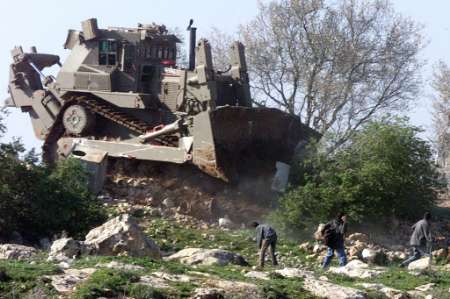
Excessive repression was carried out all day against youths throwing rocks at army jeeps, humvees and bulldozers. HRWs and Palestinian ambulance crews repeatedly tried to enter the camp. Urgently needed water, bread and medical supplies were not allowed in by the army. All negotiations with the IOF failed, both with the soldiers on the ground and the local DCO “humanitarian office”.

———————–


Smoke rises from Israeli army activity in the besieged camp.

Wednesday, September 19th:

The lock down of Al Ayn refugee camp continued. After two nights of curfew and no medical teams entering, ambulance crews were anxious to get in and tend to the wounded. The IOF responded to the requests of the medics by firing rubber coated steel bullets at them. The ambulances were hit repeatedly, and after sustaining damage to windscreens and the vehicle bodies, were made to leave the area. At 10:20am ambulance crews and two ISM HRWs tried to gain access to the medical clinic but were forced back by concussion grenades and rubber coated steel bullets.

At mid-day a large, colourful, non-violent protest march approached the camp. There were around 200 Palestinians waving flags and chanting songs. The army fired tear gas at the back of the procession, into a large group of women. They then fired tear gas and rubber bullets into the rest of the protesters. In the ensuing chaos people were hit by grenades and rubber bullets. The army fired indiscriminately into the crowd to create as much pain and havoc as possible.

One HRW and an ambulance crew bravely broke the curfew. They ran past soldiers taking desperately needed medical supplies into the camp. They stayed for the rest of the evening giving out food and medicine to the trapped occupants of the camp. At around 6pm one ambulance with medicines supplied by an ISM HRW was allowed into the camp, bringing much needed relief to families trapped in the nightmare of the IOF invasion. During the curfew on this day, a 38 year old handicapped man in a wheelchair was shot while he was looking out his window. The situation continues with ambulance crews and HRWs on stand-by all through the night waiting for the next opportunity to gain access to the terrified inhabitants of the camp.

————


Local Palestinians are arrested while demonstrating non-violently against the invasion.

Thursday, September 20th:

ISM HRWs came to the camp at 8:30am and saw the UN and the Red Cross among other NGOs on the scene for the first time.

A couple of ambulances were allowed into the camp at 9:00am to bring much needed relief and aid to the camp inhabitants. At around 10:30am two people were arrested and taken from the mosque in handcuffs, into an armoured personnel carrier. One medic was arrested from the clinic on Jammal Abdel Nasser street. The IOF entered the clinic and checked everyone’s IDs. The medic was released late in the evening after being badly beaten with sticks during his incarceration.

A peaceful demonstration was held in solidarity with the besieged camp. After speeches were made in the centre of Nablus the march began at 11:10am. There were colourful banners waved as the city’s people showed their support for the inhabitants on the streets for the second day running. As the marcher approached the camp, they were subjected to a hail of sound grenades and tear gas. The tear gas turned the crowd of peaceful demonstrators into a scene of fear and chaos.


A building that was called home by fifty children and their families is destroyed, they were given minutes notice.

Along with a Palestinian medical crew three ISM HRWs gained access to the inside of the camp. After sneaking over rough ground, the group stopped when faced with an IOF jeep standing in their way. The group gathered their courage and had the internationals in the front as they walked past the jeep. Around the corner were three or four more IOF vehicles forcing the medics and HRWs to dash down an alley and into the camp.

Urgently needed medical supplies were distributed to the grateful residents in their homes. Danger was always wearing a uniform as the medics moved around the camp. HRWs led the way calling out ‘volunteer’ so any trigger-happy soldiers knew they were a medical crew. A student from Tulkarem had been trapped in the camp since Tuesday morning. One HRW gave her his high-visibility jacket so she could leave with the team and return home. While exiting the camp the medics and activists were attacked by the IOF with sound bombs. All they wanted was to bring more supplies in to the needy people but were threatened with being shot by soldiers.

At 5pm a building which housed around fifty children, recently visited by the medics and activists in the camp, was blown up by the IOF. This illegal act of collective punishment was because a cousin of one of the residents was wanted by the Israeli Army. Later in the evening the IOF set off a series of large explosions in the camp. The explosions lasted for around 20 minutes and many homes were destroyed. The city shuddered as the IOF continued its operations in Al Ayn refugee camp.

———–


Medical workers must go through extensive searches and ID checks while attempting to deliver food and medicine to the camp under curfew.

Friday, September 21st:

After a three day siege of Al-Ain Refugee camp, IOF left the camp around 5am this morning. Residents were able to leave their homes for the first time since it began. At least two Palestinians were killed and an unknown number of people are injured. 49 residents of the camp were also arrested. Many homes in the camp showed signs of extensive damage.

The IOF blew many doors off their hinges and bullets and tear gas canisters could be found on the ground in many places throughout the camp. At least one house, which had been the residence of fifty children, was completely destroyed by explosives. Several other houses had gaping holes in walls and showed signs of attempted demolition. Today, children sat in the rubble where their house once stood.

International activists spoke with several residents of the camp, who described experiences of being without food, water and medicine. One woman spoke of being beaten by IOF soldiers outside of her home. A member of a Palestinian relief organization told activists that three medics had been arrested over the course of the invasion, with one still being held captive.

The bodies of the two Palestinians killed during the invasion were carried through the streets by hundreds of mourners who remembered with rage the brutal treatment they have endured by the IOF.


Palestinian and international HRWs walk along the destroyed route the Israeli army took through the camp.


lunedì 3 settembre 2007

Sarra village roadblock removal

Peace Activits under Arrest for Preventing the Rebuilding of Military Roadblock in Palestinian Village

International Solidarity Movement, 01/09/08 (Contact Molly, ISM Media 059943157). Yesterday in Sarra village near Nablus, four human rights defenders from Germany, the United States, The United Kingdom and Canada were arrested for blocking Israeli military bulldozers from rebuilding a roadblock between the village and the city of Nablus. The activists spent the night at Ariel police station and are currently awaiting arraignment. Two of the activists, women from the UK and Canada, were forced to spend the night handcuffed and shackled at the ankles in the hallway of the police station. The protest was held after Israeli authorities had broken their promise to remove the roadblock permanently. Israeli soldiers arrived at the village last Saturday, forcing a Palestinian villager to use his tractor to close the roadblock, despite Israeli promises that the roadblock would be permanently opened. When residents removed the roadblock once again, soldiers returned during the night, retaliating against them for having taken non-violent direct action. The soldiers shot out water tanks, roughed up residents and interrogated them.

This incident comes only days after Defense Minister Ehud Barak told Haaretz newspaper haaretz.com/hasen/spages/898487.html that he plansto replace roadblocks in the West Bank with mobile checkpoints to easerestrictions on Palestinian daily life. The Sarra roadblock is one ofhundreds of barriers that the Israeli authorities have erected toprevent travel between Palestinian communities. According to Btselem,the Israelis have constructed 217 dirt piles at entrances to villagesor to block roads, 86 fences along roadways, 12 trenches that preventvehicles from crossing, 93 locked gates at entrances to villages, withthe keys held by the army. These physical barriers accompany the hundreds of permanent and surprise checkpoints which the Israeli armymaintains inside the West Bank, limiting freedom of movement for the
occupied Palestinian population.

According to a May report released by the World Bank, "freedom of movement and access for Palestinians within the West Bank is the exception rather than the norm... the restrictions arising from closure... create such a high level of uncertainty and inefficiency that the normal conduct of business becomes exceedingly difficult and stymies the growth and investment which is necessary to fuel economic
revival."

Full World Bank report HERE: siteresources.worldbank.org/
INTWESTBANKGAZA/Resources/WestBankrestrictions9Mayfinal.pd

The village plans to continue to use non-violent means to resolve this
issue.
###

--~--~---------~--~----~------------~-------~--~----~
The International Solidarity Movement (ISM) is a Palestinian-led non-violent resistance movement committed to ending Israel's illegal occupation of Palestinian land. We call for full compliance with all relevant UN resolutions and international law.

For specific media inquires such as interview requests, photo usage, etc. please email the ISM Media Office at media@palsolidarity.org

mercoledì 29 agosto 2007

Religious Fervor Induced Over Theft of Palestinian Land

ISM, 22/08/07. From August 18th, 2007 through to the 22nd, international Human Rights Workers (HRWs) in the Susiya region noticed an increase of activity on Palestinian land. The land in question, belonging to a family in the region, has been arbitrarily declared by the military as a “special security area,”. The essential meaning being that Palestinians are not allowed to be on the land. Along with this order, no one is to be allowed to build on or work the land.

At least one month ago settlers erected a tent on the hilltop of the land in question. The tent, a square, roofed structure, co-joined a rectangular garden surrounded by cut tree branches.

On August 19th, 2007 the settler erected a second, smaller, roof-less tent in the area of the first tent. The following day, he moved much of the contents of the first tent to the second, including: a mattress and alarm clock, a low table with many books, and several religious items. It was believed that the tent served as a synagogue and also that the settler was sleeping there.

According to Palestinians within view of the tents set-up, the settler arrived in the evening and left in the morning. The morning departure was viewed also by HRWs. The Palestinian witnesses also report seeing the settler working the land in the night.

During the last few weeks, approximately 25 olive and fig trees have been planted on the land between the two tents and recognized Palestinian land. The settler draws water from the cistern, also on the appropriated Palestinian land, to tend his trees. As with the land itself, Palestinians are unable to access this valuable water resource.

Wednesday August 22nd, four HRWs observed the settler’s van leaving the tents area early in the morning, shortly after 6 am. By the time they arrived at the tents, no one was present.

Shortly after 9 am the same morning, one HRW alerted the other three HRWs of the returned presence of the settler van at the tents. Arriving at the scene around 9:30 am, the HRWs were immediately approached by the settler who had been tending the trees. The settler told the HRWs to leave the area, claiming that it was his land: Israeli land. The settler continued to tell the HRWs to leave, continued to claim rights to the land, and continued to block passage of the HRWs to the land beyond him. The settler was zealous in his declarations, fervently repeating: “Father, this is your land, this is my land,” in Hebrew, while throwing his arms up to the sky. HRWs found it impossible to discuss legal aspects of the land with someone whose entire claim was based on religious fervor, and spoke no English.

Approximately 20 minutes later, a soldier arrived to discuss the situation. The soldier maintained that he had no authority to decide whose land it was, that he was only present to prevent violence from occurring. He left after a few minutes, saying that he had called senior military officers to the scene and that both parties- the settler, and the HRWs- were allowed to remain in the area.

At 10:20, HRWs tried to contact the Kiryat Arba police, requesting their presence in Susiya.

A jeep of about four officers later arrived who told the HRWs that they also could do nothing to prevent the settler from working or living on the land, as well as that they had no authority to decide who the owners of the land are. They also showed little interest in pursuing the matter, seeming to side with the settler. They did, however, coerce the settler away from HRWs and over to the tents area.

During this time, HRWs continued their presence on the land, standing and sitting in the area where the settler trees had been planted. HRWs erected a small tarp structure as protection and shade against the sun. At one point, the settler broke away from the soldiers, running at the HRWs and tearing down their shade structure, attempting to steal the tarp from them. Soldiers eventually intervened, long after HRWs had struggled, non-violently, to keep a hold of their tarp.

A second military jeep arrived, with three more soldiers. Among these reserve soldiers, one who speaks very English quite well explained that, for the soldiers, the situation and jurisdiction is complex and that ownership of the land in question is difficult to determine. He repeatedly recommended just waiting for the Israeli court system to decide on who has property rights. HRWs contested that while the case is in courts, a very long and drawn-out process, Palestinians are prevented from accessing and using the land, while at the same time the settler is cultivating the land, establishing grounds for future attempts at claiming ownership. The HRWs continued to reiterate that the land has been declared a “special security area” by the military and that the settler should not be cultivating the land or living on it.

At approximately 1:00 pm, the police arrived, hours after having been called. The main officer maintained an aggressive posture and displayed a blatant lack of concern for the law he was supposed to be enforcing. As with the soldiers, the police also passed on responsibility for making decisions and enforcing law. And as with the soldiers, the police contradicted themselves by stating that while ownership of the land is unclear, the settler may remain on it while the Palestinians may not.

The main police officer continued in his aggressive posture and questioning, asking irrelevant questions about HRWs thoughts on September 11th and avoiding the issue at hand. He collected HRWs passports for ID and visa checks shortly after arriving. These were not returned until approximately over 2 hours later, in an unofficial sort of detention.

HRWs continued their presence on the land, alternately discussing the illegality of the settler’s actions and the military and police complicity in stealing Palestinian land, as well as raising the issue of the blatant and gross unfairness of the legal system in Israel for Palestinians.

Police eventually returned the four HRWs passports and departed the scene. Soldiers reported that the police had phoned the land administration police and asked them to come to the scene to discuss the disputed land and resolved the issue of territory and blurred boundaries. Soldiers reported that the land administration police refused to come to the scene.

Shortly after the police left the soldiers also left, telling HRWs that they would return if violence occurred and the entire process would begin anew.

HRWs stayed on for another 15 minutes before deciding to leave for the time being, deciding also to make their presence on the stolen and disputed land a regular one, visiting on a daily basis.