Visualizzazione post con etichetta settler Zionist theft. Mostra tutti i post

lunedì 22 ottobre 2007

On the Road to Nowhere, [Palestinians] Pay the Toll


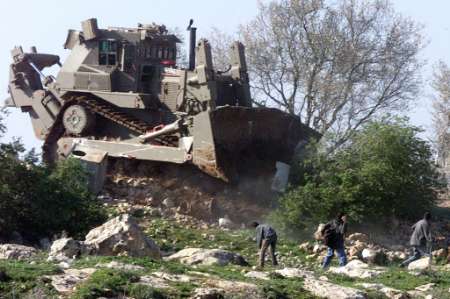
Israeli soldiers, border police and police officers arrest foreign activists, members of the International Solidarity Movement, protesting against the construction of Israel's separation fence in the northern West Bank village of Masha, near the town of Qalqilya, Tuesday Aug. 5, 2003. Israeli forces detained 47 Palestinians and foreign activists and the army said the protesters were arrested after refusing to leave a closed military zone. (AP Photo/Muhammed Azba). Since the 1970s Israel has confiscated at least 7,000,000 square metres -- eighty percent -- of the land of Mas'ha, to build the illegal Jewish settlement of Elkana.

Scott Wilson, Washington Post Foreign Service, 21.10.07. Route 505 has been blocked at the western edge of this village by the $2.5 billion barrier Israel is building to separate Jews from the Palestinians of the West Bank, splitting a largely shared economy whose shops, factory floors and restaurant terraces once provided a rare meeting place for two peoples. Now they are living increasingly estranged lives in the land they are unable to share.

Hani Amer walking near the wall which runs next to his home in Mas'ha. In the background lies the illegal Jewish settlement of Elkana. (Amer Madi). When Hani Amer refused to leave his land 'voluntarily', a new strategy was introduced. An Israeli officer came to Hani Amer and threatened that he could not stay. According to Hani Amer, he said, 'We will break you, if you don't accept our good offers. We could send someone to shoot at the settlement and we will have already prepared the charge against you. Then your house will be bulldozered because you are known as a terrorist.'

The Israeli government says the steps it has taken help ensure Israel's security in the absence of a peace deal. But Palestinian officials argue that the impoverishing effects of the economic separation spawn unrest in the territories and increase the potential for attacks inside Israel. Israel's economy is nearly 40 times larger than that of the territories, even though its population is less than twice the Palestinian one in the territories. The lopsided effects of Israel's economic withdrawal have left much of the territories economically lifeless. "We knew them," said Ruven Hirak, 51, an Israeli economics professor at Bar-Ilan University, who lives in the wealthy Jewish settlement of Elqana along Route 505 just beyond the separation fence from the village of Mas-Ha. Grocery shopping in Elqana's busy central mall one recent afternoon, Hirak said of his Palestinian neighbors, "I sat with them in restaurants, bought from them, and some of them worked here.

"Now," he said, "there is no relationship at all."

אלקנה

Elkana


דונם

Dunam

מקרא Legend

אחוז %Percent

אקרים

Acres


שטח כולל

1,444


100

361

Total Area

קרקע פרטית פלסטינית

746.5


51.7

186.6

Private Palestinian Land

אדמת סקר

0


0

0

Survey Land

אדמה שנרכשה ע"י יהודים

0


0

0

Land bought by Jews

Graphic by Peace Now

According to the World Bank, the Palestinian gross domestic product per capita has shrunk 30 percent -- to $1,129 -- since the uprising began. Unemployment and poverty rates have spiked across the territories, especially during the 16-month international embargo that followed Hamas's election victory. By contrast, the International Monetary Fund estimates that Israel's per-capita GDP is $31,767, nearly double what it was on the eve of the Palestinian uprising. The more than 550 military checkpoints, roadblocks and other obstacles within the West Bank, along with restrictions presented by the 456-mile separation barrier, have made it impossible for many Palestinian merchants to attract customers outside their small local markets. On the eve of the uprising, 136,000 Palestinians, or nearly a quarter of the labor force, worked inside Israel or in Israeli-owned enterprises in the territories. With a financial stake in Israel's security, said Persky, the Israeli army officer, only a "very few" were even tangentially involved in suicide attacks. Today, 47,400 Palestinians from the West Bank, or less than 9 percent of the workforce, have such permits. The United States and Europe are increasingly the largest markets for Israel's more than $40 billion in annual exports -- including cut diamonds, high-tech hardware and software, arms and agricultural products. Less than 5 percent of Israel's exports are sold in the Palestinian territories. By contrast, roughly 90 percent of Palestinian exports are sold inside Israel.

martedì 2 ottobre 2007

Israël construit une nouvelle route pour pérenniser les colonies proches d'Hébron

P. S. P., Le Figaro, 01/10/07. Bien qu'il s'oppose officiellement à l'éclosion de nouvelles colonies en Cisjordanie, le gouvernement israélien poursuit discrètement sa politique de faits accomplis. Répondant à une requête des colons, Israël a ainsi décidé de dévier une portion de 8 kilomètres de la route 60, qui dessert à la fois colonies israéliennes et villages palestiniens dans le sud de la Cisjordanie. Le nouveau tracé permettra aux colons juifs d'accéder à la région d'Hébron depuis Jérusalem, en contournant le camp de réfugiés palestiniens d'al-Aroub, ainsi que plusieurs villages palestiniens, qui se retrouveront isolés.
Le projet aura pour effet de faciliter l'accès aux colonies proches d'Hébron pérennisant ainsi leur rattachement au bloc de colonies du Goush Etzion. L'accès à la route leur étant devenu inaccessible, les Palestiniens des villages avoisinants devront emprunter une route secondaire. « Cela nous obligera à faire un détour de 15 kilomètres, pour aller à Jérusalem », s'emporte Saïd Madhieh, un enseignant retraité habitant le village de Halhoul.
Selon les calculs de l'ONU, la construction de la route entraînera aussi la confiscation de 326 ha de terres agricoles palestiniennes. Le village de Halhoul sera coupé de 1 500 ha de vergers. La route traversera aussi un cimetière musulman adjacent au camp d'al-Aroub, risquant de provoquer des protestations.
forums Réagir dans le forum

Les extrémistes juifs veulent de nouvelles colonies

PATRICK SAINT-PAUL envoyé spécial à Efrat, Le Figaro, 01710707. POSTÉ devant une barrière jaune, qui barre la route, un groupe de soldats israéliens interdit l'accès à la colline 1 013. « Ceci est une zone militaire fermée », lancent-ils à travers leurs mégaphones, sans conviction. Il en faudrait davantage pour décourager les centaines d'Israéliens, qui ont décidé d'ériger une nouvelle colonie au sommet de la colline, face au village palestinien de Halhoul, dans le sud de la Cisjordanie. Des organisations d'extrême droite ont lancé hier une offensive concertée pour créer quatre nouvelles colonies en Cisjordanie, espérant ainsi accentuer leur mainmise sur ce territoire occupé par Israël depuis 1967.
Drapeaux orange et bouteilles d'eau
Voitures et autocars déchargent leurs passagers au pied de la colline 1013, sous le regard médusé de quelques Palestiniens ayant osé venir assister à l'événement. Équipés de leurs « lulav », des feuilles de palmier utilisées pour construire des cabanes à l'occasion de la fête juive de Soukkot (« Tabernacles »), les colons contournent les militaires et gravissent la colline. Certains sont armés de leurs fusils d'assaut M 16, pour se protéger contre d'improbables attaques palestiniennes. Arrivés au sommet, ils construisent des synagogues improvisées avec des pierres et des cabanes de Soukkot, avant de prier et de lire des passages de la Torah.
Inquiet de la timide reprise des négociations de paix entre le premier ministre israélien, Ehoud Olmert, et le président palestinien, Mahmoud Abbas, les colons ont décidé de relancer la construction de colonies, pour empêcher des évacuations de Territoires occupés qui accompagneraient la création d'un État palestinien. « Oslo a été une catastrophe, affirme Nathan Shwartz, un colon religieux venu de l'implantation de Karme Tzur. Olmert est prêt à diviser Eretz Israël (le Grand Israël de la Bible). Il est prêt à diviser Jérusalem. Si nous laissons faire cela, les terroristes du Hamas s'empareront de Jérusalem et s'y installeront avec leurs roquettes Qassam. Nous devons les empêcher. C'est une question de vie ou de mort pour nous. »
Des camionnettes équipées de haut-parleurs et de drapeaux orange, la couleur des colons évacués de la bande de Gaza en 2005, sillonnent les routes. « Montez partout. Cette terre est à nous. Des milliers de gens sont avec nous, venus des quatre coins du pays, pour défendre leur patrie, Eretz Israël », lancent les haut-parleurs entre deux chansons populaires. Dans la colonie d'Efrat, les quelque 600 militants qui ont lancé l'assaut de la colline de Givat Ha Eitam sont emmenés par Nadia Mattar, l'égérie du mouvement antiretrait de la bande de Gaza, et par Itamar Ben Gvir, l'un des chefs du mouvement des colons d'extrême droite, déjà incarcéré à plusieurs reprises. Équipés de drapeaux orange et de bouteilles d'eau, les jeunes colons ont l'intention de camper sur place.
Les habitants d'Efrat espèrent pouvoir mettre la main sur la colline de Ha Eitam, que le tracé de la barrière de séparation israélienne a placé du côté palestinien, pour s'agrandir. « Nous avons besoin de cette colline pour notre expansion naturelle, explique le rabbin Ryskin d'Efrat. Nous combattons les fondamentalistes palestiniens. » Où les Palestiniens établiront-ils leur État, si les colonies s'étendent sans limites ? « Là où nous ne sommes pas. Il leur restera bien assez de place », juge le rabbin.
Les colons s'attendent à être délogés sous le couvert de la nuit par l'armée de ces implantations, qui sont illégales même au regard du droit israélien. Pourtant, les organisateurs considèrent leur opération comme un succès. « C'est un message pour le peuple, visant à contrer la politique destructrice du gouvernement. Des milliers de personnes l'ont entendu », se réjouit Datya Itzhaki, l'une des dirigeantes du mouvement, évacuée de Gaza en 2005.

mercoledì 29 agosto 2007

ILA Leasing Arab-Owned Land in Jerusalem to Ateret Cohanim

ISM, 21/08/07. The Israel Lands Administration (ILA) is working together with the Ateret Cohanim association to wrest from Palestinian landowners control of 30 dunams (7.5 acres) of land in East Jerusalem and to transfer it to the association without a tender. Such is the claim outlined in a petition submitted two weeks ago to the High Court of Justice, and appearing in documents which Haaretz has received. Ateret Cohanim promotes settlement of Jews in and around the Old City, and at times takes over Palestinian assets in East Jerusalem so as to "Judaize" that area.
The land in question, an olive grove called Kerem Hamufti, is in the
Sheikh Jarrah neighborhood. From the documents received, it emerges
that the ILA has signed a contract with Ateret Cohanim for "the
agricultural cultivation" of the land, even though the association has
no experience in such work.
The documents indicate that the contract was signed even though the
land that the ILA leased apparently does not belong to it and the
Interior Ministry recognizes that the Palestinian landowners "have an
interest" in it. A senior source at the ILA has said the contract was
signed in order "to keep the territory in Jewish hands."
In the petition it is claimed that an authorized official at the ILA
"acted to advance the interests of Ateret Cohanim," to prevent the
Palestinians who claim ownership of the land from developing it. The
petitioners define the ILA action as "corrupt" and are asking the
attorney general to investigate "the involvement of Ateret Cohanim in
governmental decision-making."
In March, 40 years after declaring its intentions to do so, the state
formally expropriated the land, at the request of the ILA. Former
finance minister Abraham Hirchson signed on the plan to expropriate
the property under the rubric of "acquisition for public needs."
In its petition to the High Court, the Palestinian landowners, the
Arab Hotels Company, asks for the expropriation to be prohibited
because it was done "for an extraneous, illegitimate, racist and
discriminatory purpose ... An illegitimate and corrupt hand has worked
hand in glove with the authorities or other elements to harm the
petitioner's rights, and to disinherit the petitioner for purposes of
leasing the land to Ateret Cohanim."
Kerem Hamufti is named for its former owner, Haj Amin al-Husseini, the
mufti of Jerusalem. According to Israeli and Jordanian documents, in
the 1960s it was purchased by the Arab Hotels Company of East
Jerusalem.
After the area was annexed to Israel after the Six-Day War, the
Finance Ministry stated its intention to expropriate the land "for
public purposes," but this was never carried out and the Palestinian
owners continued to cultivate it. Several times over the years an
Israeli court confirmed that the company is indeed owner of the
property.
About seven years ago the Palestinian owners submitted to the planning
authorities a request to build a hotel, a conference center and a
cultural center on the land. Architect Moshe Margalit, who drew up the
plan, relates that at the time the District Planning Commission
confirmed that the East Jerusalem company has ownership rights to the
land. The Interior Ministry confirmed to Haaretz that the company has
been allowed to continue the planning as it has been proved that it
"has an interest in the land."
Municipal blessing
>From the summaries of meetings concerning the property at the Interior
Ministry, it emerges that representatives of the ILA were present, but
did not mention they had leased the land to Ateret Cohanim or that it
belongs to the ILA.
Margalit relates that the Palestinian landowners' plan was presented
"to the most senior people at the Jerusalem Municipality" and received
their blessing. The petition also states that the mayor of Jerusalem
at the time, Ehud Olmert, and his deputy, Yehuda Pollack, the chairman
of the Local Planning and Building Committee, supported it.
However, at a certain stage, relates Margalit, it seemed that Ateret
Cohanim also submitted a plan for this parcel of land: Two years
beforehand, the ILA had granted permission to Irving Moskowitz, the
American Jewish millionaire who supports Ateret Cohanim, to plan a
neighborhood on Kerem Hamufti. A person close to the association aims
to build 250 housing units there, and pressured ministers in former
prime minister Ariel Sharon's first government to approve it.
In June, 2000, immediately after the plan by Moskowitz and Ateret
Cohanim was revealed, the landowners' attorneys applied to Jerusalem's
Local Planning and Building Committee with a request to dismiss the
scheme because "those who submitted it are not the owners of the
land."
The committee told the attorneys that the plan had been "shelved."
A few months ago the Arab Hotels Company received notice from the
Magistrates Court, allowing it to evict a Palestinian who was
squatting on the land. However, on the day of the eviction, the Amidar
company, on behalf of the ILA, filed a demand to stop it.
While the ILA and Amidar acknowledge this was indeed a matter of a
squatter, a senior source at the ILA has told Haaretz that the
Palestinian "was working with Ateret Cohanim." The source explains his
presence was necessary "to prevent theft of land by Palestinians."
The current petition says the state owns about 20 percent of Kerem
Hamufti under the Absentee Property Law, as it belonged to Al-
Husseini, who collaborated with the Nazis during World War II.
However, the Palestinian landowners' lawyers insist that the law does
not apply to the property because it was purchased from the Al-
Husseini family before Israeli rule began in East Jerusalem in 1967.
Attorney Danny Kramer, the representative of the official guardian of
absentee property, is also a signatory to the petition, which states
that the guardian has no connection to the land, and also that the ILA
has been leasing it to Ateret Cohanim "for some years now."
In its petition, the Arab Hotels Company argues that the low lease
being paid by Ateret Cohanim is proof that this is an "artificial
contract." The association is paying NIS 42.5 per dunam (which comes
to NIS 1,278 for the entire parcel of land), although it is in a
prestigious location.
The ILA's official response to Haaretz states that the contract with
the Jewish association was signed "more than five years ago"; a senior
ILA source says the contract was signed "at the beginning of the
1990s."
At the ILA they were not able to explain how the entire plot of land
was leased to Ateret Cohanim, despite the fact that even the ILA
itself says the state owns only 20 percent of it. The ILA explains the
fact that they dealt with the association without a tender by saying
"it was the only applicant." Concerning Ateret Cohanim's lack of
experience in agriculture, the ILA says: "It is not stipulated
anywhere that the minimal condition for submitting an application for
cultivation is prior experience."
Based on past High Court of Justice rulings saying that if the state
does not implement an expropriation order for many years, it's
possible to annul it, the Palestinian landowners are asking the court
to issue a show cause order, requiring the state to explain why it
should not prohibit the expropriation in this case.

Religious Fervor Induced Over Theft of Palestinian Land

ISM, 22/08/07. From August 18th, 2007 through to the 22nd, international Human Rights Workers (HRWs) in the Susiya region noticed an increase of activity on Palestinian land. The land in question, belonging to a family in the region, has been arbitrarily declared by the military as a “special security area,”. The essential meaning being that Palestinians are not allowed to be on the land. Along with this order, no one is to be allowed to build on or work the land.

At least one month ago settlers erected a tent on the hilltop of the land in question. The tent, a square, roofed structure, co-joined a rectangular garden surrounded by cut tree branches.

On August 19th, 2007 the settler erected a second, smaller, roof-less tent in the area of the first tent. The following day, he moved much of the contents of the first tent to the second, including: a mattress and alarm clock, a low table with many books, and several religious items. It was believed that the tent served as a synagogue and also that the settler was sleeping there.

According to Palestinians within view of the tents set-up, the settler arrived in the evening and left in the morning. The morning departure was viewed also by HRWs. The Palestinian witnesses also report seeing the settler working the land in the night.

During the last few weeks, approximately 25 olive and fig trees have been planted on the land between the two tents and recognized Palestinian land. The settler draws water from the cistern, also on the appropriated Palestinian land, to tend his trees. As with the land itself, Palestinians are unable to access this valuable water resource.

Wednesday August 22nd, four HRWs observed the settler’s van leaving the tents area early in the morning, shortly after 6 am. By the time they arrived at the tents, no one was present.

Shortly after 9 am the same morning, one HRW alerted the other three HRWs of the returned presence of the settler van at the tents. Arriving at the scene around 9:30 am, the HRWs were immediately approached by the settler who had been tending the trees. The settler told the HRWs to leave the area, claiming that it was his land: Israeli land. The settler continued to tell the HRWs to leave, continued to claim rights to the land, and continued to block passage of the HRWs to the land beyond him. The settler was zealous in his declarations, fervently repeating: “Father, this is your land, this is my land,” in Hebrew, while throwing his arms up to the sky. HRWs found it impossible to discuss legal aspects of the land with someone whose entire claim was based on religious fervor, and spoke no English.

Approximately 20 minutes later, a soldier arrived to discuss the situation. The soldier maintained that he had no authority to decide whose land it was, that he was only present to prevent violence from occurring. He left after a few minutes, saying that he had called senior military officers to the scene and that both parties- the settler, and the HRWs- were allowed to remain in the area.

At 10:20, HRWs tried to contact the Kiryat Arba police, requesting their presence in Susiya.

A jeep of about four officers later arrived who told the HRWs that they also could do nothing to prevent the settler from working or living on the land, as well as that they had no authority to decide who the owners of the land are. They also showed little interest in pursuing the matter, seeming to side with the settler. They did, however, coerce the settler away from HRWs and over to the tents area.

During this time, HRWs continued their presence on the land, standing and sitting in the area where the settler trees had been planted. HRWs erected a small tarp structure as protection and shade against the sun. At one point, the settler broke away from the soldiers, running at the HRWs and tearing down their shade structure, attempting to steal the tarp from them. Soldiers eventually intervened, long after HRWs had struggled, non-violently, to keep a hold of their tarp.

A second military jeep arrived, with three more soldiers. Among these reserve soldiers, one who speaks very English quite well explained that, for the soldiers, the situation and jurisdiction is complex and that ownership of the land in question is difficult to determine. He repeatedly recommended just waiting for the Israeli court system to decide on who has property rights. HRWs contested that while the case is in courts, a very long and drawn-out process, Palestinians are prevented from accessing and using the land, while at the same time the settler is cultivating the land, establishing grounds for future attempts at claiming ownership. The HRWs continued to reiterate that the land has been declared a “special security area” by the military and that the settler should not be cultivating the land or living on it.

At approximately 1:00 pm, the police arrived, hours after having been called. The main officer maintained an aggressive posture and displayed a blatant lack of concern for the law he was supposed to be enforcing. As with the soldiers, the police also passed on responsibility for making decisions and enforcing law. And as with the soldiers, the police contradicted themselves by stating that while ownership of the land is unclear, the settler may remain on it while the Palestinians may not.

The main police officer continued in his aggressive posture and questioning, asking irrelevant questions about HRWs thoughts on September 11th and avoiding the issue at hand. He collected HRWs passports for ID and visa checks shortly after arriving. These were not returned until approximately over 2 hours later, in an unofficial sort of detention.

HRWs continued their presence on the land, alternately discussing the illegality of the settler’s actions and the military and police complicity in stealing Palestinian land, as well as raising the issue of the blatant and gross unfairness of the legal system in Israel for Palestinians.

Police eventually returned the four HRWs passports and departed the scene. Soldiers reported that the police had phoned the land administration police and asked them to come to the scene to discuss the disputed land and resolved the issue of territory and blurred boundaries. Soldiers reported that the land administration police refused to come to the scene.

Shortly after the police left the soldiers also left, telling HRWs that they would return if violence occurred and the entire process would begin anew.

HRWs stayed on for another 15 minutes before deciding to leave for the time being, deciding also to make their presence on the stolen and disputed land a regular one, visiting on a daily basis.