|
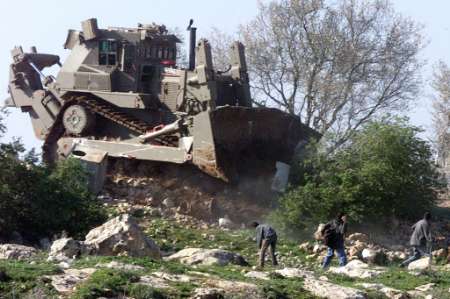
| Palestinians demonstrate against an Israeli closure near the West Bank city of Qalqilia, August 2007. (Khaleel Reash/MaanImages) |
"Getting inside the official Israeli mind is a worthwhile, if lurid, experience," the late Edward Said wrote in his article "Dignity, Solidarity and the Penal Colony." This is what it feels like when one is trying to understand the Middle East peace process that never seems to lead to anything. Observing this never ending saga, one can hardly help reaching the realization that peace is not a priority for Israel, and indeed Israeli governments have made no secret of the fact that a peace that precludes Israel's complete control over historic Palestine is of no interest to them. There is not a shred of evidence that can support Israeli claims of wanting to achieve peace based on the division of historic Israel/Palestine into two independent states. Israel has skillfully used the last 40 years to strengthen its hold on the areas occupied in 1967 and create a de facto apartheid state in all of Israel/Palestine. Consecutive Israeli governments bluntly use the so-called peace process to cover up expansion into the West Bank and execution of what has been called the slow genocide of the Palestinian people. The Israeli military is plagued by a severe lack of motivation among young recruits and increased numbers of young people avoiding the otherwise mandatory draft; according to recent stories in the Israeli press drug abuse [James D. Wolfensohn, president of the World Bank for 10 years (1995-2005), for 11 months the Middle East envoy of the Quartet: "Israeli youth finish high school and spend two-three years in the army, and then go to Thailand and other places and smoke pot to get over it, then come back and start their lives when they're 24. I don't think that's an ideal way for the next generation of Israel to live their lives.". Haaretz, 21.07.07] is rampant everywhere in the army and particularly among Israel's combat "elite" units. While the drug problem is not new (drugs were rampant in the IDF even 20 years ago) its use among combat units involved in daily operations is reported to have dramatically increased. This is hardly surprising if we consider the fact that "combat" is another word for abuse, murder and displacement of unarmed civilians.
The decision by the Israeli Supreme Court to move the separation barrier and return land back to the people of Bil'in brought a sense that justice was carried out. Indeed this decision may constitute the first crack in the separation wall, and even to an extent a crack in the armor of the almighty Israeli "defense" forces. The leaders of the struggle held fast and did not compromise their objectives or their integrity and they have much of which they can proud. However, it is unlikely that the barrier will be moved or the land returned.
For the last 60 years Israel has been intent on "The obliteration of an entire people by slow systematic methods of suffocation, outright murder and the stifling of everyday life" to use the words Edward Said. No branch of the Israeli government will admit to the illegitimacy of the occupation of Palestine; they will never admit to crimes they committed like the theft of land or the murder of innocent civilians and consequently, the "Defense" Department will not be bound by a Supreme Court's decision that goes against its intent.
At the same time it is important to note that this behemoth of a system called the Israeli "Defense" Forces is showing signs of crumbling. The Israeli military of today is not unlike the Red Army during the final years of the Soviet Union, where all that was left was the appearance of a superpower. The Israeli military is plagued by a severe lack of motivation among young recruits and increased numbers of young people avoiding the otherwise mandatory draft; according to recent stories in the Israeli press drug abuse [James D. Wolfensohn, president of the World Bank for 10 years (1995-2005), for 11 months the Middle East envoy of the Quartet: "Israeli youth finish high school and spend two-three years in the army, and then go to Thailand and other places and smoke pot to get over it, then come back and start their lives when they're 24. I don't think that's an ideal way for the next generation of Israel to live their lives.". Haaretz, 21.07.07] is rampant everywhere in the army and particularly among Israel's combat "elite" units. While the drug problem is not new (drugs were rampant in the IDF even 20 years ago) its use among combat units involved in daily operations is reported to have dramatically increased. This is hardly surprising if we consider the fact that "combat" is another word for abuse, murder and displacement of unarmed civilians.
To compound this, the IDF was severely defeated last summer during its assault on Lebanon. It was a military as well as a moral defeat, and Israel's commanders were totally humiliated by Hizballah. In Gaza the military has also proven to be inept. Even with massive use of force the IDF cannot stop the rockets launched from Gaza into Israel. Only recently several dozen new army recruits were injured by a rocket that fell in a large army base near Zikkim, just north of Gaza. And finally, with all of their intelligence the IDF is incapable of finding the soldier Gilad Shalit who is being held captive in Gaza. In light of all this, can there be any wonder that Israeli officers find diversion in drugs?
Edward Said refers to the Israeli military as "brigades of willing executioners," and frankly, one cannot blame him. In a recent story in the Israeli daily Yediot Aharonot a young tank commander describes a "battle" against three suspected "gunmen" near the wall that imprisons Gaza: "the first one was caught in the chains of my tank (and crushed to death), the second we nailed and the others escaped." The young lieutenant is congratulated by his commanding officer for courage and resourcefulness but warned that a tank should shoot from 1.5 km and not at close range. "This was practically hand-to-hand combat," says the commander.
One has to wonder, if these "gunmen" were only suspects why they were executed. If indeed they were armed, how was it that the tank managed to get so close? But the larger question answered in this particular report is this: Why are Israeli tanks still in Gaza? According this report, Israel claims 300 meters inside Gaza as a security zone (on the Gaza side of the wall) and will not permit anyone to come near.
As we engage in this lurid experience of trying to understand Israel we cannot escape the conclusion that Israel has no intention to end the occupation. There is no plan to release Palestinians from their bondage or allow the emergence of a democracy that includes Palestinian freedom. The joint, nonviolent struggle must therefore continue until full equal rights for both people are achieved in all of Israel/Palestine. It will be an uphill battle. Just they did in Bil'in, the savage beast that is the Israeli military will react to nonviolence with as much violence as it possibly can.
Miko Peled is an Israeli peace activist and writer living in the US. He is co-founder of the Elbanna Peled Foundation in memory of Smadar Elhanan and Abir Aramin. Peled is the son of the late Israeli General Matti Peled.