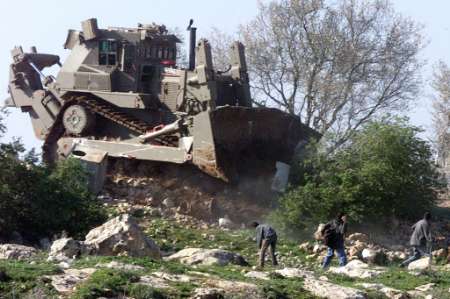
The land in question, an olive grove called Kerem Hamufti, is in the
Sheikh Jarrah neighborhood. From the documents received, it emerges
that the ILA has signed a contract with Ateret Cohanim for "the
agricultural cultivation" of the land, even though the association has
no experience in such work.
The documents indicate that the contract was signed even though the
land that the ILA leased apparently does not belong to it and the
Interior Ministry recognizes that the Palestinian landowners "have an
interest" in it. A senior source at the ILA has said the contract was
signed in order "to keep the territory in Jewish hands."
In the petition it is claimed that an authorized official at the ILA
"acted to advance the interests of Ateret Cohanim," to prevent the
Palestinians who claim ownership of the land from developing it. The
petitioners define the ILA action as "corrupt" and are asking the
attorney general to investigate "the involvement of Ateret Cohanim in
governmental decision-making."
In March, 40 years after declaring its intentions to do so, the state
formally expropriated the land, at the request of the ILA. Former
finance minister Abraham Hirchson signed on the plan to expropriate
the property under the rubric of "acquisition for public needs."
In its petition to the High Court, the Palestinian landowners, the
Arab Hotels Company, asks for the expropriation to be prohibited
because it was done "for an extraneous, illegitimate, racist and
discriminatory purpose ... An illegitimate and corrupt hand has worked
hand in glove with the authorities or other elements to harm the
petitioner's rights, and to disinherit the petitioner for purposes of
leasing the land to Ateret Cohanim."
Kerem Hamufti is named for its former owner, Haj Amin al-Husseini, the
mufti of Jerusalem. According to Israeli and Jordanian documents, in
the 1960s it was purchased by the Arab Hotels Company of East
Jerusalem.
After the area was annexed to Israel after the Six-Day War, the
Finance Ministry stated its intention to expropriate the land "for
public purposes," but this was never carried out and the Palestinian
owners continued to cultivate it. Several times over the years an
Israeli court confirmed that the company is indeed owner of the
property.
About seven years ago the Palestinian owners submitted to the planning
authorities a request to build a hotel, a conference center and a
cultural center on the land. Architect Moshe Margalit, who drew up the
plan, relates that at the time the District Planning Commission
confirmed that the East Jerusalem company has ownership rights to the
land. The Interior Ministry confirmed to Haaretz that the company has
been allowed to continue the planning as it has been proved that it
"has an interest in the land."
Municipal blessing
>From the summaries of meetings concerning the property at the Interior
Ministry, it emerges that representatives of the ILA were present, but
did not mention they had leased the land to Ateret Cohanim or that it
belongs to the ILA.
Margalit relates that the Palestinian landowners' plan was presented
"to the most senior people at the Jerusalem Municipality" and received
their blessing. The petition also states that the mayor of Jerusalem
at the time, Ehud Olmert, and his deputy, Yehuda Pollack, the chairman
of the Local Planning and Building Committee, supported it.
However, at a certain stage, relates Margalit, it seemed that Ateret
Cohanim also submitted a plan for this parcel of land: Two years
beforehand, the ILA had granted permission to Irving Moskowitz, the
American Jewish millionaire who supports Ateret Cohanim, to plan a
neighborhood on Kerem Hamufti. A person close to the association aims
to build 250 housing units there, and pressured ministers in former
prime minister Ariel Sharon's first government to approve it.
In June, 2000, immediately after the plan by Moskowitz and Ateret
Cohanim was revealed, the landowners' attorneys applied to Jerusalem's
Local Planning and Building Committee with a request to dismiss the
scheme because "those who submitted it are not the owners of the
land."
The committee told the attorneys that the plan had been "shelved."
A few months ago the Arab Hotels Company received notice from the
Magistrates Court, allowing it to evict a Palestinian who was
squatting on the land. However, on the day of the eviction, the Amidar
company, on behalf of the ILA, filed a demand to stop it.
While the ILA and Amidar acknowledge this was indeed a matter of a
squatter, a senior source at the ILA has told Haaretz that the
Palestinian "was working with Ateret Cohanim." The source explains his
presence was necessary "to prevent theft of land by Palestinians."
The current petition says the state owns about 20 percent of Kerem
Hamufti under the Absentee Property Law, as it belonged to Al-
Husseini, who collaborated with the Nazis during World War II.
However, the Palestinian landowners' lawyers insist that the law does
not apply to the property because it was purchased from the Al-
Husseini family before Israeli rule began in East Jerusalem in 1967.
Attorney Danny Kramer, the representative of the official guardian of
absentee property, is also a signatory to the petition, which states
that the guardian has no connection to the land, and also that the ILA
has been leasing it to Ateret Cohanim "for some years now."
In its petition, the Arab Hotels Company argues that the low lease
being paid by Ateret Cohanim is proof that this is an "artificial
contract." The association is paying NIS 42.5 per dunam (which comes
to NIS 1,278 for the entire parcel of land), although it is in a
prestigious location.
The ILA's official response to Haaretz states that the contract with
the Jewish association was signed "more than five years ago"; a senior
ILA source says the contract was signed "at the beginning of the
1990s."
At the ILA they were not able to explain how the entire plot of land
was leased to Ateret Cohanim, despite the fact that even the ILA
itself says the state owns only 20 percent of it. The ILA explains the
fact that they dealt with the association without a tender by saying
"it was the only applicant." Concerning Ateret Cohanim's lack of
experience in agriculture, the ILA says: "It is not stipulated
anywhere that the minimal condition for submitting an application for
cultivation is prior experience."
Based on past High Court of Justice rulings saying that if the state
does not implement an expropriation order for many years, it's
possible to annul it, the Palestinian landowners are asking the court
to issue a show cause order, requiring the state to explain why it
should not prohibit the expropriation in this case.
Visualizzazione post con etichetta Ateret Cohanim. Mostra tutti i post
Visualizzazione post con etichetta Ateret Cohanim. Mostra tutti i post
mercoledì 29 agosto 2007
ILA Leasing Arab-Owned Land in Jerusalem to Ateret Cohanim
ISM, 21/08/07. The Israel Lands Administration (ILA) is working together with the Ateret Cohanim association to wrest from Palestinian landowners control of 30 dunams (7.5 acres) of land in East Jerusalem and to transfer it to the association without a tender. Such is the claim outlined in a petition submitted two weeks ago to the High Court of Justice, and appearing in documents which Haaretz has received. Ateret Cohanim promotes settlement of Jews in and around the Old City, and at times takes over Palestinian assets in East Jerusalem so as to "Judaize" that area.


The Rules Governing the Struggle For Eretz Yisrael
 Rabbi Shlomo Aviner, Yeshivat Ateret Cohanin. In the course of the suffering accompanying the divine process of our redemption, we are once more encountering this terrible conflict between brothers involving the uprooting of Jewish settlements. We are not exempt from clarifying it in the light of Torah, which illuminates the proper path for both the individual and the nation, both in healthy situations as well as in morbid ones. There are three parties involved here: the government, civilians and soldiers.
Ateret Cohanim has embarked on a Pre-Military Educational Academy to provide a specialized Torah background to select Israeli youth who intend to pursue careers as army officers
in elite combat units
When it comes to long and short-term urban planning, it is certainly the government which must make decisions, but as far as the ideological question of whether a particular location belongs to the Jewish People or to another nation, that question transcends governments, for the answer to that question was provided by the Master-of-the-Universe, by the Torah, by Jewish tradition, by history. Even the government was commanded regarding Eretz Yisrael: “We were commanded not to abandon it to any other nation, or to desolation” (Ramban, Addendum 4 to Rambam’s “Sefer HaMitzvot”). This command transcends the government. Quite the contrary, the government draws its strength and authority from it. Uprooting a Jewish community is a terrible crime with no parallel throughout Jewish or world history. All the more so that establishing a foreign state in the very midst of our own country is a national crime which surpasses all the bounds of reason and ethics.
Likewise, the illustrious rabbis who head the “Rabbinic Union for the People and Land of Israel” recently issued a proclamation absolutely rejecting the establishment of a foreign state within Judea and Samaria, or otherwise abandoning part of Eretz Yisrael to foreigners.
Let us hope that our government will speedily free itself of the present agreement, returning to the path of truth and valor.
2. Civilians
Every Jew has to struggle to nullify these terrible decrees. The whole nation must rise as one man with one heart and struggle against this dysfunctional government that is leading us down the path of destruction.
Obviously, as with any other mitzvah, this must not be performed by means of a sin. Before the founding of the State, our master Rabbi Tzvi Yehuda Kook established red lines as far as political struggles between us: no violence, no insults, no hatred (“Et Achai Anochi Mevakesh”; LeNetivot Yisrael, Part I). Likewise, in the struggles over the completeness of the Land, Rav Tzvi Yehuda never instructed us to use violence, to insult or to hate anyone. Therefore, please do not insult policemen or soldiers, let alone their officers. When a soldier takes hold of your hand, don’t use physical force to resist. Don’t hold on to boulders. You might get hurt, or the soldier might get hurt. And don’t play freeze-tag with the soldiers either.
The evacuation of a Jewish settlement is a terrible desecration of G-d’s name. Don’t make it worse before the television cameras of Israel and the whole world, which will show Jewish soldiers dragging Jews out of a Jewish settlement.
If you force a soldier to drag you, don’t yell, “Why are you hurting me?” Don’t hurt his heart! When the Jewish Community of Hebron was just starting out, some of our group danced with an Israeli flag at the Tomb of the Patriarchs, and soldiers ordered them to stop. When they didn’t listen, the soldiers grabbed at the flag, some pulling in one direction and others pulling in the other, until the flag got ripped. Rabbi Tzvi Yehuda Kook responded, “What you did was more treif than pig. You put our friends the soldiers in an unpleasant situation in order to advance the cause.”
We see for ourselves that many soldiers feel horrible at being asked to evacuate outposts. Many themselves live in settlements and outposts. One must also be very careful of provocateurs who let their mouths spill out hatred and incitement to evil, but then report to the police what they saw around them.
Don’t send children. It is hard for them to digest simultaneously a love of the Land and the People of Israel, with a love of the army.
Remember this: Our master Rabbi Tzvi Yehuda Kook stood at the head of the war over Judea and Samaria and loudly proclaimed, “Over Judea and Samaria there will be a war!” “Over our dead bodies!” Yet he never, never instructed anyone to use force against a soldier, a policeman, or even to insult them.
Whoever has learned Halachah knows the major principle:
“We do not learn practical law either from abstact study alone, or from hearing isolated cases alone. Rather, we must learn it from a combination of abstract study with its practical applications. Once someone has asked questions and received such practical guidance, he can go and act accordingly” (Bava Batra 136b).
The utterance that “there will be a war over Judea and Samaria” is in the realm of “abstract study.” It may be profound and holy and sublime and powerful, but it is not practical Halachah. Rabbi Tzvi Yehudah rejected anything that would create a rift amongst the people, and he said, “I do not want a civil war.”
The halachic conclusion of the illustrious heads of the “Rabbinic Union for the People and Land of Israel” was as follows:
“To behave with great caution; to avoid all physical or verbal violence against our soldier brethren… and let it be said to the credit of the public that all of them but rare exceptions are following the guidance of our rabbis.”
3. Soldiers
Soldiers as well, as part of the Jewish People, must struggle devotedly to keep our land intact, all the more so if a soldier is a high-ranking officer with an influence on the workings of the army and the government. Yet even he mustn’t fulfill a mitzvah by means of a sin. To cause the disintegration of the army is a grave sin. Our army works on the basis of unity – one for all and all for one. If the army disintegrates, it is no army, and that places the nation in danger. The army is not rightist or leftist, middle-of-the-road or any other category. Otherwise, the nation would be in danger. The country and the Jewish State would be in danger.
The army is where the aggregate soul of the Jewish People is being renewed in all its glory. Driving a knife into that is the opposite of the whole process of our rebirth.
Remember this! Our great master, Rabbi Tzvi Yehuda Kook stood at the head of all the ranks of settlers in Judea and Samaria, yet no soldier ever heard from him the words, “Refuse orders.”
The soldier does not become partner in a sin, emissary to perform a sin or collaborator in a sin. The government’s sin was already performed and is now nothing but water under the bridge. Rabbi Tzvi Yehuda Kook wrote numerous flyers against abandoning parts of Eretz Yisrael, yet he never wrote: “Refuse orders!”
“Many are the thoughts in a man’s heart, yet it is G-d’s counsel that will endure” (Proverbs 19:21).
They keep presenting the same program, each time by a different name. We overcame 242, Gunnar Jarring, 338, Kissinger, the Geneva Pact, the Autonomy Agreement, the Reagan Program, the Shultz Initiative, the London Accord, Madrid, the Bi-Lateral Talks, James Baker, Oslo I, the Mitchell Report, Oslo II, the Sharm a-Sheikh Pact, the Camp David Summit, the Taba Talks, Clinton, George Tennet, General Zinni and the Saudi Plan.
We will overcome the Roadmap (and the "Disengagement Plan") as well.
Iscriviti a:
Post (Atom)