Visualizzazione post con etichetta apartheid. Mostra tutti i post

lunedì 3 dicembre 2007

Separate but Unequal in Palestine: The Road to Apartheid

Mohammed Khatib, Dissident Voice, 2.11.07. When United States Secretary of State Condoleezza Rice visited the Middle East a few weeks ago, people from our small village of Bil’in joined neighboring villages to send her a message. We protested peacefully against a West Bank highway near us that is reserved for Jewish Israeli settlers, and off-limits to Palestinians, though it was built on Palestinian land. Our banner read: “Condi, What would Rosa Parks do?”

We know that Dr. Rice experienced the bitter taste of discrimination growing up in the South during the US civil rights struggle. In Bil’in, we’ve drawn inspiration from the US civil rights movement as we’ve carried out a three year nonviolent resistance campaign against the discriminatory policies of Israel’s military occupation.

We share Dr. Rice’s admiration for the courage of Rosa Parks who was arrested in Alabama, Rice’s home state, for refusing to give her bus seat to a white man. As Palestinians we aren’t even allowed in buses on many roads in our own country, because 200 miles of the best West Bank roads are reserved for Israeli Jewish settlers.1 The color of Palestinian license plates is different from the licenses of Israelis. Palestinian plates are not allowed on most of the highways crisscrossing the West Bank, many of which were built with US government funding. Palestinians have been banned for five years now from Highway 443 where we protested.

According to the United Nations Office for the Coordination of Humanitarian Affairs (OCHA), there are 561 physical obstacles and checkpoints inside the West Bank restricting Palestinian movement within the West Bank,2 in comparison with only eight checkpoints which separate the West Bank from Israel proper. Nearly all the obstacles and checkpoints are located along the West Bank roads reserved for Israelis. This makes getting to the hospital, school and work or visiting relatives painstakingly difficult or impossible for us. This fragmentation of the West Bank has devastated our economy.

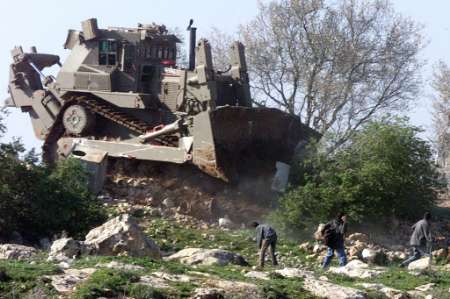
In 2001, Israeli developers began building settlement homes on land seized from Bil’in, calling them a neighborhood of the Modi’in Illit settlement bloc. Four years later, Israel’s segregation wall separated Bil’in from 50% of our agricultural land under the pretext of protecting this new settlement. In response, we held over 200 nonviolent protests together with Israeli and international supporters. Hundreds of us were injured and arrested. After our protests, Israel’s Supreme Court ruled that the wall’s route in Bil’in must be changed to return around half of our seized land. Though we celebrated this success, Israel continues to build on our land that wasn’t returned and plans to annex it as part of the Modi’in Illit settlement bloc.4

Israel has already de facto annexed the 10.2% of the West Bank that lies between the Green Line and the segregation wall, including the major settlement blocs and 80% of Israel’s 450,000 settlers. The segregation wall, settlements and settlement roads carve Palestinian areas into isolated enclaves.

We pray that our children will not spend their lives under Israeli military occupation. We hope that the Annapolis meeting will bring our dreams of freedom closer to fulfillment. But we are concerned that if Israel is allowed to keep most of its settlements and the roads that connect them, then the existing system of “separate but unequal” will be cemented in place in a Palestinian state.

  1. Forbidden roads: The discriminatory West Bank road regime, B’Tselem. #
  2. OCHA Closure Update: October 2007, The UN Office for the Coordination of Humanitarian Affairs. #
  3. West Bank settlements ‘expanding’ BBC, 7 November 2007. #
  4. One Palestinian Village Struggles Against Israel’s Ever-Expanding “Settlements”, Alternet, 26 September 2007. #
Mohammed Khatib is a leading member of Bilin's Popular Committee Against the Wall and the secretary of its village council. Read other articles by Mohammed, or visit Mohammed's website.

lunedì 12 novembre 2007

Whose road map?

Jeff Alper, The Jerusalem Post, 7.11.07. IN THE end, the Palestinians may get 80-90% of the West Bank, but they do not get a viable state. They will have sterile swatches of territory whereas Israel retains control of the borders, movement of people and goods both within the Palestinian state and between it and the countries around, much of the country's arable land, almost all its water, the Palestinians' airspace and even control of their communications. The Palestinian state is deprived of a viable economy. Given that 60% of Palestinians are under the age of 18 and that mini-state must absorb hundreds of thousands of refugees, its prospects for being a viable, stable and truly independent state are nil given the unspoken parameters outlined in the Bush letter. There will be a Palestinian state. Israel has an urgent demographic need to get the almost four million Palestinians of the occupied territories off its hands. It might even attempt to "swap" a couple hundred thousand Israeli Arab citizens of the Galilee Triangle under the pretense of giving the Palestinians more land. The crucial question is: will it be a viable state? If it's true that Olmert intends that Israel permanently retain the settlement blocs, an Israeli "greater" Jerusalem and effective control of the entire country to the Jordan River, then we will merely be substituting a sophisticated form of apartheid for occupation. The devil is in the details.
The crucial document that subverts any viable two-state solution, a factor in Israel's strategic considerations mentioned by Olmert as an aside only a few days ago, is Bush's letter of April, 2004, to then-prime minister Ariel Sharon. This little-noticed document fundamentally changed the parameters of what is to be discussed in any "peace process" and what Israel's obligations are under the road map. It is considered by the Israeli government as perhaps the most crucial element in its effort to retain the major settlement blocs and in that way foreclosing the possibility of a viable Palestinian state.

The essence of the Bush letter, which was subsequently ratified by the House of Representatives by a vote of 407-9 and by the Senate by 95-1, is the following passage: "In light of new realities on the ground, including already existing major Israeli populations centers, it is unrealistic to expect that the outcome of final status negotiations will be a full and complete return to the armistice lines of 1949."

In one seemingly innocuous sentence, President Bush fatally but knowingly undermined UN Resolution 242, the very basis of the two-state solution since 1967 and of his own road map initiative, by nullifying the requirement that Israel return to the Green Line (with agreed-upon adjustments) so that a viable Palestinian state might emerge.

Israel takes the American position - rejected by the other three members of the road map Quartet, the UN, Europe and Russia, but so what? - as agreement to its retaining its major settlement blocs. They are six or seven in number: the Jordan Valley, the Ariel bloc, the Modi'in bloc, the three blocs that make up "Greater Jerusalem" (Givat Ze'ev, Ma'aleh Adumim and the Etzion Bloc/Efrat), and perhaps a salient into Hebron.

When, then, Olmert speaks of "conforming to the road map," he speaks of withdrawal from all the occupied territory outside those settlement blocs, since the Bush letter de facto annexes them to Israel. The massive building of settlements and highways within these settlement blocs does not, therefore, constitute a breach in Israel's responsibility to end settlement construction in the first phase of the road map, since they are no longer parts of the occupied territory.

The area of the settlement blocs that Israel wishes to retain may not seem like much; between 10-20% of the West Bank, including "Greater Jerusalem." But they are crucial for a viable Palestinian state - and "viability" is a term of reference in the road map.

The settlement blocs of an Israeli "Greater Jerusalem" remove from the Palestinians the economic heart of their future state, since up to 40% of the Palestinian economy, according to the World Bank, revolves around tourism in Jerusalem. The other blocs carve the West Bank into three "cantons" (Sharon's term, since Olmert's Convergence Plan, which he never abandoned, is based on Sharon's Cantonization Plan). The Jordan Valley bloc ensures Israeli control of the border and of the Jordan River's water.

Indeed, while accepting the road map, Olmert has in mind a very different document than that of the UN, the Europeans, the Russians and the Palestinians themselves. Integral to Israel's version of the document are the "14 reservations" it appended, which effectively nullify the road map as a genuine path to peace.

Reservation # 5, for example, states that "The provisional state will have provisional borders and certain aspects of sovereignty, be fully demilitarized…, be without the authority to undertake defense alliances or military cooperation, and Israeli control over the entry and exit of all persons and cargo, as well as of its air space and electromagnetic spectrum."

IN THE end, the Palestinians may get 80-90% of the West Bank, but they do not get a viable state. They will have sterile swatches of territory whereas Israel retains control of the borders, movement of people and goods both within the Palestinian state and between it and the countries around, much of the country's arable land, almost all its water, the Palestinians' airspace and even control of their communications. The Palestinian state is deprived of a viable economy. Given that 60% of Palestinians are under the age of 18 and that mini-state must absorb hundreds of thousands of refugees, its prospects for being a viable, stable and truly independent state are nil given the unspoken parameters outlined in the Bush letter.

There will be a Palestinian state. Israel has an urgent demographic need to get the almost four million Palestinians of the occupied territories off its hands. It might even attempt to "swap" a couple hundred thousand Israeli Arab citizens of the Galilee Triangle under the pretense of giving the Palestinians more land. The crucial question is: will it be a viable state? If it's true that Olmert intends that Israel permanently retain the settlement blocs, an Israeli "greater" Jerusalem and effective control of the entire country to the Jordan River, then we will merely be substituting a sophisticated form of apartheid for occupation. The devil is in the details.

The writer is the coordinator of the Israeli Committee Against House Demolitions.

jeff@icahd.org


This article can also be read at http://www.jpost.com/servlet/Satellite?cid=1192380752506&pagename=JPost%2FJPArticle%2FShowFull


Copyright 1995- 2007 The Jerusalem Post - http://www.jpost.com/

giovedì 8 novembre 2007

Les Origines de la Solution finale. L'évolution de la politique antijuive des nazis

Thomas Wieder, Le Monde, 2.11.07. Mais un problème se pose : que faire des deux millions de juifs qui sont tombés en quelques jours dans l'orbite du IIIe Reich ? Pour Hitler, en effet, le fameux "espace vital" ne peut se concevoir autrement que "judenfrei", c'est-à-dire "libre de juifs", selon la terminologie nazie. Il devient donc urgent de trouver une "solution" à la "question juive".

Un autre projet d'histoire globale de la Shoah est en cours d'écriture. Piloté par le mémorial de Yad Vashem, en Israël, il s'agit d'une entreprise collective qui devrait compter au total une quinzaine de titres couvrant la période de 1933 à 1945. Le premier de ces volumes, qui paraît aujourd'hui en français, s'intéresse à l'évolution de la politique antijuive entre 1939 et 1942. Sa rédaction a été confiée à Christopher Browning, un universitaire américain de 63 ans dont le grand public a surtout retenu l'étude qu'il consacra il y a une quinzaine d'années à un groupe de cinq cents Allemands "ordinaires" : ceux-ci, bien que sans passé criminel, participèrent en 1942-1943 à l'extermination de 80 000 juifs polonais (1).

C'est en septembre 1939, au moment où l'armée allemande envahit la Pologne, que commence le nouveau livre de Browning. Du point de vue militaire, le triomphe des nazis est sans appel. Mais un problème se pose : que faire des deux millions de juifs qui sont tombés en quelques jours dans l'orbite du IIIe Reich ? Pour Hitler, en effet, le fameux "espace vital" ne peut se concevoir autrement que "judenfrei", c'est-à-dire "libre de juifs", selon la terminologie nazie. Il devient donc urgent de trouver une "solution" à la "question juive".

Pendant trente mois, plusieurs "solutions" seront expérimentées. La première repose sur le principe de la mise à l'écart. Dans le prolongement de la politique de ségrégation appliquée en Allemagne depuis 1933, elle vise à séparer les juifs du reste de la population. Jusqu'à la fin de 1940, plusieurs plans seront échafaudés. Pendant quelques mois, Adolf Eichmann réfléchit ainsi à l'implantation d'une "réserve" juive dans la région de Lublin, dans l'est de la Pologne. Sans grand succès. Une autre idée sera ensuite étudiée : l'installation des juifs à Madagascar. L'île étant une colonie française, le projet trouve un certain crédit après la défaite de la France en juin 1940. Mais il sera rapidement abandonné.

Tout change en juin 1941 avec l'entrée en guerre de l'Allemagne contre l'URSS. En quelques semaines, les troupes allemandes déferlent sur la Biélorussie, l'Ukraine et les Etats baltes. Cette fois les nazis entendent tirer la leçon du précédent polonais. L'échec des plans d'expulsion imaginés au cours des mois précédents les conduit à envisager une "solution" plus radicale pour les juifs présents sur leurs nouvelles terres de conquête : leur liquidation systématique.

Commence alors ce que Raul Hilberg a appelé l'époque des grands "nettoyages meurtriers". Partout, les mêmes scènes de terreur se répètent : rassemblés dans les villages, les juifs sont ensuite amenés vers un site d'exécution où ils creusent une fosse avant d'être fusillés, soit debout soit après avoir été obligés de se coucher sur les corps de ceux qui sont déjà morts. L'efficacité de cette "méthode standardisée d'assassinats de masse" est redoutable. Fin 1941, 500 000 à 800 000 juifs ont déjà été exécutés de la sorte.

Entre-temps, une autre méthode de mise à mort a été testée : le gazage dans des camions ou des baraquements de fortune. Expérimentée à une époque où la politique antijuive n'obéit pas encore à un "plan préconçu, logique et centralisé", l'idée plaît à Himmler, le chef de la SS, qui s'inquiète des effets secondaires des fusillades sur le psychisme de ses hommes... A l'automne 1941, les réunions s'enchaînent au sommet de l'Etat pour étudier la question. Fin octobre, "le régime nazi a franchi le pas décisif", estime Browning, qui retrace l'infernal concours d'arbitrages qui conduit à la concentration des juifs dans des centres dévolus à leur extermination. Il faudra six mois pour passer de la "conception" à la "mise en oeuvre" de cette politique. Au printemps 1942, le complexe d'Auschwitz-Birkenau devient opérationnel. Plus d'un million de juifs y seront assassinés.

"Je vais à nouveau être prophète, avait déclaré Hitler le 30 janvier 1939. Si la juiverie financière internationale (...) réussissait à précipiter encore une fois les peuples dans une guerre mondiale, alors la conséquence n'en serait pas la bolchevisation de la terre et la victoire de la juiverie, mais l'anéantissement de la race juive en Europe." Trois ans auront été nécessaires pour réaliser cette sinistre prophétie. De cette marche vers l'irréversible, Christopher Browning livre la chronique la plus exhaustive et la plus à jour qui ait été publiée en français.


Les Origines de la Solution finale. L'évolution de la politique antijuive des nazis (septembre 1939-mars 1942), de Christopher R. Browning. Traduit de l'anglais (Etats-Unis) par Jacqueline Carnaud et Bernard Frumer, Les Belles Lettres, 632 p., 35 €.

(1) Des hommes ordinaires a été réédité en mars 2007 (Tallandier "Texto", 366 p., 8 €).

Thomas Wieder

venerdì 5 ottobre 2007

Na'ima is threatening the Jewish majority

Dafna Golan, Haaretz, 03/10/07. Jerusalem, which is now joyously celebrating the 40th anniversary of its reunification, is a divided city. The discrimination in education is part of a consistent attempt to reduce the number of Palestinian residents in the city, so as to maintain a Jewish majority. These efforts are also reflected in the demolition of homes, the confiscation of land, the confiscation of ID cards from anyone who has gone to study elsewhere, for example, and in the crowded conditions in the schools. All these are the implementation of a policy that considers Palestinians second-class citizens. The educational policy in Jerusalem is a microcosm of the general situation in discriminatory Israel. A country that builds schools for children from one group and not from another is an apartheid state.

At the start of school last year the education minister declared her intention of working to reduce the shortage of about 1,300 classrooms in East Jerusalem, but during the past year only 50 new classrooms were built there. Despite the commitment of the Education Ministry and the Jerusalem Municipality to the High Court, from 2001-2007, to build at least 645 classrooms in East Jerusalem (245 according to a 2001 High Court decision and 400 in the context of the promise given to the High Court this year), in fact, fewer than 100 new classrooms have been built since 2001.

The petitions of parents whose children found no room in Jerusalem schools continue to be processed in the High Court, but the legal discussions, the focus on details, are concealing what any child can see: Jerusalem, which is celebrating the 40th anniversary of its reunification, is conducting a policy of separation.

According to the report of the Coalition for the Advancement of Arab Education in East Jerusalem, only about half the Palestinian children in East Jerusalem, about 39,400 out of about 79,000, are at present studying in the city school system. Most of the others study in private schools, in United Nations schools or outside the city. About two-thirds of the public schools in East Jerusalem operate in rented apartments. And, still, hundreds of children remain without a place in Jerusalem's schools.

During 40 years of occupation Israel built Jewish neighborhoods on Arab land in East Jerusalem, such as Gilo, French Hill, Neveh Yaakov et al, and - wonder of wonders - there are no children in these neighborhoods who have to turn to the courts in order to attend school. After all, it is unthinkable to have no room for Jewish children in the Jerusalem school system.

Jerusalem, which is now joyously celebrating the 40th anniversary of its reunification, is a divided city. The discrimination in education is part of a consistent attempt to reduce the number of Palestinian residents in the city, so as to maintain a Jewish majority. These efforts are also reflected in the demolition of homes, the confiscation of land, the confiscation of ID cards from anyone who has gone to study elsewhere, for example, and in the crowded conditions in the schools. All these are the implementation of a policy that considers Palestinians second-class citizens.

That's why there is no room for Na'ima in Jerusalem's schools. Na'ima, like thousands of other Palestinian children in Jerusalem, threatens the Jewish majority. The Israeli school system does not want Na'ima. It doesn't want Na'zz to remind it that maintaining the Jewish majority is an unethical goal. The educational policy in Jerusalem is a microcosm of the general situation in discriminatory Israel. A country that builds schools for children from one group and not from another is an apartheid state.

The writer is a member of the Law Faculty at the Hebrew University in Jerusalem.

domenica 2 settembre 2007

Isolation Strategy. UN summit: Boycott Israel

Yaakov Lappin, ynetnews, 31/08/07. United Nations conference at EU parliament compares Israel to apartheid South Africa. A UN conference, held at the European Parliament in Brussels, heard an array of speakers call for a boycott against Israel and strategize on ways to achieve its international isolation, during the first day of an event billed by organizers as a gathering to promote "Middle East peace".

T
he 'International Conference of Civil Society in Support of Israeli-Palestinian Peace' has been organized by the UN's Committee on the Exercise of the Inalienable Rights of the Palestinian People, and attracted political figures and pro-Palestinian members of non governmental organizations (NGOs).

According to the Bnei Brith organization, which sent delegates to attend the conference from its European Affairs Office, British Member of Parliament Clare Short said during her speech that Israel was not interested in a two-state solution, and blasted the EU for "allowing" Israel to build "an apartheid wall".

"It opened this morning with some 400 participants attending, representatives of 140 civil society organizations, members of the European and national parliaments, 53 government observers, as well as 16 intergovernmental organizations, including UN agencies. The Committee is very pleased with this big turnout," he said.

"The boycott worked for South Africa, it is time to do it again," Short was quoted as saying.

The security fence was also attacked by the European Parliament's vice president, Edward McMillan-Scott, who maintained that it would not bring peace to Israel. McMillan-Scott added that the European Parliament was committed to "a two state solution with safe borders," according to the Bnei Brith report of the conference.

Addressing the conference on behalf of PA President Mahmoud Abbas, Leila Shahid, Palestinian Representative to the EU, read out a statement in which Abbas expressed satisfaction that the conference was hosted by the European Parliament, and lamented the suffering of the Palestinian people.

Pierre Galand, European coordinator of the Committees and Associations for Palestine, claimed that the conference was taking place despite pressures to cancel it, and blamed the Fatah-Hamas conflict on "Israeli policy".

'Members guided by clear agenda'

"This is a conference of Israel-haters," Adam Mouchtar, Director of Bnei Brith's European Union Affairs Office, told Ynetnews. Mouchtar attended the conference's first day, and said its members were clearly guided by a single agenda: "To prove that Israel is a racist apartheid state, and therefore Israel should be boycotted internationally, as South Africa was."

"We've had this in Durban in 2001. These are the same organizations that took over the Durban conference and coined the term 'Zionism is racism'," Mouchtar said.

He added that the most positive speech came from an Israeli-Arab Knesset Member, Nadia Hilou, who praised the recent boost in relations between Israel and the Palestinian Authority.

"I feel that it's a farce," Mouchtar said, adding: "It's a biased conference. It nearly totally excludes any reasonable Israeli speakers." According to Mouchtar, one of the few Jewish attendees was a "self hater" invited to "legitimize the claim that the conference was not biased".

Mouchtar called on the UN Secretary-General, Ban Ki-moon, to take action to prevent such activities in the future, adding that the actions of UN sub-committees were "delegitimizing the good work the UN is doing in other fields".

'Campaign to demonize Israel'

But Wolfgang Grieger, Secretary of the Committee on the Exercise of the Inalienable Rights of the Palestinian People, told Ynetnews that the conference had "received a message from Ban Ki-moon".

"
It opened this morning with some 400 participants attending, representatives of 140 civil society organizations, members of the European and national parliaments, 53 government observers, as well as 16 intergovernmental organizations, including UN agencies. The Committee is very pleased with this big turnout," he said.

A spokesman for NGO Monitor, an Israeli watchdog, told Ynetnews: "As NGO Monitor's continued research has shown, non governmental organizations funded and supported by the EU and other international governments, are at the forefront of the political campaign to demonize and delegitimize Israel.

"This conference highlights once again, the moral bankruptcy of so many of these groups and individuals who compare the Israel-Palestinian conflict to apartheid South Africa, and single out Israel for boycotts and sanctions," he said.

lunedì 23 luglio 2007

An introduction to Hebrew University, Jerusalem

Seán O'Neill. 18/07/07. Christian Peacemaker Teams. When I went to the orientation for international students at Hebrew University in Jerusalem, I expected the ethos to be pro-Israeli. However, I was taken aback by the level of anti-Palestinian propaganda and fear-mongering. If this type of misinformation and outright racism is being disseminated by Israeli universities, then they are indeed complicit in the growing apartheid regime taking hold here, making it harder and harder for Palestinian society, thousands of years in the making, to survive. The human ability not to see what one doesn't want to see is phenomenal, especially when you've been told not to look.

The first part of the orientation was about the history of Hebrew University, including how despite being "liberated" in 1967, the campus is still surrounded by 3 hostile Arab villages. Then the director of the program turned to security. He implored us all to be vigilant looking for abandoned bags both on and off campus. He said that in the evenings students should stay in big groups, reminding them of the three nearby Arab villages.

Next was transportation. "How many of you promised your parents before you came not to use public buses (for fear of a suicide bomber)?" he asked. Twenty to thirty hands, out of the two hundred people, went up. "Keep that promise," he said. He continued, "Never get on the Arab bus. It doesn't go anywhere you want to go." He warned against going anywhere in the jurisdiction of the Palestinian Authority, recounting vague horror stories about Israeli children being kidnapped and taken into the West Bank. He qualified this however by saying that it should be all right to visit Jewish settlements in the West Bank.

Curious students cautiously raised their hands "What kind of bags should we be looking for that might be bombs?" one asked. "Any bag could be a bomb," he replied. "Even if you can see through the bag and see that it is just a loaf of bread. There could be a bomb inside the bread. Arab terrorists have been known to do that." Another queried, "What if we want to go to Eilat (a Red Sea resort)? Doesn't the Israeli highway to Eilat go through the West Bank?" He reassured her, "Yes, but you'll be ok as long as you stick to good Jewish transportation.

" A third student wanted to know about Jerusalem itself. "Where is it safe to go in East Jerusalem?" (East Jerusalem is the older, Palestinian part of the city, as opposed to the newer Jewish city to the west.) "As for the Old City, you'll be all right in the Jewish quarter," he explained. "The Christian and Muslim quarters however are iffy, and at night they're not safe. As for the rest of East Jerusalem, stay away. There's just nothing for you to see there."

At this point I'd heard enough. I took my bag and left. If students follow his advice, they'll never see most of the fascinating historic parts of Jerusalem or get a sense of its unique character, shaped by thousands of years of history and culture. They'll never see the Holy Sepulcher, where Jesus is said to have been crucified, or walk the grounds of the Al Aqsa mosque, the third holiest site in Islam. They'll never hear the live Middle-Eastern music at the Jerusalem Hotel on a Friday night. They'll never see the sun set behind the golden Dome of the Rock from the Mount of Olives. They may as well not have come to Jerusalem at all.

If this type of misinformation and outright racism is being disseminated by Israeli universities, then they are indeed complicit in the growing apartheid regime taking hold here, making it harder and harder for Palestinian society, thousands of years in the making, to survive.

The human ability not to see what one doesn't want to see is phenomenal, especially when you've been told not to look.

Christian Peacemaker Teams is an ecumenical initiative to support violence reduction efforts around the world. To learn more about CPT's peacemaking work, visit our website www.cpt.org Photos of our projects are at www.cpt.org/gallery A map of the center of Hebron is at http://www.reliefweb.int/rw/fullMaps_Sa.nsf/0/5618737E38C0B3DE8525708C004BA584/$File/ocha_OTS_hebron_oPt010805.pdf?OpenElement The same map is the last page of this report on closures in Hebron: www.humanitarianinfo.org/opt/docs/UN/OCHA/ochaHU0705_En.pdf

lunedì 16 luglio 2007

Sudafrica: la seconda giovinezza di Nelson Mandela


joshua.massarenti. Panorama.it. 16/07/07.


Non gli sono bastati 27 anni trascorsi dietro le sbarre di un carcere di massima sicurezza, otto passati alla guida dello Stato del Sudafrica e chissà quanti altri sforzi e sacrifici spesi nella lotta contro il regime dell’apartheid. Chiunque al suo posto non avrebbe esitato a salutare amici (tanti, tantissimi) e nemici per godersi i fasti di una meritatissima pensione politica. Così fu nel 2004 quando l’ex presidente sudafricano e Premio Nobel per la pace, Nelson Rolihlahla Mandela annunciò il suo ritiro dalla vita pubblica, dopo aver guidato il suo paese in un delicatissimo processo di riconciliazione nazionale.

Sono passati tre anni, colmi di ricordi e di onorificenze. L’ultima in ordine di cronaca chiama in causa le stelle del calcio internazionale (Pelé, Gullit, Weah, Eto’o…), protagoniste di una partita di gala prevista a Città del Capo il 18 luglio prossimo per festeggiare gli 89 anni di una vera e propria “leggenda vivente”. Nonno Mandela ringrazia tutti cogliendo l’occasione per prendere ancora una volta il mondo in contropiede: l’ex detenuto più illustre del mondo annuncerà nel giorno del suo 89mo compleanno la nascita di un gruppo di riflessione di altissimo profilo internazionale per proporre soluzioni innovative alle più gravi crisi politiche e umanitarie del pianeta. Su pressioni del magnate Sir Richard Branson e del musicista Peter Gabriel, il leader sudafricano ha deciso di mettere a frutto il suo carisma per interpellare amici di vecchia data - Bill Clinton, Jimmy Carter, Mary Robinson, Desmond Tutu, Muhammad Yunus e Kofi Annan - e costituire un gruppo di saggi in grado di orientare le decisioni dell’attuale leadership mondiale.

Leggi il profilo di Mandela sul Time Magazine e sulla Bbc

Il sito della Mandela Foudation

Su You Tube, la prima intervista televisiva di Mandela (21 maggio 1961)

http://blog.panorama.it/mondo/2007/07/16/sudafrica-la-seconda-giovinezza-di-nelson-mandela/