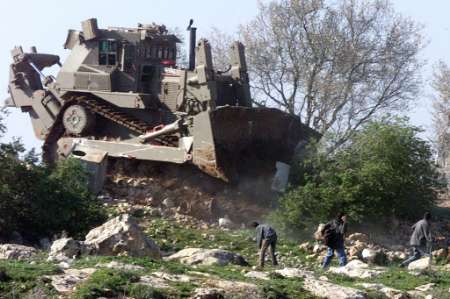
Ameen Abu Warda nisreen at imemc dot org - IMEMC, 6.11.07 10:19. The International and Public Relations department of the Palestine Liberation Organization (PLO) on Monday issued a report claiming that 44 Palestinians had been deliberately targeted and assassinated by the Israeli army during the month of October, 27 of them by Israeli army air strikes, and a further 120 injured. The report also details the abduction of at least 350 Palestinian civilians, the destruction of at least 3 homes, the damaging of 445 Dunums of Palestinian-owned land, and the confiscation of over 1130 Dunums for Illegal Israeli settlements.
The department further criticizes a perceived increase of pressure on the Gaza Strip, with fuel and other essential supplies being further restricted, and the threat of a power-cut being expressed by the Israeli government.
The report finishes with a sharp criticism of recent events in the Negev detention facility, branded the enacted procedures as inhumane and illegal, and calling on all concerned parties to intervene on the behalf of the detainees.
Translated by Nisreen Qumsieh - IMEMC News.
.
Visualizzazione post con etichetta land confiscation. Mostra tutti i post
Visualizzazione post con etichetta land confiscation. Mostra tutti i post
martedì 6 novembre 2007


venerdì 5 ottobre 2007
Israël poursuit le maillage routier des colonies juives en Cisjordanie
Michel Bôle-Richard, Le Monde, 06/10/07. En sortant du bloc de colonies de Goush Etzion, au sud de Bethléem, la route 60, le grand axe qui traverse la Cisjordanie du nord au sud, serpente entre les villages palestiniens avant d'atteindre la périphérie d'Hébron. Afin de remédier à cet inconvénient, les autorités israéliennes ont décidé de construire une nouvelle route, sur 8 kilomètres, qui, à l'avenir, permettra de rattacher la région d'Hébron à Goush Etzion. Les colons pourront ainsi librement circuler sur cette nouvelle voie. Les Palestiniens, eux, devront emprunter l'ancienne route 60. Le projet, déjà existant mais qui vient d'être réactivé à la demande des colons, inquiète énormément les populations palestiniennes situées sur le tronçon, car l'accès à leurs terres sera entravé et leur liberté de circulation réduite. "Pour moi, cela s'appelle l'apartheid. Tout cela est la preuve de ce que les Israéliens n'abandonneront jamais la Cisjordanie. Ils considèrent que c'est à eux, et les colons disent que nous n'aurons jamais la paix, que notre place est en Jordanie", raconte, début octobre, Saïd Madheh, enseignant en retraite. Il explique également qu'il n'a plus accès à ses terres, à proximité de la colonie de Karmi Zur. "Elle ne cesse de s'étendre et si, demain, cette nouvelle route est construite, toute cette région fertile sera coupée en deux. L'objectif est de relier les colonies entre elles en laissant les Palestiniens de côté", ajoute-t-il. Article paru dans l'édition du 06.10.07.
CONFISCATION DE TERRES
En effet, les habitants craignent qu'à l'avenir, la route 60 soit coupée à l'entrée de Goush Etzion et qu'ils soient contraints d'emprunter la petite route 356 pour se rendre à Bethléem et à Jérusalem : ce qui constitue un énorme détour, sur une route étroite et accidentée.
La "60 bis", large de 20 m, gèlera de fait une section de 160 m de large, soit 326 hectares de cultures, selon les chiffres fournis par l'OCHA, l'Office de coordination des affaires humanitaires de l'ONU. Au passage, elle empiétera sur un site archéologique, occupera une partie du cimetière du camp de réfugiés d'Al-Arrub, écornera une réserve naturelle, sectionnera les champs d'une école agricole, contraindra à démolir plusieurs maisons, et coupera une quinzaine de chemins agricoles permettant d'exploiter les cultures. Des tunnels sont prévus, mais les paysans craignent qu'ils ne soient pas suffisamment larges et leur compliquent la vie pour se rendre sur leurs champs. Un immense pont surélevé est prévu à la hauteur du camp d'Al-Arrub. Ce qui inquiète énormément Issa Abu Kheiran, le responsable de ce camp de réfugiés de 7 000 personnes. "Des centaines d'arbres ont déjà été coupés. La route va passer tout près de l'école secondaire. Les gens commencent à se mobiliser. Ils veulent nous encercler. Ils ne veulent pas que l'on construise, que l'on cultive nos terres. Nous ne nous laisserons pas faire", dit-il.
Des responsables de la municipalité d'Halhul ont saisi la justice israélienne lorsque des ordres de confiscation de terres ont été notifiés. Une audition a eu lieu le 22 juillet. Le tribunal a demandé qu'une enquête approfondie soit effectuée afin de lui permettre de statuer. Moussa Makhamreh, l'avocat, s'efforce de recueillir des témoignages pour dénoncer ce projet.
Hussein Mourab, ingénieur de Halhul, explique que cette nouvelle route est un désastre pour la région et qu'il faut reconsidérer son bien-fondé et sa conception. Mais il est clair que la "60 bis" n'a d'autre objectif que de désenclaver les colonies de Migdal Oz et de Karmi Zur ainsi que de permettre aux colons de Kiryat Arba, à proximité d'Hébron, de circuler en toute tranquillité sur les terres de Judée et de rejoindre Goush Etzion et Jérusalem sans côtoyer de Palestiniens.
Michel Bôle-Richard
mercoledì 19 settembre 2007
Israeli High Court allows the construction of the Segregation Wall on Lands of Um Salamuna village
The Applied Research Institute of Jerusalem, 05/09/07. On August 2, 2007, the Israeli Supreme Court rejected the petition filed by the Palestinian residents of Um Salamouna village southwest Bethlehem Governorate, regarding the building of the Israeli Apartheid Wall which stretches across the village’s lands, isolating approximately 500 dunums which constitutes 41.5 % from the total village area (1200 dunums). The Israeli court rejected the petition filed by the local resident of the village using the common Israeli pretext 'vital to the security of Israel.'
The Palestinian residents of Um Salamouna village filed the petition in January 25, 2007 to the Israeli Supreme Court under file number 07/834, after the Israeli Army started construction work to build the Israeli Apartheid Wall on their lands, causing severe damages to their agricultural areas. The filed petition specifically was put against the Israeli military order number 69/06/T, issued by the Israeli Army in September 5, 2006, in which 152 dunums of the village lands were declared confiscated to construct the planned Israeli terminal on the western entrance of Um Salamouna village and to resume the construction of the Israeli Apartheid Wall at the same area. See Map 1
Um Salamouna, Location & Population
Um Salamouna is a Palestinian village located 7.8 km south of Bethlehem Governorate. It has a population of 807 residents (PCBS 2006). The village is bordered by Marah M’allah village and Za’tara bypass road from its north and the under construction Israeli commercial terminal from its northwest, the Israeli Apartheid Segregation Wall from its western side, and to the eastern side is Al Halqum village, and Marah Rabah village at its south side.
The Israeli Tightening on Um Salamouna
Um Salamuna village became a target of the Israeli Army when it was decided to rip the village apart by building the Apartheid Wall and a terminal on the agricultural lands at the northwestern entrance of the village, cutting off the residents from their traditional link to surrounding areas for commercial or social activities.
More over, The Israeli plan for Um Salamouna terminal comes to serve the Israeli policy to tighten the grip on the Palestinian residents and their movement and access to their agricultural lands, but more than that, it will serve as a commercial terminal leading to alternative route for the Palestinian trucks or any other form of Palestinian transportation on bypass road # 60, which will be restricted Israeli settlers use, another form of Israel’s apartheid system in the occupied Palestinian territory. For more clarification refer to the previously written case study (Israeli Military Orders to demolish Six Palestinian Houses in Um Salamouna Village South of Bethlehem City. May 8, 2007).
To Conclude
Um Salamouna village, as well as most of the Palestinian villages and cities, is facing an endless suffering because of the Israeli colonization practices against their lands and properties, and the Israeli Segregation Wall is one of the Israeli employed tools to loot and steal as much as possible of the Palestinian lands under the pretext of 'security.'
Under the International law rules and conventions, Israel is prohibited from destroying or/ and seizing Palestinians' lands and properties, unless such acts constitute a military necessary and as long it is carried out on temporary bases.
- Article 147 of the Fourth Geneva Convention indicated that: Extensive destruction and appropriation of property not justified by military necessity and carried out unlawfully and wantonly, is a grave breach of the Convention.
- Article 23 of the Hague Convention of 1907 also provides: In addition to the prohibitions provided by special Conventions, it is especially forbidden to destroy or seize the enemy's property, unless such destruction or seizure be imperatively demanded by the necessities of war;
Iscriviti a:
Post (Atom)