Visualizzazione post con etichetta Amira Hass. Mostra tutti i post

domenica 16 dicembre 2007

A bad odor

Amira Hass, Haaretz, 8.12.07. The two council heads - Hassan Mfarja of Beit Liqia and Naji Jamhur of Beit Anan - had a dream: to open an orderly dump site far from the built-up area that would serve seven villages in the area and enable more stringent environmental protection. But the Civil Administration blocked the route they paved to the site and confiscated the truck. This is Area C, they were told. And the Civil Administration is the master in Area C (which is under complete Israeli control) and in those villages, which are close to the Green Line, 95 percent or more of the lands are included in Area C. Area C (60 percent of the West Bank, as determined in the Oslo years) is exactly the territory that Israel has its eye on in the hope of annexing a large piece of it in the context of the "permanent status agreement." Palestinian development of the territory endangers its chances of becoming Judaized. Therefore, Israel is not allowing Palestinians to build on their own lands, to expand the master plan (which explains why Beit Liqia looks like a refugee camp) or to connect villages to the water grid.
For a period of four years, the Palestinians conducted exhausting negotiations with the Israel Defense Forces and the Civil Administration over establishment of a central and very advanced waste disposal site, with German funding, in the Ramallah district. Finally, the army and Civil Administration authorities agreed that it would be established in a part of Area C that is not built up and not in Area B (under Palestinian administrative control and Israeli security control), right between the villages.

This site will not open before 2010, maybe even 2011. And what will happen until then?

venerdì 30 novembre 2007

A gesture to the Prisons Service

Amira Hass, Haaretz, 21.11.07. Conviction in the military tribunals is almost always a foregone conclusion. The punishments are harsh and excessive with regard to every count in the indictment. They are motivated by revenge on the part of representatives of the occupying people against representatives of the occupied people. No detainee is given the minimal rights needed to defend himself against the accusations. The threat of detention ?(in unbearable conditions?) until the end of proceedings spurs the accused and those who represent him to sign a plea bargain without cross-examining the prosecution?s witnesses and verifying their veracity.

True, civilian courts are also not immune to discrimination and prejudice, but it is reasonable to assume that were the military tribunals to conduct themselves in the same way as the civilian courts do, many Palestinian detainees would not be convicted at all, due to a lack of concrete evidence, while others would be sentenced to much shorter terms. With this in mind, the prisoner release is also a gesture to the military judges: They will have fewer months of unjustifiable detention on their consciences.
D
uring the 1990s, Israel released some 10,000 Palestinian prisoners within the framework of the Oslo accords. Just as it was in Ireland and South Africa, that is the accepted practice: When, in a struggle against national repression, the parties agree to make peace, the occupying party recognizes that the violence of the prisoners it releases was a response to its own violence. This is not a gesture, but a necessary step toward a solution. The released Palestinians included almost all of those who had been convicted of murdering other Palestinians ?(due to suspicions that they were collaborators?). But Israel refused to release Palestinians who had been convicted of murdering Jews. It also refused to release detainees from East Jerusalem, the Golan Heights or Israel. Some 84 prisoners who belong to these four categories have already been in prison between 18 and 30 years, serving life sentences that will end only with their own deaths.

If these prisoners had been Jews, they would have been released long ago − whether because, as Jews who murdered Palestinians, their sentences would have been commuted by the president ?(Ami Popper, who murdered seven workers, is the exception among Jewish prisoners who murdered Palestinians; he gets regular furloughs but has not been released?), or because they would have been charged with lesser crimes than murder to begin with and would not have been tried in military tribunals.

Had Said al A?tabeh of Nablus, the most veteran of the Palestinian prisoners, been a Jew, he would not have started serving his 31st year in jail in July, with no end in sight. He was convicted of commanding a Democratic Front for the Liberation of Palestine cell, one of whose members planted a bomb that killed one Israeli and wounded another 32. If Muhkhles Burghal from Lod, who was convicted 20 years ago of throwing a hand grenade that failed to explode at a bus carrying soldiers, had been a Jew, he would not have been imprisoned until now, with another 20 years still to go − without the right to furloughs, without the right to hug his 70-year-old mother.

These are the prisoners whose release today, yesterday or 10 years ago would have proven that Israel is indeed interested in change, recognizes its own long history of violence and seeks to reduce it. Its failure to release them is not only a bitter disappointment to their families and friends. It is a blow to everyone who is interested in a solution of peace

giovedì 8 novembre 2007

A moment before the lights go out

Amira Hass, Haaretz, 8.11.07. Alan Johnston, the BBC corresponded kidnapped in Gaza, related in an interview that at a relatively early stage, he started suffering from all kinds of aches because of the water he drank. This was the same water that the kidnappers drank, but Johnston's unaccustomed body sent warning signals: This is not water that is fit for drinking. And this is the water that reaches most of the taps in the Gaza Strip. Salty, in a few places brackish to contaminated, with an oily consistency. That is clearly felt when bathing.

The reason is an ancient one: overpumping because Gaza must make do with the waters from its aquifer alone. It is as if we were to say to the residents of Be'er Sheva: make do with the water that flows nearby. The water sources in the rest of the country are not for you.

Over the last few years, there have been some improvised private and public solutions. Private water purification plants in homes and commercial companies that sell purified water.

The municipalities, for their part, set up large brackish water desalination facilities and several central taps. Thousands of people go there daily to fill up jerry-cans with water that will not taste like it came from a puddle and will not cause diarrhea, infections, kidney problems and who knows what else.

The electricity and fuel supply to Gaza has already been reduced to below the level of basic human needs. An additional reduction will affect the above solutions to the water problem, and beyond. "To darken Gaza," as some of the security experts among us have recently proposed, does not end merely with darkened homes at night. You don't have to be an expert in public health to realize that it would create an endless chain reaction of public health problems and environmental blights.

Today, around a year and a half after Israel bombed the transformer station in Gaza, only 193 megawatts out of the 240 or so it needs is supplied to the Strip.

The water network is the biggest energy consumer in the Gaza Strip: it requires approximately 25 megawatts of the 240 megawatts the Gaza Strip needs.

The 135 wells across the Gaza Strip that supply water, poor quality as it may be, cannot function if the electricity and diesel fuel supply is cut further. The same is true of sewage treatment plants.

Already now, each day, no water is supplied to around 15 percent of the Strip's residents. Each area receives water only every other day. The water is pumped electrically and stored in home reservoirs on every rooftop. Power outages are frequent.

When a power outage in a given area occurs on a day when the municipalities channel water to it, the houses are denied water for three, and sometimes even four, days.

The water network also needs around 150,000 liters of diesel fuel per month. The sewage system needs around 100,000 liters.

The Coastal Municipalities Water Utility, the supplier of sewage and water services in the Gaza Strip obtained only 60,000 liters of diesel fuel in October, because the quantity of fuels sold from Israel to the Gaza Strip was reduced. And this is before "the darkening" proposed by Ehud Barak and Matan Vilnai.

The water company must choose to favor the sewage system over the water system. As the deputy CEO of the company, Maher Najjar, explains: The collapse of the sewage system entails a bigger humanitarian threat.

Just imagine a huge flood of sewage. Hence, for example, the seven wells in the northern Gaza Strip that are diesel operated were allocated only 2,000 liters of diesel in early November, instead of the 10,500 liters needed to operate them.

Even before the lights go out, Israel is prohibiting the entry of raw materials into the Gaza Strip.

No one is talking any more about dozens of development projects that have consequently been frozen, such as the one to desalinate well water that serves the residents of the El Bureij refugee camp. Let them continue drinking the water that endangers their health.

Raw material is not the only thing Israel is barring entry of: Vital spare parts are also being barred entry. In the Gaza City sewage treatment facility there are several minor malfunctions.

However, Israel is barring the entry of the spare parts needed to repair them. Sewage undergoes only minimal treatment before it flows into the sea. And the sea, of course, doesn't stop at the Erez or Rafiah checkpoints.

venerdì 19 ottobre 2007

The 41st kilometer. Israel has turned the Gaza Strip into a zoo

Amira Hass, Haaretz, 19.10.07. A zoo. This is one of the ways that Palestinians describe the conditions under which nearly 1.5 million of them have been living: in an area of some 360 square kilometers, closed in on three sides by sophisticated barbed-wire fences, concrete walls and military lookout towers, and to the west by Israeli navy ships that seal them off from the sea. Overhead, in the sky, unmanned aircraft and hot air balloons continually photograph whatever happens inside this closed cage, which has seven gates connecting it to the world, all of which are sealed off almost hermetically. During the past four months, Israel has permitted about 2,000 people to leave the Gaza Strip - a minority of them were ill; more than half were Fatah senior activists or loyalists who were fleeing from the Strip; and the rest were individuals holding dual citizenship or visas for prolonged stays abroad. For the sake of comparison: In 1999, 1,400 people a day went through the Rafah crossing point alone, in addition to the thousands who passed though the Erez crossing point, despite the permanent closure policy. Now, 1.5 million human beings are living with the knowledge that the length of their world is at most 41 kilometers long and 12 kilometers wide.

The comparison to a zoo was made by Dr. Mamdouh al Aker, a doctor who heads the Palestinian Independent Commission for Citizens' Rights. For another Gazan, a prominent businessman whose food plant is working at about 5 percent of its capacity, the situation is reminiscent of a hospital: Like patients, the inhabitants do not work, but they receive food. They do not work, because for four months Israel has prohibited not only the exit of any Gazan products to market, but also the entry of any raw materials or means of production. If the prices of goods continue to rise and the cash crisis worsens because of the severing of contact between banks in Israel and the banks in Gaza, the international aid organizations will soon increase the quantities of food that they donate, which today account for about 10 percent of the supplies that are brought in. Perhaps the day will come when they will drop food packages from helicopters.

The governments of Israel, the United States and Europe see the hermetic imprisonment of 1.5 million human beings and the final destruction of Gaza's economic infrastructure as a suitable answer to Hamas, at least until it falls. It appears that the Ramallah "government" agrees with them. Indeed, the head of the Gazan "government," Prime Minister Ismail Haniyeh, has hinted that the exclusive Hamas regime in Gaza is temporary. But, this temporary nature depends on the success of a dialogue between Hamas and Fatah, whereas Israel and the United States are forbidding Palestinian President Mahmoud Abbas from carrying on such a dialogue. And Abbas, in any case, is for the moment sticking to the approach that Hamas is a hostile entity.

As always, the students who are not being allowed to leave are a minority whose imprisonment reflects the extent of the destruction inflicted upon the Palestinian future. For years now Israel has been preventing Gazans from studying in the West Bank. As a consequence, those who want to undertake advanced studies at the university level must go abroad. Take, for example, 10 outstanding students who have received scholarships for master's and doctoral studies in Germany. Take another several hundred students who are already studying abroad and got stuck in the Gaza Strip over the summer, and others who registered for studies abroad this year. The essential future contribution by all of these students to their community is ensured. But if they do not leave the Gaza Strip today, right now, some of them will lose their scholarships, others the first semester of the school year and still others the entire year. Thousands of other young people have simply given up on their aspiration to study abroad because of the closed-gates policy. And when they do not receive the opportunity to get to know the world, the world according to Hamas and the religious horizons that it offers are the most persuasive.

Since 1991, Israel has been using the partial or total imprisonment of the Gazans in their cage, for longer or shorter periods, as a political strategy: Sometimes it is depicted as punishment, sometimes as a deterrent action and always as a preface to a political plan. Until not long ago, it seemed as though the terms of imprisonment could not be any worse. The past four months have proven that there is always "worse."

martedì 25 settembre 2007

Peace groups challenge gov't separation of Israelis, Palestinians

Amira Hass, Haaretz, 25/09/07. Because of this separation, the Palestinians know only settlers and soldiers - in other words, only those whose conduct and roles in the system justify the Palestinians' conclusion that it is impossible to reach a just agreement and peace with Israel. This separation also reinforces Israelis' racist - or at best, patronizing - attitudes toward the Palestinians.

The anarchists, Machsom Watch, Yesh Din, Rabbis for Human Rights, the Israeli Committee Against House Demolitions, Physicians for Human Rights and other activist groups - few as their members may be - disrupt the separation policy and its ills. They remind the Palestinians that there are other Israelis, so perhaps there is still hope. And in their immediate environment, they expose Israelis to facts and experiences that make it difficult for them to keep wallowing in their voluntary ignorance and disregarding the dangers that our oppressive regime poses over the Palestinians.

mercoledì 29 agosto 2007

Israel, PA agree impoverishing Gaza will topple Hamas which thinks to be strengthened

Amira Hass, Haaretz, 29/08/07. There are three different governments in this land, and all three are absolutely sure that Western nations and Arab countries will continue to pay for food packages for the million and a half residents of the Gaza Strip for an unlimited period of time. That is the only explanation for the continued closure of the Karni Crossing, the single transfer point for goods to and from Gaza for the last two and a half months. This is the only way to explain why the three governments - Israel, the Palestinian Authority in Ramallah and Hamas in Gaza - are not taking seriously the solutions proposed by the Palestinian private sector to operate Karni privately with outside help.

It is still possible to transfer food, medicine and a small amount of raw materials through the Sufa and Kerem Shalom crossings. But the vast majority of the raw materials needed to continue production in Gaza and all of the products intended for sale outside of Gaza can only pass through Karni. And when Karni is closed, almost all production shuts down completely.

In the first two months of the closure, according to PalTrade, the Palestine Trade Center, the direct damage to local industry amounted to $8 million in the furniture sector, $15 million in textiles and $3 million in foodstuffs. The losses to agriculture reached $16 million.

The shortage of raw materials has halted 95 percent of all construction, which is valued at $160 million. About 85 percent of all industry is closed down temporarily and 70,000 workers have been laid off.

The three governments are disregarding common sense, reflected in the question asked by Salah Ayash of the Gaza textile industry: "Why should I ask for handouts when I am capable of supporting myself?"

Using economic power to maintain control is nothing new. Since the beginning of the 1990s, the Israeli policy of impoverishment has only become more sophisticated and widespread. It has always been based on the knowledge that the Western world will subsidize it and compensate for the damage the Israeli government causes.

Israeli officials claim that Mahmoud Abbas asked to keep Karni closed. His people, of course, deny this - as expected. Gaza businessmen think this Israeli claim is not true, but still believe that Abbas is not making any effort to open Karni.

In any case, Israel is not waiting for orders from Abbas to open or close crossings. Israel has its own considerations, which converge with those of the government in Ramallah: In Jerusalem and in Ramallah they are convinced that the policy of impoverishment will make the population of Gaza disown Hamas and bring about its fall.

The Israeli government also does not care about the immediate damage caused to numerous Israelis in the private sector from the closure of Karni. For example, textile manufacturers have been dependent on Gaza workshops for decades. They are too unimportant for anyone to listen to them, but they are causing a chain reaction of damage to sewing workshop owners, workers, drivers and small shop owners.

Every day Israeli industry loses $2.2 million from the closure of Karni, according to what Shraga Brosh, the president of the Manufacturers' Association, said two weeks ago.

There is also long-term damage, according to Brosh. The chances of successful economic cooperation with Gaza subcontractors or the sale of Israeli products in Gaza are also in danger. But all this, and the tens of thousands of Israelis hurt by these policies, are small change compared to the political goal of defeating Hamas.

Hamas knows how to lead prayers in the mosques but does not know what economics is, explained one textile workshop owner. But it is probably more accurate to say that the Hamas government is convinced that the policy of impoverishment will actually strengthen its position among most of the Palestinian public, and draw it closer to uncompromising ideological positions and pan-Islamic power centers: Not just because of the many charitable organizations that Hamas established, but also because experience teaches us that people will accuse two other governments: Israel and the Palestinian Authority in Ramallah, which is increasingly considered to be a lackey of the U.S.

venerdì 24 agosto 2007

Too many authorities

Amira Hass, Haaretz, 23.08.07. Not only are some 1.5 million Gaza residents living like prisoners in the largest jail in the world, but they are also subjected to daily attacks by Israel that leave them with more dead to bury. Two children were killed on Tuesday, and not only those suspected of firing Qassam rockets. And if there's no shelling, there's a short-term incursion, and dozens of people are arrested and undergo a day-long campaign of humiliation.

There are also murders by fellow Palestinians, though fewer than during Fatah rule. But the vendetta cycle continues to be a threat. Fatah members were arrested and tortured, and a Fatah supporter's wedding was raided by Hamas gunmen.

The economy has been completely paralyzed for two months now. Tens of thousands of private-sector workers have not made even NIS 100 in the past two months. There is zero export because the Karni crossing is closed. This situation will continue for a long time if Israel's attitude toward Hamas remains as it is.

W
hen replacement parts for the ruined purification facility pumps are not brought into Gaza, another sewage flooding disaster is liable to occur. The electricity was cut off because the European Union is concerned that Hamas is diverting money intended for the private power station in Gaza and isn't paying for the fuel. Heaps of garbage are piled up in the crowded areas of Khan Yunis, Gaza City and Jabalya. Residents burn the garbage when it isn't removed, producing clouds of foul-smelling toxins.

The municipal workers haven't been paid since January, and are on strike. On the other hand, there are tens of thousands of police officers and public-sector workers who aren't showing up for work on orders from the government in Ramallah, but are still receiving their meager paychecks. There are people who work but aren't getting paid because they were appointed during the Hamas period. Someone informs on his neighbor, who's continuing to work as a police officer, and Ramallah immediately fires the policeman. The informing and the fear of it are breaking this society apart from the inside.

The big fear now is what will happen when the school year begins. The Ramallah government has given an order that the weekend is Friday and Saturday, but the Gaza government decided that it's Thursday and Friday. Anyone who works on Saturday has his salary frozen, and anyone who works on Thursday fears that Hamas will harass him. In most government ministries, the solution is a three-day weekend. But schools can't do that, and some fear that the battle between Hamas and Fatah will express itself in new ways, on the backs of the students and teachers.

The residents of Gaza are torn between too many authorities: Israel, the occupier that shirks its obligation as an occupying power; the Palestinian Authority in Ramallah, which is abandoning its citizens while continuing to try to ostracize the majority movement and make it fail; Hamas, which boasted about "liberating" Gaza and uses Qassam fire and declarations of "resistance" to escape its political and economic failures; the donor states, which use (generous) donations to cover up political powerlessness; and the United States, which is leading the boycott campaign and supports Israel.

This multiplicity is confusing, paralyzing. It's no wonder that in the meantime, Gaza is getting ready for the next blow.

domenica 5 agosto 2007

Palestinian shepherds have water tank, tractor confiscated

Amira Hass, Haaretz, 5/08/07. The Civil Administration confiscated a tractor and a water tank belonging to Palestinian shepherds living in the northern Jordan Valley. This was the only readily available water source for the approximately 60 members of the Basharat and Bani-Oudeh families and their 1,500 heads of sheep and goats. The Civil Administration is reportedly prepared to return the equipment if its owners agree to leave the area and pay transport costs. The shepherds have been living for decades in the area of Hadidiya, east of Beka’ot, on lands owned by their home villages of Tamun and Tubas. After the 1967 War, Israel declared large areas in the northern Jordan Valley closed military zones. Palestinians have been evacuated from these areas four times, including from privately owned lands. At the end of 2006, the High Court of Justice rejected a request from the residents to rezone their land as residential, even though the settlement of Ro’i is located a kilometer away. The High Court ordered the Palestinians to move to an area recommended by the Civil Administration in Area B, under Palestinian administrative control, which the residents rejected as unsuitable for farming and grazing. In April, the Civil Administration destroyed their corrals, and they moved to an area south of Hadidiya. In May, the residents were warned that their presence in the area would be considered illegal.

[Stop the Wall, 9/0//07. Since 1977, the Zionist settlement Ro’i has been expanding on Al Hadidiye’s land in the area. The expulsion orders are aimed at granting the settlement 20,000 dunums of the Palestinian Bedouins’ fertile lands in the northern Jordan Valley for colonization. Ro’i settlement is prospering on the ruins of yet another Palestinian community and their land. Signs publicly announce houses to be for rent and Zionist organizations such as the “Jordan Valley Development Fund” collect tax-free money for the ethnic cleansing of the Valley from its inhabitants. Companies such as Carmel Agrexco are selling the Zionist produce from the Jordan Valley – the fruits of the ethnic cleansing of the Palestinian people. ]

mercoledì 1 agosto 2007

Holocaust survivor says new $20 Israeli government allowance is "absurd"

Intenational Herald Tribune. 31/07/07. Israelis cite the Nazi genocide as one of the symbolic reasons why the Jewish state must exist. But survivors say that while the memory of the Holocaust has been institutionalized and venerated, they themselves have been neglected. Many survivors were outraged. "The government doesn't understand the significance of the Holocaust and what horrors the survivors went through. If they did, they wouldn't propose this absurd and insulting plan." "For 42 years I received nothing from the state. This grant has arrived too late for thousands of survivors. Time is working against us". "I think we should take all the Holocaust survivors, excuse me if this is shocking, and put them on a train to the airport and fly them to Germany. In Germany, where all this great horror occurred, they relate to survivors as people who need to be taken care of".

Critics maintain that more of the nearly $80 billion (€59 billion) in reparations Israel has received in compensation from Germany should have gone to the survivors. A large percentage of the reparations, which were paid beginning in the 1950s as Israelis struggled to build their fledgling state, went to the military and for infrastructure.

full text

lunedì 30 luglio 2007

MK: Monthly grant for Holocaust survivors a 'mockery'

Barak Ravid, Haaretz Correspondent. 30/07/07. Chairwoman of the Knesset lobby for Holocaust survivors, Labor MK Colette Avital, condemned on Monday the monthly allowance the government has decided to grant 120,000 survivors. The decision allocates survivors some NIS 1,000 [€ 169.031; US$ 231.214] in its first year of its implementation, which comes about to about NIS 83 monthly [€ 14.0301; US$ 19.1943]. Avital called the decision a "mockery." The benefit will be extended to 120,000 survivors over the age of 70 who receive old age allowances. Each person can expect to receive NIS 83 per month in the first year, a sum which will increase gradually each year. "We are correcting a 60-year-old blight," Olmert said of the decision. "Holocaust survivors living in Israel are entitled to live respectably without reaching a situation in which it is beyond their means to enjoy a hot meal".
Haaretz full text

israel.jpost.com.30/07/07. "Scorn for the poor and salt in the eyes of Holocaust survivors," Colette Avital said of Prime Minister Ehud Olmert's decision on giving additional monetary aid to survivors, Israel Radio reported Monday. There are some 260,000 Holocaust survivors in Israel today, one third of whom live below the poverty line. Many suffer from physical and emotional ailments, loneliness and depression, and a lack of family and social support systems. This is an aging population, with 10,000 of its members requiring welfare assistance.

venerdì 20 luglio 2007

Power like the king of England

Amira Hass. Haaretz. 19/07/07. The Palestinians cannot forget that thousands of Israeli commanders and soldiers who killed women and children, broke hands and feet and defended the robbery of lands with their weapons, are walking around free. Had Olmert sincerely wanted to strengthen Abbas, he would at least have agreed to the request that Fatah representatives have been making for years: Demonstrate some degree of equality, release all those who were imprisoned for life for activity against the occupation, prior to the signing of the Oslo Accords. Release those who have been sitting for 20 and 30 years, and those whose dispatchers at the time are among the senior negotiators today. The failure to release them after 1994 was one of the important contributing factors to weakening the status of the PA and Fatah. But after all, the "gestures" are being made in the concept of Israeli supremacy, of throwing a few crumbs to Abbas in anticipation of his obedience and of a grade of "good behavior" befitting a loyal subject. When that is the plan, it is also a surefire recipe for weakening Abbas.

At the end of the week, 256 families will celebrate the release from prison of their dear ones, and mothers are already relieved that the manhunt for their wanted sons has ended. In the cities where the wanted men live, there is also a sense of relief: The armed men - particularly those from Fatah - prided themselves on their weapons in the context of internal power games. They endangered their own surroundings rather than the Israeli occupation. We can gauge the extent to which the gestures will strengthen Palestinian Authority Chairman Mahmoud Abbas not by the praise that Prime Minister Ehud Olmert is getting from U.S. President George W. Bush, but by how the gestures are received in Palestinian society.

The intensive public relations campaign regarding the "gestures" reinforces the Palestinians' understanding that Israel is buying its ability to continue with the policy of occupation at a bargain price. After all, it is not planning to return the land it robbed from every Palestinian. The network of roadblocks and separate roads - which is destroying the fabric of Palestinian society - will not be removed, and the angry soldier at the roadblock will not stop turning every simple trip into torture.

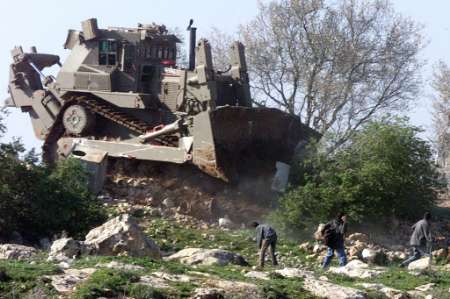
The Palestinians are sufficiently experienced to know that all the smiles being exchanged by Abbas and Olmert are not stopping the bulldozers, which continue to imprison them in enclaves among the growing settlement blocs. The declarations by Saeb Erekat about adhering to "a state within the 1967 borders" do not convince the public that a government led by the Palestinian Liberation Organization and Fatah will manage to do what it has not done since 1994: to fight against the Israeli project of occupation and colonization.

The concept of "amnesty" that is being used to describe the agreement to stop chasing wanted men demonstrates to what extent Israel is entrenched in its position of domination. According to the law, the president is allowed to pardon "criminals." According to the law, a "criminal" is someone who was tried and convicted. It's true that the late president Chaim Herzog pardoned leading members of the Shin Bet security service before they were tried for the murder of the hijackers of bus no. 300, after the majority opinion in the High Court of Justice ruled that the president of Israel has the same power to pardon as the king of England and the president of the United States.

But here it is a "pardon" of the Shin Bet and the army in the field. The ease with which the concept "pardon" was accepted in the media is additional proof of the sweeping approval that Israelis grant the Israel Defense Forces and its soldiers to act as prosecutor, judge and executioner. Is it any wonder that they are given the power of a king of England, to pardon before a trial?

Even the fate of the prisoners to be released in the context of the gestures had been sealed, even before they were tried in the big show called "the Israeli military court." A show, because the same military establishment that occupies and destroys and oppresses the civilian population is the body that decides that opposing the occupation (even by popular demonstrations and stone throwing) is a crime. Its judges are loyal to the interest of defending the occupier and the settler. The gesture of the prisoner release is therefore a very minor repair of a substantial legal flaw.

The Palestinians cannot forget that thousands of Israeli commanders and soldiers who killed women and children, broke hands and feet and defended the robbery of lands with their weapons, are walking around free. Had Olmert sincerely wanted to strengthen Abbas, he would at least have agreed to the request that Fatah representatives have been making for years: Demonstrate some degree of equality, release all those who were imprisoned for life for activity against the occupation, prior to the signing of the Oslo Accords. Release those who have been sitting for 20 and 30 years, and those whose dispatchers at the time are among the senior negotiators today. The failure to release them after 1994 was one of the important contributing factors to weakening the status of the PA and Fatah.

But after all, the "gestures" are being made in the concept of Israeli supremacy, of throwing a few crumbs to Abbas in anticipation of his obedience and of a grade of "good behavior" befitting a loyal subject. When that is the plan, it is also a surefire recipe for weakening Abbas.

http://www.haaretz.com/hasen/spages/883350.html