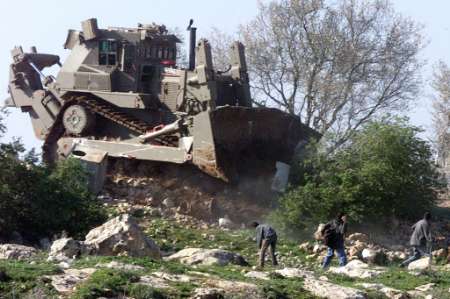
Gideon Levy, Haaretz, 29.11.07. The public discourse in Israel has momentarily awoken from its slumber. "To give or not to give," that is the Shakespearean question - "to make concessions" or "not to make concessions." It is good that initial signs of life in the Israeli public have emerged. It was worth going to Annapolis if only for this reason - but this discourse is baseless and distorted. Israel is not being asked "to give" anything to the Palestinians; it is only being asked to return - to return their stolen land and restore their trampled self-respect, along with their fundamental human rights and humanity. This is the primary core issue, the only one worthy of the title, and no one talks about it anymore. Just as a thief cannot present demands - neither preconditions nor any other terms - to the owner of the property he has robbed, Israel cannot present demands to the other side as long as the situation remains as it is. After 40 years, one might have expected that the real core issue would finally be raised for honest and bold discussion: Does Israel have the moral right to continue the occupation? No one is talking about morality anymore. Justice is also an archaic concept, a taboo that has deliberately been erased from all negotiations. Two and a half million people - farmers, merchants, lawyers, drivers, daydreaming teenage girls, love-smitten men, old people, women, children and combatants using violent means for a just cause - have all been living under a brutal boot for 40 years. Meanwhile, in our cafes and living rooms the conversation is over giving or not giving.
Lawyers, philosophers, writers, lecturers, intellectuals and rabbis, who are looked upon for basic knowledge about moral precepts, participate in this distorted discourse. What will they tell their children - after the occupation finally becomes a nightmare of the past - about the period in which they wielded influence? What will they say about their role in this? Israeli students stand at checkpoints as part of their army reserve duty, brutally deciding the fate of people, and then some rush off to lectures on ethics at university, forgetting what they did the previous day and what is being done in their names every single day. Intellectuals publish petitions, "to make concessions" or "not to make concessions," diverting attention from the core issue. There are stormy debates about corruption - whether Prime Minister Ehud Olmert is corrupt and how the Supreme Court is being undermined. But there is no discussion of the ultimate question: Isn't the occupation the greatest and most terrible corruption to have taken root here, overshadowing everything else?
Security officials are terrified about what would happen if we removed a checkpoint or released prisoners, like the whites in South Africa who whipped up a frenzy of fear about the "great slaughter" that would ensue if blacks were granted their rights. But these are not legitimate questions: The incarceration must be ended and the myriad of political prisoners should be released unconditionally. Just as a thief cannot present demands - neither preconditions nor any other terms - to the owner of the property he has robbed, Israel cannot present demands to the other side as long as the situation remains as it is.
Security? We must defend ourselves by defensive means. Those who do not believe that the only security we will enjoy will come from ending the occupation and from peace can entrench themselves in the army, and behind walls and fences. But we have no right to do what we are doing: Just as no one would conceive of killing the residents of an entire neighborhood, to harass and incarcerate it because of a few criminals living there, there is no justification for abusing an entire people in the name of our security. The question of whether ending the occupation would threaten or strengthen Israel's security is irrelevant. There are not, and cannot be, any preconditions for restoring justice.
No one will discuss this at Annapolis. Even if the real core issues were raised, they would focus on secondary questions - borders, Jerusalem and even refugees. But that would be escaping the main issue. After 40 years, one might have expected that the real core issue would finally be raised for honest and bold discussion: Does Israel have the moral right to continue the occupation? The world should have asked this long ago. The Palestinians should have focused only on this. And above all, we, who bear the guilt, should have been terribly troubled by the answer to this question.
Visualizzazione post con etichetta Israel occupation. Mostra tutti i post
Visualizzazione post con etichetta Israel occupation. Mostra tutti i post
giovedì 29 novembre 2007


lunedì 26 novembre 2007
What do you mean when you say 'no'?
Gideon Levy, Haaretz, 18.11.07. Of all Israel's iniquities in the occupied territories - the brutality, the assassinations, the siege, the hunger, the blackouts, the checkpoints and the mass arrests - nothing serves as witness to its real intentions than the settlements. Certainly for the future. Every home built in the territories, every light pole and every road are like a thousand witnesses: Israel does not want peace; Israel wants occupation. Whoever is serious about peace and a Palestinian state does not put up even a shed. From Oslo through Camp David and on to the road map, Israel has not put an end to the most criminal enterprise in its history. The mountains of excuses, "settlement blocs" and "natural growth," as well as "beyond the fence" and "inside the fence," cannot conceal the naked truth: The enterprise has not ceased for a moment. It will not stop now. The hands of a quarter million settlers are soiled by iniquity and felony, but they are not the true guilty party. That belongs to all Israel's governments, with the exception of Yitzhak Rabin's second government. All of them have a hand in the iniquity.
A festive day for peace: Israel is planning to announce a freeze on construction in the settlements as compensation for refusing to discuss the core issues. The Palestinians are ecstatic at all the good-will gestures Israel is throwing their way. First came the release of prisoners, now a freeze on construction, and the prime minister has already spoken with the settler leaders and informed them of the decision. They said it was a "difficult meeting," as it always is, winking at each other deviously.
Undoubtedly, Israel wants peace. But a tiny detail seems to have been forgotten: Israel has signed a series of binding agreements to freeze settlement activity, which it never intended to fulfill. Of the 40 years of occupation, only during three has construction been stopped despite all the agreements and promises to do so. There is no reason to believe that Israel will behave differently this time.
Of all Israel's iniquities in the occupied territories - the brutality, the assassinations, the siege, the hunger, the blackouts, the checkpoints and the mass arrests - nothing serves as witness to its real intentions than the settlements. Certainly for the future. Every home built in the territories, every light pole and every road are like a thousand witnesses: Israel does not want peace; Israel wants occupation. Whoever is serious about peace and a Palestinian state does not put up even a shed.
From Oslo through Camp David and on to the road map, Israel has not put an end to the most criminal enterprise in its history. A short memory refresher: In article 7 of the Oslo Accords, Israel promised that "no party would undertake unilateral steps to alter the situation on the ground, prior to the completion of negotiations for the final status." That really made an impression on Israel. During the 10 years that followed, the number of settlers doubled. What about the heroic peace efforts of Ehud Barak as prime minister? During the 18 months of his government, Israel began the construction of 6,045 residential units in the territories.
And why did Israel sign up to the road map two years later? "The government of Israel will freeze all its settlement activities, in accordance with the Mitchell report, except for natural growth in the settlements." And what happened in practice? Accusations that the Palestinians are not implementing the agreements, and a boatload of new settlers. This was also the case in 2005, another major "year of peace": the disengagement. And what did Israel do in its own backyard? Another 12,000 new settlers.
This terrible enterprise, whose purpose is to foil any chance for peace, is also a criminal enterprise. According to Peace Now, based on Civil Administration data that have been kept hidden for years, about 40 percent of the settlements were built on privately owned land of Palestinians helpless to safeguard what is in most cases their sole property that was robbed in broad daylight by an occupying state. This took place years after the Supreme Court ruled in 1979 that it is illegal to build on private Palestinian land. Indeed, while Israel is debating whether it is a state of laws, whether the prime minister was given a discount for the house on Cremieux Street, and whether we want a powerful Supreme Court, we should remember that what is happening in the territories is the real corruption that engulfs us.
Now we are on the eve of another peace event, yet during the past year another 3,525 new residential units were built in the territories, under the auspices of a government that talks incessantly about the end of occupation and two states. All the grandiloquent statements are void of substance when we read the data: Construction is at a peak in 88 settlements. Go to the territories and see for yourselves. When the construction firm Heftsiba imploded, suddenly hundreds of new settlers came to light, further proof of the magnitude of the "frozen" enterprise.
The mountains of excuses, "settlement blocs" and "natural growth," as well as "beyond the fence" and "inside the fence," cannot conceal the naked truth: The enterprise has not ceased for a moment. It will not stop now. The hands of a quarter million settlers are soiled by iniquity and felony, but they are not the true guilty party. That belongs to all Israel's governments, with the exception of Yitzhak Rabin's second government. All of them have a hand in the iniquity.
Nowadays, when Ehud Olmert says no, what does he mean? Is the "no" really "no" - perhaps it is only "maybe but not right now?" In view of past experience, the bitter truth is that Olmert's "no," like all those before it, is more inviting than "yes."
Undoubtedly, Israel wants peace. But a tiny detail seems to have been forgotten: Israel has signed a series of binding agreements to freeze settlement activity, which it never intended to fulfill. Of the 40 years of occupation, only during three has construction been stopped despite all the agreements and promises to do so. There is no reason to believe that Israel will behave differently this time.
Of all Israel's iniquities in the occupied territories - the brutality, the assassinations, the siege, the hunger, the blackouts, the checkpoints and the mass arrests - nothing serves as witness to its real intentions than the settlements. Certainly for the future. Every home built in the territories, every light pole and every road are like a thousand witnesses: Israel does not want peace; Israel wants occupation. Whoever is serious about peace and a Palestinian state does not put up even a shed.
From Oslo through Camp David and on to the road map, Israel has not put an end to the most criminal enterprise in its history. A short memory refresher: In article 7 of the Oslo Accords, Israel promised that "no party would undertake unilateral steps to alter the situation on the ground, prior to the completion of negotiations for the final status." That really made an impression on Israel. During the 10 years that followed, the number of settlers doubled. What about the heroic peace efforts of Ehud Barak as prime minister? During the 18 months of his government, Israel began the construction of 6,045 residential units in the territories.
And why did Israel sign up to the road map two years later? "The government of Israel will freeze all its settlement activities, in accordance with the Mitchell report, except for natural growth in the settlements." And what happened in practice? Accusations that the Palestinians are not implementing the agreements, and a boatload of new settlers. This was also the case in 2005, another major "year of peace": the disengagement. And what did Israel do in its own backyard? Another 12,000 new settlers.
This terrible enterprise, whose purpose is to foil any chance for peace, is also a criminal enterprise. According to Peace Now, based on Civil Administration data that have been kept hidden for years, about 40 percent of the settlements were built on privately owned land of Palestinians helpless to safeguard what is in most cases their sole property that was robbed in broad daylight by an occupying state. This took place years after the Supreme Court ruled in 1979 that it is illegal to build on private Palestinian land. Indeed, while Israel is debating whether it is a state of laws, whether the prime minister was given a discount for the house on Cremieux Street, and whether we want a powerful Supreme Court, we should remember that what is happening in the territories is the real corruption that engulfs us.
Now we are on the eve of another peace event, yet during the past year another 3,525 new residential units were built in the territories, under the auspices of a government that talks incessantly about the end of occupation and two states. All the grandiloquent statements are void of substance when we read the data: Construction is at a peak in 88 settlements. Go to the territories and see for yourselves. When the construction firm Heftsiba imploded, suddenly hundreds of new settlers came to light, further proof of the magnitude of the "frozen" enterprise.
The mountains of excuses, "settlement blocs" and "natural growth," as well as "beyond the fence" and "inside the fence," cannot conceal the naked truth: The enterprise has not ceased for a moment. It will not stop now. The hands of a quarter million settlers are soiled by iniquity and felony, but they are not the true guilty party. That belongs to all Israel's governments, with the exception of Yitzhak Rabin's second government. All of them have a hand in the iniquity.
Nowadays, when Ehud Olmert says no, what does he mean? Is the "no" really "no" - perhaps it is only "maybe but not right now?" In view of past experience, the bitter truth is that Olmert's "no," like all those before it, is more inviting than "yes."
Iscriviti a:
Post (Atom)