Visualizzazione post con etichetta Lieberman. Mostra tutti i post

sabato 1 settembre 2007

A l'est de Jérusalem, l'entrelacs de routes aménagées par les Israéliens compromet la viabilité d'un futur Etat palestinien

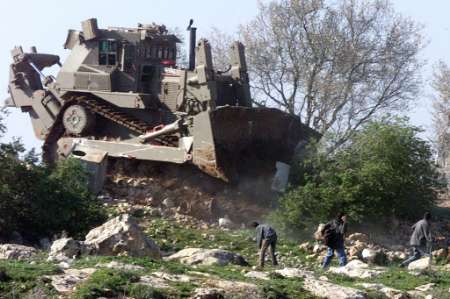
Benjamin Barthe, Le Monde, 01/09/07. Les négociations entre le président palestinien, Mahmoud Abbas, et le premier ministre israélien, Ehoud Olmert - qui se sont rencontrés une nouvelle fois, mardi 28 août - n'impressionnent visiblement pas le ministère israélien des transports : sur le terrain, ses pelleteuses et ses géomètres façonnent pour la Cisjordanie un avenir aussi éloigné que possible d'un quelconque accord de paix.


D'après un rapport de l'organisation pacifiste israélienne La Paix maintenant, publié lundi 27 août, 315 millions de shekels (55 millions d'euros) ont été investis cette année dans la construction de six routes destinées à relier au territoire israélien des colonies situées à l'est de la "barrière de séparation", donc promises à la démolition dans la logique d'un accord de paix. L'un des chantiers prévoit notamment de connecter à Jérusalem quatre implantations du sud de Bethléem : Tekoa, Asfar, Maale Amos et Nokdim, lieu de résidence d'Avigdor Lieberman, le ministre des affaires stratégiques, chef du parti d'extrême droite Israël Beitenou. "Cette route doit lui permettre de rejoindre son bureau d'une seule traite, sans croiser le moindre indigène", raille l'avocat israélien Dany Seideman, fondateur de l'association Ir Amim, qui travaille à une meilleure entente entre Juifs et Arabes dans la Ville sainte.

Les plans du ministère des transports prévoient également l'élargissement de la route d'accès à Ariel, l'une des colonies les plus peuplées de Cisjordanie, ainsi que de l'artère Jérusalem-Jéricho, fréquentée par les colons de la vallée du Jourdain. Les nouveaux ouvrages ainsi créés s'ajouteront à la trentaine de routes préexistantes, d'une longueur de 350 km, interdites de façon partielle ou intégrale aux Palestiniens.

La version officielle, selon laquelle ces investissements ne sont motivés que par des questions de sécurité, est contestée par le géographe palestinien Khalil Toufakji. "Le gouvernement israélien veut créer deux Etats à l'intérieur de la seule Cisjordanie, affirme-t-il : un pour les colons qui disposeront d'infrastructures leur permettant d'être de facto assimilés à Israël ; et un autre pour les Palestiniens qui sera constitué de cantons isolés les uns des autres. Comme durant le processus de paix, les belles paroles prononcées devant les médias sont en décalage complet avec la réalité sur le terrain."

COUPURE NORD-SUD

En réponse à cette critique, l'Etat juif dit travailler également à la "continuité" territoriale dont le président américain George Bush a fait l'un des prérequis du futur Etat palestinien. De fait, divers chantiers ont été lancés pour désenclaver au moyen de ponts ou de tunnels les poches d'habitations créées par la barrière de séparation. A l'est de Jérusalem, une rocade est également en cours de construction dans le but d'accélérer le trafic entre Ramallah et Bethléem. L'un des tronçons sera ouvert aux automobilistes israéliens, qui seront séparés de leurs homologues palestiniens par un mur érigé au milieu de la chaussée.

Signe que la viabilité du futur Etat palestinien n'est pas le principal souci des planificateurs, l'échangeur pour accéder à Jérusalem ne sera ouvert qu'aux Israéliens. Un choix éloquent, selon Dany Seideman : "Olmert poursuit l'oeuvre de Sharon, qui avait imaginé le concept de continuité par les transports pour répondre aux inquiétudes de la Maison Blanche, tout en continuant à construire des colonies."

A l'est de Jérusalem, en l'occurrence, le gouvernement espère pouvoir bâtir la zone dite "E1", un ensemble de collines pelées qui s'étendent entre la partie arabe de la Ville sainte et l'immense bloc de colonies de Maale Adoumim. Pour les Palestiniens, la mise en oeuvre de ce projet sonnerait le glas de leur rêve d'Etat, car il promet d'accentuer la coupure nord-sud de la Cisjordanie et d'isoler celle-ci de Jérusalem-Est, dont ils veulent faire leur capitale.

"La route Ramallah-Bethléem est la réponse du gouvernement à ces critiques, dit Dany Seideman. Elle lui permet de dire aux Américains : "Regardez, même avec E1, les Palestiniens circulent librement." La continuité nord-sud ainsi créée aura la largeur de la route : 16 mètres, ni plus ni moins. Abba Eban (un ex-diplomate israélien) disait que les hommes politiques ne se mettent à agir intelligemment que lorsqu'ils ont épuisé toutes les alternatives, conclut Dany Seideman. Visiblement, nous n'y sommes pas encore."

Benjamin Barthe
Article paru dans l'édition du 01.09.07.

sabato 4 agosto 2007

Aid, Diplomacy and Facts on the Ground: The Case of Palestine

Nadia Hijab, Middle East Policy, Aug 3, 2007

This article was originally published by Middle East Policy and is republished with the author's permission.

Aid, Diplomacy and Facts on the Ground: The Case of Palestine, by Michael Keating, Anne Le More and Robert Lowe. Chatham House Publishers, 2006

Why has $6 billion of taxpayers’ money given in aid to Palestinians between 1993 and 2004 not staved off a collapse of the Palestinian economy, polity and society? Why do donors provide aid, given Israel’s obligations as an occupying power, and fund major infrastructure projects that Israel then destroys? Aid in the absence of a political agreement can do more harm than good, by funding the occupation, postponing the national agenda, creating unaccountable elites, co-opting the leadership needed to achieve freedom and justice, and making donors feel good and powerful, among other things. See, for example, the essays by Nigel Roberts and Rex Brynen on the PA’s system of patronage, and Jeff Halper’s honest and insightful essay into ways to provide solidarity without reinforcing the skewed power dynamic. The problem with the "both sides" approach is that the Israeli settlement enterprise is a clear attempt by one side to settle the conflict in a way that destroys the other side’s national and human rights. The participation in the present Israeli cabinet of far right nationalist Avigdor Lieberman, whose views on "transfer" of Israeli Arab citizens out of the state have been described as racist by many Israelis, does not emerge out of a vacuum but is well within the broad Israeli policy framework.

I would take the analysis a step further and argue that Israel’s strategy has remained unchanged since the earliest days of Zionism: to give life to the myth of "a land without a people for a people without a land." Israel’s settlement policy in the West Bank is a clear continuation of the Zionist movement’s five-decades-long settler policy in pre-1948 Palestine. The unwillingness to give up the dream of a Greater Israel in a land as people-less of Palestinians as possible explains the determination to avoid the two-state solution.

As the authors compellingly show, the deliberate policy of closure of Gaza that Israel planned all along as part of its unilateral disengagement could provide an answer to Israel’s "demographic dilemma": civil war among Palestinians. This would result in Palestinians engaging in "self-ethnic cleansing" rather than Israel’s having to do it. This interpretation seems too much of a horror to be true, but it is borne out by the facts on the ground today and the history of the past century.

No one is proposing a cut-off of humanitarian aid. Rather, the aim must be to end the situation that makes aid necessary. The best way forward for the Palestinians, Israelis and the world is to finally apply international law to the conflict, as is well articulated in Claude Bruderlein’s very interesting paper on human security, and Karma Nabulsi’s compelling analysis of the de-democratization of the Palestinian body politic as a result of Oslo, and other papers.

There is a strong element of hypocrisy in the aid boycott of Hamas when "both sides" use measures that violate international law (attacks on civilians by Palestinians, as well as by Israelis, in addition to targeted assassinations, home demolitions, collective punishment, land confiscations and the occupation itself), when Israel blatantly does not recognize past agreements or Palestinian national rights, and when someone like Lieberman serves in the Israeli cabinet.

Providing Israel with huge amounts of aid as well as preferential trade access and other benefits in both Europe and the United States has clearly convinced Israel there is no price to pay for its destruction of Palestinian national rights.

The , Europeans have much more of an interest than the United States in the stability of the region, given their proximity, and they also have considerable clout though they prefer not to admit it. Just a hint that the EU may be considering the application of Article 2 of its trade-association agreement with Israel, which provides for upholding human rights, would do a great deal to get the Israeli government’s attention.

The other option is for donors to witness and collude in the physical, social and political destruction of a people, and, with it, the whole body of international law that the human race put in place during the twentieth century to avoid other global conflagrations that would end its time on earth.


Nadia Hijab is a senior fellow at the Institute for Palestine Studies and former UN development officer.