Visualizzazione post con etichetta Peace Now Settlements in Focus December 2007. Mostra tutti i post

martedì 18 dicembre 2007

Officials: Israel to allow construction in existing W. Bank settlements

Haaretz by Reuters, 18.12.07. Israel will allow construction within built up areas of existing Jewish settlements in the West Bank, but will not expand beyond those areas, Israeli officials said on Monday. The position could widen the rift in U.S.-backed peace talks launched by Prime Minister Ehud Olmert and Palestinian President Mahmoud Abbas during a regional peace summit held in Annapolis, Maryland last month. The Palestinians say the negotiations, the first in seven years, hinged on Israel committing to halt all settlement activity, including "natural growth," as called for under the long-stalled road map peace plan. The Bush administration has likewise urged Israel to stop settlement expansion. A senior Israeli official said "We don't need American approval if we are doing something that we think, as a sovereign state, we should do."

While Israel's decision would allow construction within existing built-up areas, the land that lies between existing buildings and the much larger outer jurisdictional boundaries of the settlements would be off limits, officials said.

The first round of the peace talks following Annapolis opened in discord last week after the Palestinians demanded a halt to Israeli plans to build some 300 new homes in the East Jerusalem neighborhood known to Israelis as Har Homa and to the Palestinians as Abu Ghneim.

The senior Israeli official, speaking on condition of anonymity, said the Har Homa development plan was approved 10 years ago by the Israeli government and called for 6,500 units, 4,500 of which are already being built and lived in.

"We told the Americans and the Palestinians that in those places, within the built-up line, Israel will continue to build, because there is no other way," the official said.

The official said the fate of Har Homa and other building projects depended on the outcome of the negotiations, which Olmert and Abbas said they hoped to complete before Bush leaves office in January 2009.

"If Har Homa will not be part of Israel, it doesn't matter if Har Homa is 5,000 units or 6,000 units, Har Homa will be dismantled," the official said.

In addition to requiring from Israel to end all settlement activity, the road map's first phase calls on the Palestinians to crack down on militants. Israeli officials have conditioned implementation of any peace deal on the Palestinians upholding their end in both the West Bank and the Hamas-controlled Gaza Strip.

"Before Palestine will be established, Gaza will have to comply with the rules that exist in the first phase of the road map," the senior Israeli official said.

The official said Israel defined a settlement freeze as a commitment not to build any new settlements and not to confiscate any additional Palestinian lands for settlement use.

Included in its definition of a settlement freeze, the official said Israel will not provide economic incentives for more Israelis to move to existing settlements.

"It doesn't mean people cannot go and live in existing settlements. Where there are vacant places, vacant apartments, people can go and live there with their families," he said.

"If somebody bought an empty lot in one of the settlements 10 years ago and he owns it, and he decides now in the year 2007, 10 or 15 years after he purchased it, to build on it, the government of Israel cannot do anything about it."

The official said it was unclear what "natural growth" included.

Related articles:
  • Peace Now: IDF carried out only 3% of settlement demolition orders
  • Jerusalem promises to freeze W. Bank settlement construction
  • Palestinians slam Israeli move to build new homes in E. Jerusalem
  • PA to U.S.: We'll accept nothing less than total settlement freeze
  • Peace Now Settlements in Focus - Vol. 3, Issue 5: Settlements and the Annapolis Peace Process

    [Note: This [December 2007] edition of Settlements in Focus does NOT address the controversy over new tenders recently issued by the Government of Israel for the construction of 307 new units in Har Homa, a settlement located in southeast Jerusalem. We will cover this issue in detail in an upcoming edition. For further reading at this time, we recommend the December 12th lead editorial in Ha'aretz, as well as Akiva Eldar's December 10th column in Ha'aretz.]
    With respect to Olmert's "bold" commitment to not build new settlements, this commitment is nothing more than a reiteration of a policy that is more than a decade old. In 1996, the Israeli government declared that Israel would establish no new settlements, and subsequent governments have repeated this commitment. Since the original declaration, the debate has focused not on the establishment of new settlements, but rather on the question of expansion of existing settlements, with Israel arguing that existing settlements should be allowed to continue to expand via "natural growth" and the Palestinians and the international community arguing that such growth was not "natural" and should not be permitted. It should be noted that Phase I of the Roadmap explicitly requires Israel to stop all settlement expansion, including expansion due to "natural growth." (For an excellent discussion of the controversy over "natural growth and what it does or does not mean, we recommend this 2001 analysis by Geoffrey Aronson, of the Foundation for Middle East Peace).

    Although Israel has officially committed itself to a "no new settlements" policy for more than a decade, on the ground Israel has unofficially established around 100 new settlements which are illegal even from the Israeli point of view. The story of the establishment of these "illegal outposts" – which are in effect proto-settlements – was told in the report prepared at the request of then-Prime Minister Ariel Sharon by attorney Talia Sasson. For details of that report, see: http://www.peacenow.org.il/site/en/peace.asp?pi=61&fld=343&docid=2012&pos=0

    A real "no new settlements" policy should mean not only refraining from establishing new settlements, but also dismantling all of the new settlements that have sprung up in the form of illegal outposts. Unfortunately, thus far there is no evidence that this is what Olmert means by his commitment.

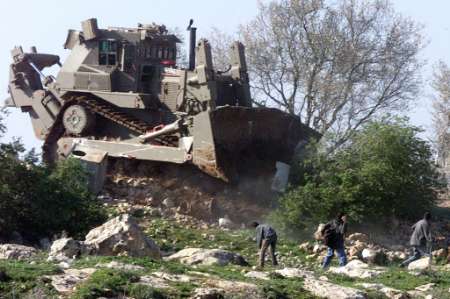
    "Freezing settlements" means halting ALL construction activity. This has not happened. It means stopping the bulldozers, including those operating in the "settlement blocks" and/or west of Israel's security barrier. While these latter areas may be within the so-called Israeli national consensus and may well become part of Israel in the future, at this point they are part of the area whose status must be resolved through negotiations, not through continued Israeli efforts to put houses and people on the ground. Any other definition of a settlement freeze is not serious. Any other definition will be exploited by settlers and their advocates to continue construction, and any other definition will signal to the Palestinians and the world that Israel is not sincere about negotiations.
    I
    n short, the government of Israel continues to support the settlement enterprise actively, through public investment, construction, and approvals, but also passively, by failing to enforce the law to any meaningful degree.

    Produced by Hagit Ofran, Peace Now and Lara Friedman, Americans for Peace Now