Gideon Levi, Haaretz, 4/08/07. "The people here are confused," Zbeidi's uncle, Jamal, says. "To go with [Palestinian Authority Chairman] Abu Mazen is to go with America, and to go with Hamas is to go with religion. Both are bad." [...]
It is close to 11 o'clock. A small and mysterious ball of fire suddenly shoots across the sky, from west to east. "We are their training field," the sheikh says wearily. When a momentary silence falls, our hosts identify the strange whirring noise we hear. Good evening, remotely piloted vehicle (RPV). From now until first light, the whirring will accompany us nonstop, whispering, distant - and very threatening. If a pistol appears in Act I, there will be a murder in the final act. If the RPV appears early on, everyone here knows, there will be an IDF operation later [...]
The first telephone report comes at 12:40 A.M. A convoy is advancing from the Nazareth road. Out of the north shall come evil this night. We go on eating under the RPV skies, watching jeeps with glittering headlights approach. To be on the safe side, the lights on the roof are turned off. Jamal calls his son, who is still in the street, and tells him to come home.
The IDF is in town.
A chorus of chickens squawking suddenly jolts me out of my imaginary calm, like a soundtrack for the approaching drama. Maybe they know something I don't? Watermelon is served. The jeeps are getting closer. I urge my hosts to go downstairs.
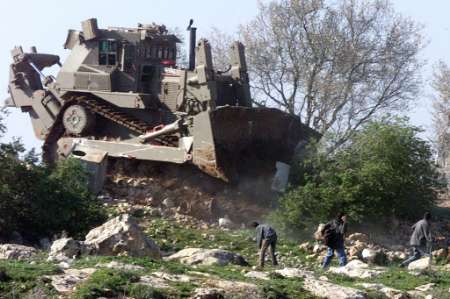
At 1:30 A.M. we decided to go to sleep; I fall asleep instantly. I hoped to wake up in the morning. Fifty-five minutes later the "white night" of the Jenin camp has ended. Jamal wakes us with whispers. The IDF is outside. The suggestion made by Miki, the photographer, to sleep in our clothes, was smart: We leap out of bed fully dressed. There is a huge noise outside. The Hummers and the bulldozer that traditionally precedes the jeeps, checking for booby-traps, are next to the window.
Often gunshot and explosive devices greet the uninvited guests, but tonight things are quiet. Jenin camp welcomes the forces. The chugging of the bulldozer fills me with dread.
We get out of bed and whisper, so the soldiers outside won't hear, and move toward the staircase, the only protected space in the building. But the convoy is right outside. What will happen now? How many residents have been killed when they made a wrong move next to soldiers with light trigger fingers? The whole family is by now sitting hunched over on the stairs, stunned with sleeplessness, used to the Hummer drill.
My thoughts wander outside. What do the soldiers in these steel contraptions know about the fear they are sowing nightly, among thousands of people, including children and infants? Young and brainwashed, do they ever think about this? And what do most Israelis know about the terror raids and those living in their shadows? Why does the army have to come here and create all this disturbance? To remind people who the lord of the land is?
The whole camp awakens like this, every night. But no one dares peek out the window or turn on a light. No one talks, no one moves. They sit bent over on the stairs, eyes red from lack of sleep. I almost faint from fright. The ringing of a phone suddenly cuts through the stillness: Zakariya Zbeidi is calling from the Muqata to ask how we are. A bit later Jamal whispers that the convoy has moved away and we can go back to sleep. I try to relax. Finally I drift off. Soon it will be 3:30 A.M. Forty minutes of restless sleep and they are back. This time I play dead and don't move from the bed. The Hummers and the bulldozer drive back and forth, for some reason. What are they looking for here?
Visualizzazione post con etichetta Zakariya Zbeidi. Mostra tutti i post
Visualizzazione post con etichetta Zakariya Zbeidi. Mostra tutti i post
domenica 5 agosto 2007


mercoledì 18 luglio 2007
Il «Che» della Palestina: mi batterò per i nostri diritti ma senza più armi
Umberto De Giovannangeli. l'Unità. 17/07/07. «Abu Mazen è stato eletto dal popolo palestinese e non intende rinunciare alle sue prerogative. Non sarà una banda di golpisti (i miliziani di Hamas, ndr) manovrati dall'esterno a impedirgli di assolvere alle sue funzioni. Ma dialogo non è sinonimo di resa,: questo Israele deve averlo ben chiaro in testa. La pace è riconoscimento delle ragioni dell'altro, è porre fine all'occupazione simboleggiata dal muro dell'apartheid, è porre fine all'assedio di Gaza, è ripristinare la legalità internazionale, è la liberazione dei prigionieri, è il diritto al ritorno dei rifugiati del 1948...».
UN TEMPO neanche troppo lontano, era il ricercato numero uno di Israele. Per i palestinesi di Jenin è l'eroe dell'Intifada armata, per le unità di élite di Tsahal il nemico più pericoloso da eliminare. Nonostante la giovane età, per i ragazzini palestinesi è già divenuto una leggenda, un modello da imitare. Il suo nome è Zakariya Zubeidi, 31 anni, capo delle Brigate dei martiri di Al Aqsa a Jenin, la «capitale» dell'Intifada. Lui e i suoi uomini furono i più tenaci difensori di Arafat nei mesi di assedio israeliano alla Muqata, il quartier generale del rais a Ramallah. Zubeidi è sfuggito a innumerevoli tentativi di eliminazione mirata. Se Marwan Barghuti è stato il simbolo politico della seconda Intifada in Cisgiordania, Zakariya Zubeidi ne è stato l'artefice sul campo. Per questo è stato definito dai ragazzi di Jenin il «Che (Guevara) di Palestina». Oggi Zubeidi ha deciso di abbandonare la lotta armata, e come lui almeno altri 180 militanti delle Brigate Al Aqsa, il braccio armato di Al Fatah, che hanno sottoscritto un documento nel quale si impegnano a «cessare gli attacchi contro Israele». In questa intervista esclusiva a l'Unità, il leader delle Brigate Al Aqsa spiega le ragioni di questa scelta: «Abbiamo abbandonato le armi ma non abbiamo rinunciato a batterci per i diritti del popolo palestinese. Ma sono altre le “armi” che oggi vanno imbracciate per difendere i nostri diritti: sono le “armi” della politica». Del suo passato, Zubeidi non rinnega nulla: «Ho visto morire attorno a me decine di compagni. Li ricordo uno per uno. E li onoro. Perché hanno sacrificato la loro vita per un ideale: la Palestina libera». «Noi -aggiunge- non ci aspettiamo nulla di buono dall'occupazione, né obbediamo agli ordini di Israele. Siamo agli ordini della nostra direzione e del suo capo, Mahmud Abbas (Abu Mazen). È per lui che abbiamo deposto le armi».
Nel giorno del nuovo incontro tra Ehud Olmert e Abu Mazen, lei ribadisce l'addio alle armi. È una resa?
«No, è la determinazione a proseguire con altri mezzi la stessa battaglia: quella per la creazione di uno Stato di Palestina sui territori occupati da Israele nel 1967».
Qual è allora il senso della decisione assunta?
«Semplice: le Brigate Al-Aqsa non rappresenteranno un ostacolo verso i progetti politici volti a risolvere la questione palestinese».
Un passo importante che ha anche un segno di autocritica rispetto al passato?
«Ho visto morire attorno a me decine di compagni. Li ricordo uno a uno. Non erano dei pazzi assetati di sangue, amavano la vita ma ancor di più la libertà. Sono caduti in nome della Palestina libera, per questo continuerò a onorarli. Ma anche allora era chiaro in noi che non era con le armi che potevamo edificare lo Stato di Palestina: quelle armi potevano difendere la nostra gente, dimostrare a Israele che non era con la forza che avrebbe garantito la propria sicurezza, ma le armi non potevano sostituire la politica, il negoziato. Quel tempo è venuto. E il tempo che la politica dia una speranza a migliaia di giovani palestinesi che fin qui hanno conosciuto solo sofferenza, dolore, rabbia. Negoziati seri rappresentano un mezzo di resistenza all'occupazione come lo è il fucile, ma bisogna saper valutare quando utilizzare l'uno o l'altro mezzo a seconda del momento».
C'è chi sostiene che alla base della sua scelta c'è la garanzia di essere tirato fuori dalla lista nera di Israele.
«In altri termini avrei deposto le armi per salvarmi la vita. È una infamia, a cui non intendo ribattere. I miei compagni, quelli con cui ho condiviso momenti terribili, sanno che la scelta a cui siamo giunti è frutto di una riflessione difficile, che ci ha accompagnato negli anni in cui eravamo braccati dagli israeliani, ben presente anche quando eravamo impegnati nei combattimenti. La nostra è una scelta politica che non ha nulla a che fare con i destini individuali».
Una scelta di disarmo con cui le Brigate Al Aqsa intendono sostenere la politica di Abu Mazen, un presidente dimezzato…
«Dimezzato? Abu Mazen è stato eletto dal popolo palestinese e non intende rinunciare alle sue prerogative. Non sarà una banda di golpisti (i miliziani di Hamas, ndr) manovrati dall'esterno a impedirgli di assolvere alle sue funzioni. Ma dialogo non è sinonimo di resa,: questo Israele deve averlo ben chiaro in testa. La pace è riconoscimento delle ragioni dell'altro, è porre fine all'occupazione simboleggiata dal muro dell'apartheid, è porre fine all'assedio di Gaza, è ripristinare la legalità internazionale, è la liberazione dei prigionieri, è il diritto al ritorno dei rifugiati del 1948...».
E per voi delle Brigate Al Aqsa qual è il «prezzo» da pagare per una pace giusta, dura, tra pari?
«È riconoscere che non c'è altra soluzione che quella di due popoli, due Stati. E che Israele va accettato per quel che è: lo Stato degli Ebrei, con il quale vivere a fianco».
Una linea che verrebbe tacciata di tradimento da i capi di Al Qaeda.
«Non m'interessa. Al miliardario saudita (Osama Bin Laden, ndr) non è mai fregato niente di noi palestinesi, nel suo intimo ci considera razza inferiore; lui vuole solo strumentalizzare la nostra sofferenza. I palestinesi non sono nemici dell'Occidente, ci consideriamo amici dell'Europa: noi vogliamo solo poter vivere da uomini e donne liberi sulla nostra terra. Per averci al suo fianco, Bin Laden ci ha promesso armi e denaro. Ma noi palestinesi non siamo carne da macello per il suo Jihad».
Sarà possibile riprendere il dialogo con Hamas?
«Forse, ma non di certo con coloro che si sono macchiati dei peggiori crimini a Gaza. I carnefici dei propri fratelli non possono restare impuniti».
domenica 15 luglio 2007
Fatah men, including Zbeidi, turn in their guns in amnesty deal
Aluf Benn, Avi Issacharoff and Amos Harel, Haaretz Correspondents. 15/07/07. Scores of wanted Fatah militants in the West Bank have turned in their weapons, under an arrangement in which Israel will grant them effective amnesty as a gesture to Palestinian Authority Chairman Mahmoud Abbas. Most of the fugitive militants have signed documents that announced their resignation from the paramilitary organization and a promise to refrain from terrorism. As of Saturday night, nearly 150 of the 178 militants had signed the document. Scores of them had turned in their weapons by Sunday.
The Prime Minister's Office, apologizing for an earlier denial, acknowleged Sunday that Zacharia Zbeidi, head of the Fatah Tanzim militia in the West Bank city of Jenin and one of the highest-profile Fatah commanders on Israeli wanted lists in the territories, is among the nearly 200 militants to whom Israel plans to offer amnesty.
Abu Obeida, a Hamas spokesman in the Gaza Strip, harshly criticized Fatah for the amnesty agreement, saying it was meant to destroy the spirit of the resistance and allow Israel to focus on Hamas militants.
The offer to clear the Fatah men from the lists of wanted fugitives is part of a package of measures which Prime Minister Ehud Olmert is to formally present to Abbas in a meeting with the Palestinian Authority chairman on Monday. The gestures will also include a release of prisoners.
On Saturday, an Israeli official denied Palestinian reports that Zbeidi was on the list. But the Prime Minister's Office reversed course on Sunday morning, conceding that the reports were correct.
The effective amnesty would extend to nearly 75 percent of the wanted militants of the Fatah Al-Aqsa Martyrs' Brigades.
Israel refuses to grant similar status to several dozens of the remaining known members of the Al-Aqsa Martyrs' Brigades, and there are Palestinian demands that they also be included in the deal. The list of the wanted members of the Fatah's military wing was prepared by the Shin Bet and was compiled following meetings between Israeli officials and a PA security delegation headed by Ziad Habrich, commander of the Preventive Security in the West Bank.
Anger over plan to let Hawatmeh return
Meanwhile, rightists and families of victims of terror attacks have reacted with anger to reports quoting Israeli security sources as saying they are inclined to allow the head of the Democratic Front for the Liberation of Palestine, Nayef Hawatmeh, to enter the West Bank on Wednesday, as part of the package of goodwill gestures.
Minister of Strategic Threats Avigdor Lieberman was quoted Sunday as saying that the aging Hawatmeh, whose organization was responsible for the killings of many Israelis in attacks going back more than three decades, should be allowed to enter, and then immediately arrested.
Families of the victims said Sunday that under no circumstances should Hawatmeh be allowed to return. DFLP militants carried out an operation against the northern town of Ma'alot on May 15, 1974, in which 22 schoolchildren were killed.
But Deputy Defense Minister Matan Vilnai said Saturday that "We need to view the request of the PA Chairman regarding Hawatmeh's entry into the West Bank favorably, especially since it does not involve entry into Israel and it is for a limited period of time."
"Even though Hawatmeh dealt with terrorism in the past, under the current circumstances he is proving to be a person capable of contributing toward leading the Palestinians toward a more rational condition," Vilnai added.
At the scheduled Monday talks between Olmert and Abbas, a meeting which was orginally planned for Sunday, Israel will present the Palestinian leader with additional gestures, including entry permits to the West Bank for senior officials from the Popular and Democratic Fronts, as well as promises for lifting roadblocks in the West Bank - as soon as the necessary preparations are completed by the security forces.
"These are measures that we believe will contribute significantly to bolstering Abbas," a senior political source in Jerusalem said Saturday night. "They hold political risks for Olmert, but it is a reasonable risk."
The meeting between the two leaders will be held at the prime minister's official residence in Jerusalem. In the original planning, Olmert had been scheduled to visit Jericho, but that has been postponed. No other ministers will be included in the meeting with Abbas, but earlier, Olmert will hold preparatory meetings with Defense Minister Ehud Barak and Foreign Minister Tzipi Livni.
The list of prisoners that are slotted for release includes 250 names, most members of Fatah, and the rest from the Popular Front for the Liberation of Palestine (PFLP) and the Democratic Front (DFLP).
The adult prisoners scheduled for release have at least one year of their sentence left, while the minors have at least six months. Elderly and sick prisoners are also expected to be included.
"No once can claim that Israel is releasing prisoners that do not have significant portions of their sentence still to serve," a political source said.
A ministerial committee on the prisoners will meet Tuesday to approve the list, and initiate the process of releasing them, expected to take several days. Olmert would also like to gain the release of some of the veteran prisoners jailed before the Oslo Accords in 1993, as long as they were not involved in attacks that killed Israelis.
Referring to the PFLP, the DFLP, and other Marxist-Leninist offshoots of the PLO, the political source said that even though Israel is not certain what their views are on the internal power struggle between Fatah and Hamas, Israel would like to encourage them to support Abbas and the head of the PA's emergency government, Salem Fayad.
However, the General Secretary of the PFLP, Ahmed Sa'adat, who is in jail for his role in the October 2001 assassination of the leader of the Moledet party, Rehavam Ze'evi, is not on the list of prisoners to be released.
The effort to draw the various non-Islamist factions toward supporting Abbas is also behind Olmert's inclination to accede to the request of the PA chairman to allow the head of the DFLP, Hawatmeh, and other senior figures from his group and the PFLP to enter the West Bank.
Abbas would like these leading veteran figures in the PLO to participate in a conference that will offer his leadership and the Fayad government legitimacy. The gathering is expected to take place in the West Bank, and entry is likely to be allowed for a specific period of time.
The agreement with the Al-Aqsa fugitives includes four stages:
1. They will promise to refrain from terrorism and cut their links with the group.
2. They will spend a week in holding areas of the PA, where they will not be allowed to use cellular telephones or contact members of the group.
3. They will restrict their movements, for a three-month period, to the area where they reside.
4. After three months, they will be allowed to move freely in the West Bank.
"Our aim is to remove 180 persons from the list of targets of the Shin Bet, so that they can now focus on Hamas and Islamic Jihad," a political source said.
Hawatmeh likely to be granted entry
There are strong indications that Israel will allow DFLP leader Nayef Hawatmeh to enter the West Bank on Wednesday as part of the goodwill package toward Abbas.
http://www.haaretz.com/hasen/spages/881764.html
Olmert's Latest Gesture: Conditional Pardon for 178 Terrorists
Hillel Fendel. IsraelNationalNews. Sunday, Jul. 15 '07 29 Tammuz 5767. Prime Minister Ehud Olmert has agreed to an arrangement whereby 178 wanted Fatah terrorists are granted amnesty, in exchange for their promise to stop terrorism. The 178 have already signed their commitment to cease engaging in terrorism against Israel.
The name of Zekarya Zubeidi, who has been wanted for many years for his terrorist activity against Israel, is on the list as well. The Prime Minister's Bureau clarified on Sunday morning that this was indeed the case. The Bureau even apologized for the "technical glitch" that led to the omission of his name in initial reports.
Representatives for Zubeidi signed this morning his commitment to stop terrorism against Israel.
Palestinian Authority sources say that many of the 178 will be eligible to receive up to 60,000 shekels for turning in their weapons. An M-16 rifle will net them 55,000-60,000 shekels, a Kalachnikov - 15,000 shekels, and a pistol between 12,000 and 24,000 shekels. The money is to come from the PA's coffers.
The PA will reissue weapons to many of the 178 who will join the PA's security forces.
The 178 terrorists will benefit from a trial period of three months in which they will not be arrested, unless Israel receives information that they are planning terrorism. If during the three months they do not engage in terrorism, they will be officially removed from the "wanted" list.
However, they apparently will not receive an official and irreversible pardon, such that if ever they return to terrorism, they will be liable to be tried on their previous crimes as well.
The Israel Law center (Shurat HaDin) has filed a petition with the High Court against the plan by Prime Minister Olmert to remove 178 Arab terrorists from the "wanted list."
The petition claims that the deal was made in secret with Palestinian Authority officials and ignores international law that requires Israel to bring to trial terrorists who have committed crimes against humanity.
Olmert also previously agreed to release 250 imprisoned terrorists, though their names have not yet been determined.
Reactions
Several Cabinet ministers are against some of Olmert's latest gestures. Strategic Affairs Minister Avigdor Lieberman (Yisrael Beiteinu) said the mass pardons are a "grave error." He explained that he is remaining in the government in order to "minimize the damage done" by the government.
Trade Minister Eli Yishai (Shas) said that he is against gestures of this nature to Abu Mazen, explaining that Abu Mazen must make more efforts to help himself instead of relying on Israel to prop him up.
Welfare Minister Yitzchak Herzog (Labor) said Israel has no choice but to make difficult concessions in order to strengthen the "moderate" elements in the PA.
The Legal Forum, a group of attorneys who lobbied for civil rights of Gush Katif residents, has called upon Justice Minister Daniel Friedmann to object to what it calls the "laundering of the murderers." Forum Director Nachi Eyal says, "The government has reached new heights in proving the truth of the Sages' dictum, 'Whoever is merciful to the cruel will end up being cruel to the merciful.' It was cruel to the youths in Amona and during the Disengagement, and is not closing their criminal files regarding their protests - and yet is now showing compassion to debased murderers. The message being given is an abuse of justice and the victory of the murderers over their victims."
In response to sharp criticism from the Likud for the amnesty plan, an official of the Prime Minister's office said Sunday, "The Likud has forgotten that in February, 2005 [then-ministers] Binyamin Netanyahu and Limor Livnat, both of the Likud, enthusiastically backed" moves to free Arab terrorists.
Iscriviti a:
Post (Atom)