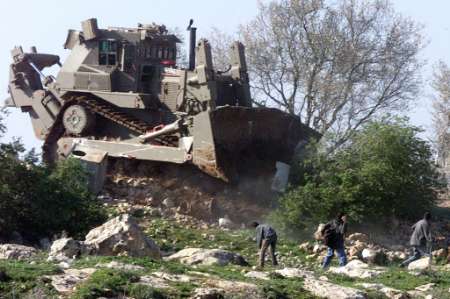
ISM Media Alert mailto:media@palsolidarity.org,18.11.07. This morning an Israeli jeep containing 4 Israeli soldiers invaded the school grounds of the Azzoun High School - contravening international law.  Jeep #401 entered the school grounds at approximately 8:30am, at the end of the second lesson, driving through the school yard, all the way up to the steps of the main school building. Teachers and principals advised that there was nothing in the village this morning to provoke such an action by the Israeli soldiers - indeed, a teacher on his way to school was stopped at the Azzoun gate on Tuesday 13th November by Israeli soldiers and told to inform the principal that Israeli soldiers would attack and enter the school - proving that it was premeditated.  Rather, they consider these actions as part of a cynical strategy to garner High Court approval for a four kilometre wall to be built along the highway from Izbat Al Tabib to Kafr Laqif - a wall that will effectively seal the main gate of Azzoun
forever and impede travel for Palestinians throughout the region - for which the markings already exist.   "If they can present a big file, showing lots of trouble in Azzoun, then the High Court will grant them permission to build this wall." said principal Majd.  "We know the game they play."
Three teachers and one administrator went to speak to the soldiers, requesting very politely that they leave.  Soldiers replied that it was the teachers who should leave them alone - telling them to go back to their classrooms and stop interfering in the soldiers' work, all the time pointing a gun at the teachers.

One teacher reported: "We said to him that there are rules that forbid him from entering a school".  The soldier said "For me there are no rules.  I will come one time, two times, ten times, as many times as I want and no one can forbid me.  If you forbid me, I will shoot you."'
Another teacher, reportedly asked the soldiers "What if we were soldiers and came to your schools?", and was immediately threatened with arrest.  The teachers told the soldiers that coming into the school would cause problems, asking "Do you want to cause problems?" to which the head soldier replied "Yes, I do."

The teachers consider these actions to be provocations by the Israeli soldiers, which are common.  Two weeks ago soldiers shot two sound bombs into the school, and regularly enter the village and wait outside the school to provoke the students as they are heading home for the day.  These provocations in the past gave soldiers the excuse for imposing curfews on the village.  They take on an even more sinister edge now that the Commander has advised villagers that students caught throwing rocks will be killed.

Azzoun school prinicpals claim that this is the first time a jeep has entered school grounds in the history of the Israeli occupation of Palestine.  The principal called the Qalqilia DCO, who seemed to not know about this invasion, and advised that they will find out what happened from the soldiers.

The teachers closed the doors to the main school building, leaving the soldiers in the school yard, where they waited and circled for ten minutes, before driving the jeep to block the entrance to the school.
When teachers went down to close the main school gates, soldiers tried to stop them saying "You are forbidden to close the door to the school.  Don't close the door".  Teachers openly defied this order, closing the gate and saying "We will close the gate, you do what you do".  Since the incursion, the school gates have been fixed, so that no vehicle entry is possible, and strengthening them to prevent ram raids.

Teachers and principals advised that there was nothing in the village this morning to provoke such an action by the Israeli soldiers - indeed, a teacher on his way to school was stopped at the Azzoun gate on Tuesday 13th November by Israeli soldiers and told to inform the principal that Israeli soldiers would attack and enter the school - proving that it was premeditated.  Rather, they consider these actions
as part of a cynical strategy to garner High Court approval for a four kilometre wall to be built along the highway from Izbat Al Tabib to Kafr Laqif - a wall that will effectively seal the main gate of Azzoun forever and impede travel for Palestinians throughout the region - for which the markings already exist.   "If they can present a big file, showing lots of trouble in Azzoun, then the High Court will grant them permission to build this wall." said principal Majd.  "We know the game they play."

For More Information:

John 054 5364072

--~--~---------~--~----~------------~-------~--~----~
The International Solidarity Movement (ISM) is a Palestinian-led  non-violent resistance movement committed to ending Israel's illegal occupation of Palestinian land.  We call for full compliance with all relevant UN resolutions and international law.

For specific media inquires such as interview requests, photo usage, etc. please email the ISM Media Office at media@palsolidarity.org
Visualizzazione post con etichetta Apartheid Wall. Mostra tutti i post
Visualizzazione post con etichetta Apartheid Wall. Mostra tutti i post
venerdì 23 novembre 2007
IOF provoking troubles so the High Court will grant permission to build the Wall


giovedì 1 novembre 2007
En séjour illégal, même chez eux
Gideon Levy, Haaretz, 26.10.07. L’électricité et l’eau, ils se les font venir par des lignes improvisées qui passent par l’ouverture de drainage aménagée sous le Mur de séparation construit ici il y a un an et demi environ et qui porte le nom impeccablement lessivé d’ « enveloppe de Jérusalem ». Mais ce Mur n’enveloppe personne ici, il étrangle seulement. Lorsque quelqu'un veut se laver ou préparer une tasse de thé, il téléphone à des proches qui vivent à Bir-Naballa, de l’autre côté du Mur, et leur demande de leur ouvrir le robinet. Quand le Mur a été achevé, un étroit passage leur y a été laissé, afin qu’ils puissent continuer à subsister d’une manière ou d’une autre. Le garde-frontière de faction à cette entrée permettait à leurs enfants d’aller à l’école à Bir-Naballa, et eux-mêmes transportaient à dos d’âne les produits de première nécessité. Une fois, un des membres de la famille, Houssam, a été frappé alors qu’il essayait de faire passer par cette porte un sac d’aliment pour les bêtes. Il y a un mois et demi, même ce riche filon s’est arrêté. Le 12 septembre, sans la moindre notification préalable, l’Administration civile a envoyé une bétonnière qui est arrivée et a déversé son contenu dans l’étroit passage. La dernière porte leur a été fermée et scellée. Les voilà devenus des résidents en séjour illégal, dans leurs maisons.
Shlomo Laker, l’avocat, explique qu’il y a encore des milliers d’habitants qui vivent en bordure de la capitale unifiée et qui se trouvent dans des situations semblables. Lui-même en représente un millier d’entre eux dont la vie a été détruite à cause du Mur. Les fêtes terminées, on pensait que le problème serait résolu. Israël n’arrête pas de déclarer que le « cadre de vie » des Palestiniens ne sera pas affecté par le Mur de séparation. Les paroles d’un côté, les actes de l’autre. Les fêtes se sont achevées mais pas les tourments. Le 18 septembre, les enfants sont restés coincés de l’autre côté du Mur, sans aucune possibilité de rentrer à la maison. Le lendemain, Mahmoud a emmené le groupe des élèves à l’école en passant par le barrage de Kalandiya. Entrer dans les Territoires, cela ils peuvent le faire, mais revenir : seulement avec un permis d’entrer en Israël, permis qu’ils n’ont pas. Chaque jour, Mahmoud et les enfants contactent « B’Tselem » ainsi que le « Centre humanitaire » de l’Administration civile, afin d’obtenir une autorisation de revenir des Territoires en Israël [sic], chez eux. Cela prend du temps. Un jour, l’autorisation n’est arrivée que le soir déjà tombé, et avec lui l’heure du repas de rupture du jeûne ; alors ils ont décidé de rester sur le lopin devant une des maisons. Sous la voûte du ciel, ils ont planté une tente où ils ont passé l’après-midi et la nuit, avec leurs parents de l’autre côté.
(Traduction de l'hébreu : Michel Ghys)
Source traduction : Palestine Solidarité
http://www.palestin
martedì 23 ottobre 2007
Separation Barrier cuts off children from Tel ‘Adasa, which is in East Jerusalem , and their school in Bir Nebala

Tel Adasah children break the Ramadan fast in Bir Nabala streets. Photo: Kareem Jubran, excert from B'Tselem Video.
B'Tselem, 22.10.07. Sixty-eight Palestinians, twenty-six children among them, live in the area called Tel ‘Adasa, in East Jerusalem, on land Israel annexed in 1967, near the ‘Atarot industrial area and Begin Road (Route 404). West of this road, on which Palestinians are forbidden to travel, Israel built a section of the Separation Barrier, which separates the residents of Tel ‘Adasa from the adjacent town, Bir Nebala, which lies outside Jerusalem 's municipal borders. Although all the residents of Tel ‘Adasa have dwelled permanently in their community for dozens of years, and many were even born there, Israel has never recognized them as residents of Jerusalem, and they have not been given Israeli identity cards. As a result, the Israeli authorities consider them to be staying illegally in East Jerusalem . They are technically forbidden to enter or stay in Jerusalem (even in their own homes) or receive any services provided by the state.
The refusal of Israel to recognize the residents of Tel ‘Adasa as residents of East Jerusalem, thereby turning them into persons staying illegally in Israel, gravely infringes their human rights, especially their right to freedom of movement, in flagrant breach of international law. The building of the Separation Barrier and the recent closing of the only opening in the barrier, which is their only way to get to and from the West Bank, prevents them from obtaining services outside Jerusalem . This situation has made their living conditions intolerable, and is liable to lead to the rapid removal of them from their homes. B'Tselem calls on the Israeli government to dismantle the Separation Barrier in this area and recognize the right of the residents of Tel ‘Adasa to stay in East Jerusalem and move about there freely. Until then, the authorities must reopen the passageway in the Separation Barrier and issue permanent permits to the residents so that they will be able to cross Qalandiya Checkpoint.
Iscriviti a:
Post (Atom)