Join Us in Palestine for the 2007 Olive Harvest Campaign! Palestinian
farmers and agricultural organizations, in coordination with the
International Solidarity Movement, the International Women's Peace
Service, and the Christian Peacemaker Team announce the 2007 Olive
Harvest Campaign. The campaign will begin on October 16th, after the
end of Ramadan, and will continue for six to eight weeks, depending on
the size of the harvest.

The Israeli government continues to seize Palestinian land throughout
the West Bank to expand settlements and build its illegal annexation
barrier. As this goes on, Palestinian communities continue to resist
Israel's attempts to cement its control of the West Bank and imprison
Palestinians behind walls and fences.

The Olive Harvest is an annual affirmation of Palestinians'
historical, spiritual and economic connection to their land, and a
rejection of Israeli efforts to seize it. Palestinians are the
indigenous people of this land who have farmed olives here for
thousands of years. The annual harvest is a symbol of life for
Palestinian communities.

Agricultural productivity over the last seven years has decreased
dramatically because of closures and sieges, which prohibit access to
farms and markets. Israel's barrier and increased settler attacks on
farmers and their families in the fields have further diminished
Palestinians' ability to earn a living. Over half a million olive and
fruit trees have been destroyed since September 2000. Palestinian
agriculture is being destroyed by the policies of the Israeli
government and the rights of Palestinians to their land and to a
livelihood are being denied.

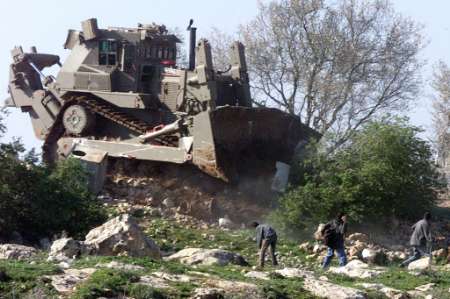
International and Israeli volunteers join Palestinians each year to
harvest olives, in spite of efforts by Israeli settlers, soldiers and
bulldozers to destroy this vital piece of Palestinian life.

How It Works

The Olive Harvest Campaign provides a wonderful opportunity to spend
time with Palestinian families in their olive groves and homes. The
presence of internationals during harvest time has proven in the past
to help limit and decrease the severity of attacks. Last year (2006)
was the first year since the beginning of the intifada that a farmer
was not murdered while trying to harvest his olives. One farmer was
severely beaten, and in that instance, no internationals or Israelis
were present. Your presence makes all the difference in reducing the
levels of violence Palestinians experience while standing up for their
rights.

After a two-day training session, volunteers for the Olive Harvest
Campaign will stay in Palestinian homes or international apartments in
West Bank communities and accompany Palestinian families to their
olive groves to serve as witnesses to document and expose attacks by
settlers -- supported by the Israeli Army -- on farmers and their
families.

In addition to olive harvest, volunteers will have the opportunity to
join Palestinians in nonviolent protests throughout the West Bank
against the construction of the annexation barrier, settlements and
settlement roads.

This 2007 Olive Harvest Campaign is part of the ongoing work of the
International Solidarity Movement, a Palestinian-led movement
comprising of Palestinian, Israeli and international activists working
to raise awareness about the struggle for Palestinian freedom and an
end to the occupation. ISM uses nonviolent, direct-action methods of
resistance to confront and challenge the Israeli persecution of
Palestinians. With your help and participation, we will expose the
injustice of the Israeli occupation and send a message to the world
that the occupation must end and the wall must fall!

For more information on preparation, travel and arrival in Palestine,
please see the ISM Palestine website, www.palsolidarity.org/main/join/.
ISM support groups located around the world can help answer your
questions about the movement and Olive Harvest Campaign. Many will
provide training sessions. For information on how to contact local ISM
support groups worldwide, please also see the ISM website.


--~--~---------~--~----~------------~-------~--~----~
Please consider a financial donation to help continue the important work of the ISM. You may donate securely online at our website: http://www.palsolidarity.org/main/donations

For more information, visit the ISM website at http://www.palsolidarity.org
PLEASE FORWARD THIS UPDATE WIDELY
Visualizzazione post con etichetta ISM.. Mostra tutti i post
Visualizzazione post con etichetta ISM.. Mostra tutti i post
giovedì 23 agosto 2007
Olive Harvest 2007: You Are Needed More Than Ever!


lunedì 16 luglio 2007
Nablus: Misery at Checkpoints
International Solidarity Movement. 15/07/07. Nablus in the West Bank is home to approximately 250.000 people, and with its university and central location as a major commercial and educational focal point, it has also been a place which attracts workers and students from other villages and cities in the area. Nablus is surrounded by 35 villages in addition to illegal Israeli settlements such as Itamar, Berakha,and Alon Moreh, and Yitzhar.
The roads in and out of Nablus are controlled by the Israeli Occupation Forces (IOF), and they control the thorough-fares in and out of the city, thus stopping the entry and exit of every one of the West Bank residents approaching the city. The Checkpoints of Huwwarra leading southward, Beit Iba to the northeast, and Badan to the east are all used as means of collective punishment. The Badan checkpoint especially, has made itself famous for the arrogance and harsh behavior with which the IOF meet the Palestinian population. Long delays, often for hours on end in excruciatingly hot temperatures, without any possibility of getting away, turning back, or finding shade.
On the 12th of July, two ISM-teams approached the checkpoints of Huwwarra and Badan to monitor the actions of the soldiers, report any violations of human rights, and assist Palestinians approaching the checkpoints. At 7.30 the Badan checkpoint was in reality completely closed, and 10 minutes later the checkpoint suddenly opened up, thus slowly allowing Palestinian cars to go through the checkpoints manned by the IOF. The ISM-team observed and intervened when the IOF forced 4 of the Palestinian men waiting by the checkpoint to carry large boulders in order to further fortify the checkpoint, and prevent cars from approaching the soldiers from more than one lane.
The soldiers did not allow for anyone to pass the checkpoint by foot which created a lot of trouble for the people that came by foot and for workers and students that had to wait next to cars already filled with people. Women and children had to stay under the hot sun for hours and many had to wait more than 3 hours to pass. One of the Palestinian women, Huda, waited in the sun with her five children, the oldest being 9 years old and the youngest girl, an infant of 7 months. Around 08.00 am approximately 50 cars were waiting on each side of the checkpoint and many more Palestinians were standing beside the cars, hoping to get the chance to lay out their reasons for passing to the arrogant and dazed soldiers. At around 08.30 am a bus arrived and all the men, around 20 had to get out and line up beside the bus, facing the valley below, with their backs to the road. A while later women and children were forced out as well, and all of their luggage was searched. Two of the men in the line were taken aside and had to sit down in the scorching sun. The detained men were handcuffed and blindfolded, one of them had to put his own T-shirt over his head, while the other young man was blindfolded with a piece of cloth. The plastic handcuffs that the soldiers used were very tight, and the soldiers refused to loosen up, even after complaints and requests. After fifteen minutes one of the two detainees was released and could
return to the bus. After standing outside in the heat for 40 minutes, the remaining men could get back to the bus. However one exhausted man was taken to a metal booth and was made to sit on a boulder in a very uncomfortable position.

The ISM-team managed to approach the man, and had him whisper his name and ID-number so that steps could be taken to secure his identity and prevent him from “dissapearing” into the Occupation Forces administration. We also made sure to get the phone number of his parents, and put Machsom Watch and Hamoked in touch with the DCO. It was now clear that the young man would not be released within the near future. The soldiers claimed his was one of the wanted men on their list containing 167 numbers. Each number is the last four numbers in a Palestinian ID-number and everyone on that list is wanted and to be arrested.

Time passed and the heat and position weakened the man and he was barely conscious at some points. The activists were allowed to give him water, but no food and absolutely not talk to him. After nearly 2 and a half hour in detention his condition was just getting worse, but the soldiers kept repeating that this was a dangerous man and not the 18 year old student that he really is, and refused to do something about the situation. When almost 4 hours had passed and the soldiers started to become disturbed by the international presence and the repeated reminders of what human rights violations they committed, the internationals had to leave in order not to escalate the violence. An hour after that, the man was taken away, still under arrest.
http://www.palsolidarity.org/main/2007/07/15/nablus-misery-at-checkpoints/
Iscriviti a:
Post (Atom)