Visualizzazione post con etichetta Israeli government strategic settlement blocs. Mostra tutti i post

lunedì 12 novembre 2007

Whose road map?

Jeff Alper, The Jerusalem Post, 7.11.07. IN THE end, the Palestinians may get 80-90% of the West Bank, but they do not get a viable state. They will have sterile swatches of territory whereas Israel retains control of the borders, movement of people and goods both within the Palestinian state and between it and the countries around, much of the country's arable land, almost all its water, the Palestinians' airspace and even control of their communications. The Palestinian state is deprived of a viable economy. Given that 60% of Palestinians are under the age of 18 and that mini-state must absorb hundreds of thousands of refugees, its prospects for being a viable, stable and truly independent state are nil given the unspoken parameters outlined in the Bush letter. There will be a Palestinian state. Israel has an urgent demographic need to get the almost four million Palestinians of the occupied territories off its hands. It might even attempt to "swap" a couple hundred thousand Israeli Arab citizens of the Galilee Triangle under the pretense of giving the Palestinians more land. The crucial question is: will it be a viable state? If it's true that Olmert intends that Israel permanently retain the settlement blocs, an Israeli "greater" Jerusalem and effective control of the entire country to the Jordan River, then we will merely be substituting a sophisticated form of apartheid for occupation. The devil is in the details.
The crucial document that subverts any viable two-state solution, a factor in Israel's strategic considerations mentioned by Olmert as an aside only a few days ago, is Bush's letter of April, 2004, to then-prime minister Ariel Sharon. This little-noticed document fundamentally changed the parameters of what is to be discussed in any "peace process" and what Israel's obligations are under the road map. It is considered by the Israeli government as perhaps the most crucial element in its effort to retain the major settlement blocs and in that way foreclosing the possibility of a viable Palestinian state.

The essence of the Bush letter, which was subsequently ratified by the House of Representatives by a vote of 407-9 and by the Senate by 95-1, is the following passage: "In light of new realities on the ground, including already existing major Israeli populations centers, it is unrealistic to expect that the outcome of final status negotiations will be a full and complete return to the armistice lines of 1949."

In one seemingly innocuous sentence, President Bush fatally but knowingly undermined UN Resolution 242, the very basis of the two-state solution since 1967 and of his own road map initiative, by nullifying the requirement that Israel return to the Green Line (with agreed-upon adjustments) so that a viable Palestinian state might emerge.

Israel takes the American position - rejected by the other three members of the road map Quartet, the UN, Europe and Russia, but so what? - as agreement to its retaining its major settlement blocs. They are six or seven in number: the Jordan Valley, the Ariel bloc, the Modi'in bloc, the three blocs that make up "Greater Jerusalem" (Givat Ze'ev, Ma'aleh Adumim and the Etzion Bloc/Efrat), and perhaps a salient into Hebron.

When, then, Olmert speaks of "conforming to the road map," he speaks of withdrawal from all the occupied territory outside those settlement blocs, since the Bush letter de facto annexes them to Israel. The massive building of settlements and highways within these settlement blocs does not, therefore, constitute a breach in Israel's responsibility to end settlement construction in the first phase of the road map, since they are no longer parts of the occupied territory.

The area of the settlement blocs that Israel wishes to retain may not seem like much; between 10-20% of the West Bank, including "Greater Jerusalem." But they are crucial for a viable Palestinian state - and "viability" is a term of reference in the road map.

The settlement blocs of an Israeli "Greater Jerusalem" remove from the Palestinians the economic heart of their future state, since up to 40% of the Palestinian economy, according to the World Bank, revolves around tourism in Jerusalem. The other blocs carve the West Bank into three "cantons" (Sharon's term, since Olmert's Convergence Plan, which he never abandoned, is based on Sharon's Cantonization Plan). The Jordan Valley bloc ensures Israeli control of the border and of the Jordan River's water.

Indeed, while accepting the road map, Olmert has in mind a very different document than that of the UN, the Europeans, the Russians and the Palestinians themselves. Integral to Israel's version of the document are the "14 reservations" it appended, which effectively nullify the road map as a genuine path to peace.

Reservation # 5, for example, states that "The provisional state will have provisional borders and certain aspects of sovereignty, be fully demilitarized…, be without the authority to undertake defense alliances or military cooperation, and Israeli control over the entry and exit of all persons and cargo, as well as of its air space and electromagnetic spectrum."

IN THE end, the Palestinians may get 80-90% of the West Bank, but they do not get a viable state. They will have sterile swatches of territory whereas Israel retains control of the borders, movement of people and goods both within the Palestinian state and between it and the countries around, much of the country's arable land, almost all its water, the Palestinians' airspace and even control of their communications. The Palestinian state is deprived of a viable economy. Given that 60% of Palestinians are under the age of 18 and that mini-state must absorb hundreds of thousands of refugees, its prospects for being a viable, stable and truly independent state are nil given the unspoken parameters outlined in the Bush letter.

There will be a Palestinian state. Israel has an urgent demographic need to get the almost four million Palestinians of the occupied territories off its hands. It might even attempt to "swap" a couple hundred thousand Israeli Arab citizens of the Galilee Triangle under the pretense of giving the Palestinians more land. The crucial question is: will it be a viable state? If it's true that Olmert intends that Israel permanently retain the settlement blocs, an Israeli "greater" Jerusalem and effective control of the entire country to the Jordan River, then we will merely be substituting a sophisticated form of apartheid for occupation. The devil is in the details.

The writer is the coordinator of the Israeli Committee Against House Demolitions.

jeff@icahd.org


This article can also be read at http://www.jpost.com/servlet/Satellite?cid=1192380752506&pagename=JPost%2FJPArticle%2FShowFull


Copyright 1995- 2007 The Jerusalem Post - http://www.jpost.com/

venerdì 9 novembre 2007

Nothing less than our freedom

Mohammed Khatib, The Electronic Intifada, 7.11.07. For the people of our small village of Bil'in, which lies west of Ramallah in the occupied West Bank, the planned negotiations between Palestinian and Israeli leaders in Annapolis, Maryland evoke mixed feelings. Like all Palestinians, we pray that our children will not spend their lives as we did, under Israeli military occupation. But our experience has been that Israel, the stronger party, exploits peace talks as a smokescreen to obscure facts that it is establishing on the ground. During the Oslo "peace" process Israel built settlements in the occupied territories at an unprecedented rate. Israel's system of settler-only roads, which is now strangling our cities and villages, was created during the Oslo process. This makes us wary of the Annapolis negotiations.

Israel built settlements throughout the West Bank even though international law prohibits an occupying power from settling its population in occupied territory. Now Israel intends to annex most West Bank settlement blocs either through negotiated agreement with the Palestinians, or unilaterally.

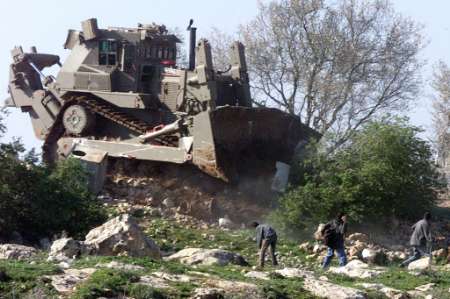
Bil'in, like tens of West Bank villages, is losing vital land and resources to Israel's settlement blocs. In 1991, Israel confiscated 200 acres of our village's land and declared them state land. In 2001 private Israeli developers began building a new Jewish settlement there, as part of the Modi'in Illit settlement bloc.

In 2005 Israel's apartheid wall separated Bil'in from 50 percent of our agricultural land. In response, we held over 100 nonviolent protests together with Israeli and international supporters. Hundreds of us were injured and arrested. After our protests and a legal appeal, Israel's high court ruled last month that the wall's route in Bil'in must be changed to return about half of our land that was taken.

Though we celebrated this success, Israel, with US backing, still plans to annex the Modi'in Illit settlement bloc which includes more of our land. Unlike the settlements initiated by the settler movements, the settlement blocs were built in strategic areas by the Israeli government under the Likud, Labor, and Kadima parties. The settlement blocs are designed to ensure Israeli control of our movement, borders, access to water and of Jerusalem, even following the creation of a "sovereign" Palestinian state.

Some Israeli politicians claim that the settlement blocs that Israel intends to annex comprise five percent of the West Bank. However, these politicians do not include the settlements in occupied East Jerusalem in their calculations because occupied East Jerusalem was unilaterally and illegally annexed by Israel in 1967.

But in reality, Israel has already de facto annexed the strategic 10.2 percent of the West Bank that lies between the Green Line and the apartheid wall, including the settlement blocs. About 80 percent of all Israeli settlers now reside west of the apartheid wall and inside the West Bank.

As Palestinians, we have expressed our willingness to live together on this land with the Jewish people, and to live in one democratic state with Jewish Israelis as equal citizens. However, most Jewish Israelis and their politicians have clearly stated that they must live in a Jewish state, not in a state for all of its citizens. For this reason, we agreed to live in two states -- Palestine side by side with Israel.

For Palestinians, agreeing to live in a state on 22 percent of our historic homeland was a great compromise. But Yasser Arafat was besieged in his office by Israel because he didn't accept Israel's so-called "generous offer" at Camp David. He was punished because he would not surrender yet more land, and accept a state composed of isolated cantons carved up by Israel's settlement blocs.

We take strength from our faith that no situation of injustice can continue forever. In the end we will all have to live on this land as equals. When that time finally comes we will discover that we are more similar than different. Until then, we will not accept shiny trinkets made of words like "state" and "sovereignty" when we know that within our "state" we will not be able to access our water, exit and enter freely, or move from one place to another without Israeli permission. I will not be free so long as Israel's settlement blocs and wall steal and carve up my land and surround my capital, Jerusalem.

We have suffered too much for too long. We will not accept apartheid masked as peace. We will settle for no less than our freedom.

Mohammed Khatib is a leading member of Bil'in's Popular Committee Against the Wall and the secretary of Bil'in's Village Council. For more information see http://www.apartheidmasked.org/.