Visualizzazione post con etichetta Electronic Intifada. Mostra tutti i post

venerdì 14 settembre 2007

Defend the Palestinian cause against its most unreasonable supporters

Hussein Ibish, The Daily Star, 14/09/07. In the United States a small but vocal group of left-wing commentators has reacted by defending Hamas and heaping vitriol on Fatah. However well-intentioned, their rhetoric, or more significantly what it advocates, might significantly undermine efforts to help to end the occupation. Such support for the Muslim far right is symptomatic of a broad trend in Arab leftist circles. Some in the Arab left have, in effect, abandoned many of the left's traditional values, including class analysis and a materialist program for social change, secularism and iconoclasm, feminism and the cause of women's rights, and internationalism. What remains intact is Arab nationalism, suspicion of the West, and hatred of Israel. There are still many honorable pockets of bona fide leftist thinking in the Arab world. However, some Arab leftists now find themselves reading politics mainly through the lens of ethnic nationalism, an orientation now dominated by Islamist organizations. Thus, Islamist groups can seem appealing to those on the left. What gets lost or ignored in the process is the far right's reactionary, repressive and theocratic agenda.

In the United States, the most strident of these voices are Columbia University professor Joseph Massad, Asaad AbuKhalil of California State University, Stanislaus, and Ali Abunimah and others writing on the Electronic Intifada Web site.

Massad has drawn an extended analogy comparing Hamas to the deposed and murdered Chilean leftist President Salvador Allende, and Fatah to the fascist dictator Augusto Pinochet. When someone on the left starts looking at Khaled Meshaal and seeing Salvador Allende, their moral and political compass may be so badly broken that there is little hope for them to ever find their way back. Similarly, Abunimah has repeatedly compared Fatah and the Palestine Liberation Organization to the Nicaraguan Contras, arguing: "These are Palestinian Contras."

Rather than seeing the obvious shortcomings on both sides, these writers insist that the fault line is between a gang of traitors on the one hand and the defenders of Palestine on the other.

Massad has passionately defended Hamas' extremely violent takeover of the Gaza Strip, for example, claiming that Fatah had "pushed it into a corner in the hope of slaughtering all its leadership in Gaza" and that, therefore, Hamas "could not but defend itself against their final onslaught." In May 2006, AbuKhalil urged Hamas to "to pre-empt their enemies if they want to rule," anticipating the bloody scenes in Gaza over a year later. And Abunimah has gone so far as to accuse Fatah of waging a "war against the Palestinian people."

Massad takes every opportunity to suggest that Hamas and democracy are organically linked, declaring that "the supporters of Hamas, whether believers or atheists or secularists or Islamists, are the supporters of the real Palestinian democracy because Hamas' struggle is a struggle against dictatorial traitors (under the legal definition of treason)." However, when it was obvious that Mahmoud Abbas was about to be elected Palestinian president in January 2005, Abunimah's Web site published several articles questioning the possibility of democracy under occupation and arguing that "the elections are a liability for the Palestinians."

Electronic Intifada then published "The False Promise of Western Democracy," which claimed that the election of Abbas "added to a growing worldwide skepticism about Western notions of democracy (i.e. institutionalized suffrage, parliamentary procedures, etc.)." The article affirmed that "the value of Western democracy is questionable for the Palestinian people" and condemned the international community for "an invasive imposition of democratic practices" on the Palestinians.

There were no articles to this effect following the Hamas parliamentary victory.

The rationalization many of these commentators offer to explain Palestinian support for Fatah and opposition to Hamas is that it is the fruit of willful wickedness and greed. Singled out for special condemnation has been the beloved Palestinian poet Mahmoud Darwish, who Massad frankly accuses of being an intellectual prostitute: "Perhaps Mahmoud Darwish's recent poem in support of the coup published on the front page of the Saudi newspaper Al-Hayat, can be explained by the monthly checks he receives from the Fatah-controlled Palestinian Authority, and he is not alone."

AbuKhalil claims that Darwish supports Fatah only because the "Oslo regime gave him a nice house in Ramallah." He added that, "I expect [Darwish] to declare [Israeli Prime Minister Ehud] Olmert the 'knight of Zionism' any day now," and that Darwish's recent poetry reading in Haifa was properly translated as: "I want Nobel. Please give me Nobel. I really want Nobel. Please give it to me NOW. If you give me Nobel, I will keep repeating that Arabs are in love with Israeli nuclear weapons."

These hyperbolic and hyper-personalized attacks on Darwish typify the approach to Palestinian politics that has been developed by some leftist and secular defenders of Hamas. These accusations can border on incitement to violence. What is to be done to those condemned, as Massad put it, "under the legal definition of treason?"

Those presently inclined to be sympathetic to Hamas need to step back and ask themselves: Are we really laboring to support the creation of another theocracy in the Middle East? Would we want to live in such a society? Is that what liberation looks like?

An approach that simply condemns Israel and the US, now lamentably extended to include, and even focus on, other Palestinians and Arabs, is trapped in the limitations of its own negativity. By offering nothing of positive value, this method functions as a terribly weak argument for ending the occupation. Any successful approach to pro-Palestinian advocacy in the United States should therefore emphasize the benefits to the United States, and indeed to Israel, of freedom for the Palestinian people. The Palestinians cannot achieve their aims without international backing that applies pressure on Israel and that provides the context and support that a workable agreement and a fledgling state would obviously require. This is why Hamas' policies that reject international law outright are so damaging to the Palestinian cause.

Therefore, building international support to end the occupation must be the principal aim above all in the US. The single greatest tool for this that Palestinian- and Arab-Americans have is their citizenship. Their primary task is to engage the political system nationally and the policy conversation as it is taking place in Washington. A politically receivable message is urgently required. This could emphasize the benefits to American policy goals in the region generally, reducing the appeal of anti-American extremism in the region, enhancing the US role as a responsible world leader, the promotion of American values such as independence and citizenship, and economic benefits to the region and to the US.

Palestinian-Americans have to recognize that their traditional approaches have failed and see the poverty and pointlessness of a purely negative agenda of condemnation without positive content. The keys to success are to take much better advantage of our status as Americans, develop new and effective forms of advocacy, and forge the alliances that can actually achieve results.

Hussein Ibish is a senior fellow at the American Task Force on Palestine (ATFP) in Washington. He wrote this commentary, of which a much longer version can be accessed on the ATFP Web site (www.ATFP.net), for THE DAILY STAR.

full text

giovedì 13 settembre 2007

Abbas' Village League

Arjan El Fassed, The Electronic Intifada, 10/09/07. For as long Palestinians have resisted violent Israeli policies against them, successive Israeli governments have tried to undermine Palestinian unity and foment divisions. A principal strategy has been to try to foster alternative leaders willing to abandon fundamental Palestinian demands for justice and focus on an agenda with which Israel is comfortable. This is taking place now as Israel shuns the elected Hamas movement, and tries to prop up the discredited Fatah leadership headed by Mahmoud Abbas. Following the elections, Israel kidnapped dozens of elected officials belonging to Hamas and is still holding them in its prisons.

There is a great deal of continuity here; a key component of Israeli policy has been to refuse to recognize legitimate Palestinian leadership. While it now embraces the Palestine Liberation Organization (PLO) and shuns Hamas, until 1993 Israel refused to consider the PLO as a possible negotiating partner. Israel could always produce internationally acceptable reasons for such a position. After all, one would not expect a "respectable" country to negotiate with "terrorists," as Israel always did and still does refer to Palestinian leaders. Even after the PLO's historic concessions in 1988 when the Palestinian National Council, the parliament-in-exile, accepted the two-state solution -- without receiving any reciprocal recognition from Israel -- Israel refused to deal with the PLO directly. The policy goes back even further.

In 1976, in an attempt to forge an alternative leadership to the PLO, Israel allowed elections to be held for municipalities in the occupied West Bank. Contrary to Israel's hopes and expectations, PLO-aligned mayors and councillors swept the board. They called for a complete end to the occupation and opposed talks on Palestinian "autonomy" between Israel and Egypt at Camp David. In 1978 the leaders of this new movement formed the National Guidance Committee, which comprised a wide spectrum of Palestinian national political orientations and included elected mayors (like Bassam Shaka'a and Karim Khalaf who were maimed when Gush Emunim settlers aided by the Israeli military planted bombs in their cars in 1980) and representatives of trade unions, societies and associations.

Just as it has done with Hamas leaders more recently, Israel dismissed the PLO mayors, expelling many of them into exile. In 1980 the mayors of Hebron and Halhoul were deported and the mayors of Nablus and Ramallah were severely maimed by car bombs planted by Israeli death squads. In March 1982, Israel occupation authorities dismissed all elected Palestinian mayors and city councils.

In the early 1990s, Israel was pressured by Washington to negotiate directly with the Palestinians, though it still refused to talk to the PLO. Instead, the negotiations that started in Madrid and continued in Washington, were conducted with respected independent personalities such as Haidar Abdel Shafi -- with the backing of the PLO. It quickly became clear, to Israel's frustration, that these negotiators would stick to basic Palestinian principles and not sell out Palestinian rights. Simultaneously, Israel began a secret back channel with the PLO leadership that had been weakened and bankrupted because its embrace of Saddam Hussein following his invasion of Kuwait. Those talks led to the disastrous Oslo Accords that transformed the PLO into a security subcontractor in the still-occupied West Bank and Gaza Strip.

In December 2001, a year into the second intifada, and after the failure of the Camp David summit in July 2000 to impose a bantustan solution on the Palestinians, then-Israeli prime minister Ariel Sharon decided that PLO leader Yasser Arafat had outlived his usefulness to Israel. Sharon declared Arafat "irrelevant" and cut off relations with the Palestinian Authority. So began a slow decline until Arafat died under mysterious circumstances in November 2004. Arafat was replaced by the current Palestinian Authority President Mahmoud Abbas, who had long enjoyed explicit backing from Washington and who was the key Palestinian figure in the secret channel that led to Oslo.

Abbas is now explicitly armed and backed by Israel and the United States and has declared war on the Hamas movement. We can reach back to another precedent to understand his current role. Following the debacle (from Israel's perspective) of the 1976 municipal elections, it set up the Village Leagues in the 1980s. These were bodies staffed by Palestinian collaborators appointed by Israel.

Unlike the National Guidance Committee and many of the officials elected in 1976, the Village Leagues did not struggle against the occupation. While Israel attempted to suppress an authentic Palestinian national movement and uproot the influence of the PLO, the Village Leagues were an attempt to impose an Israeli form of limited autonomy. The Village League of the Hebron district was established in 1979, headed by former Jordanian Cabinet Minister Mustafa Dudin. In 1981, two more leagues were established in Ramallah and Bethlehem districts. Some members of the Village Leagues had criminal histories.

Because of their willingness to collaborate, Village League leaders were given a facilitator role by Israel; money was channeled through them and they received various benefits from the Israeli rulers. Through a series of military orders, the Leagues were authorized by Israel to arrest and detain political activists and establish armed militias, as well as carry out administrative and bureaucratic tasks such as issuing drivers' licenses. Palestinians living in rural areas had to turn to the Village Leagues for everything from work permits to family reunification permits.

Palestinians responded to the forming of the Village Leagues with demonstrations and strikes, coordinated by the National Guidance Committee. After the deportation of the mayors of Hebron and Halhoul and the maiming of the mayors of Nablus and Ramallah, Ariel Sharon (at that time defense minister) outlawed the National Guidance Committee. The elected mayors and the municipal councils were dismissed.

Israel hoped that the Village Leagues would create and empower a "moderate" Palestinian leadership that would then to agree to negotiate with Israel on the subject of "autonomy" -- a code word for limited self-rule under continued Israeli occupation and colonization. The leagues were designed to provide a "moderate" Palestinian leadership that would be prepared to negotiate with Israel on the subject of autonomy for the West Bank. For that same purpose the Palestinian Authority was established and it is for this reason that Abbas is currently allowed to talk with Israel's Prime Minister Ehud Olmert.

There is a disturbing parallel with current Israeli policy: just as Israel now uses the Abbas-dominated militias of the Palestinian Authority to crack down on those who resist the occupation, Israel attempted to do the same with the Village Leagues. Members of the Village Leagues had little hesitation when it came to the use of force: they manned roadblocks, carried out checks on identity cards and broke up meetings and demonstrations against the occupation.

It is not known how many members the Leagues had and how much support it received. What is known is that Village League leaders were widely viewed as corrupt, dishonest and having accepted an Israeli definition of the problem. The aims of the Leagues were, in the words of the Hebron district Village League leader Mohammad Nasser: "to improve relations with Israel, to prevent terrorism, to combat communism and to work for the establishment of peace and democracy."

If one replaces the words "communism" with "Islamic extremism" then one has a description that matches almost exactly the stated goals of the Abbas leadership even as it cracks down on civil liberties, gerrymanders election laws, and shuts down over one hundred civil society organizations.

Yet despite Israeli efforts to invigorate the Leagues with massive support, by 1983 they had begun to disintegrate, unable to operate in the face of public resistance. Many Palestinians already consider the players in Abbas' regime as little more than criminals and collaborators. It is only a matter of time before today's Village League, headquartered in Ramallah, headed by Abbas and his unelected prime minister Salam Fayyad, and armed and funded by Israel, the European Union and the United States, is also disbanded by the people.

Arjan El Fassed is cofounder of The Electronic Intifada.

lunedì 3 settembre 2007

Heritage uprooted

Sonja Karkar, The Electronic Intifada, 03/09/07. 07Universally regarded as the symbol of peace, the olive tree has become the object of violence. For more than forty years, Israel has uprooted over one million olive trees [The number of olive trees planted in Palestine today 06, November, 2004 exceeds 12 million] and hundreds of thousands of fruit trees in Palestine with terrible economic and ecological consequences for the Palestinian people. Their willful destruction has so threatened Palestinian culture, heritage and identity that the olive tree has now become the symbol of Palestinian steadfastness because of its own rootedness and ability to survive in a land where water is perennially scarce.

Throughout the centuries, Palestinians farmers have made their living from olive cultivation and olive oil production; 80 percent of cultivated land in the West Bank and Gaza is planted with olive trees. [1] In the West Bank alone, some 100,000 families are dependent on olive sales. [2] Today, the olive harvest provides Palestinian farmers with anywhere between 25 to 50 percent of their annual income, and as the economic crisis deepens, the harvest provides for many their basic means of survival. [3] But despite the hardships, it is the festivities and traditions that accompany the weeks of harvesting that have held Palestinian communities together and are, in fact, a demonstration of their ownership of the land that no occupation can extinguish except by the annihilation of Palestinian society itself.

And that is precisely what Israel has been doing -- through brute force and far more insidious ways. Under an old law from the Ottoman era, Israel claims as state property, land that has been "abandoned" and left uncultivated for a period of four years and this land is then usually allocated to Israeli settlers. Of course, the land has not been voluntarily abandoned. Because of Israel's closure policy, which imposes the most draconian restrictions on movement, Palestinian farmers cannot reach their agricultural lands to tend and harvest their crops. Not only are permits required to move about in their own homeland, but farmers are forced to use alternative routes which must be negotiated on foot or by donkey because about 70 percent of these alternative routes -- those connected to main or bypass roads -- have been closed by the Israeli army with concrete blocks and ditches. And now a wall is being built for "security reasons" which will permanently separate Palestinian families from their farmlands, except for the gates that allow access at certain times, but more often than not, at the whim of Israeli soldiers who may not even turn up to open them. [4] This makes year-round maintenance of farmers' crops extremely difficult if not impossible. Hence, the "abandonment" of land that Israel uses to justify its land theft.

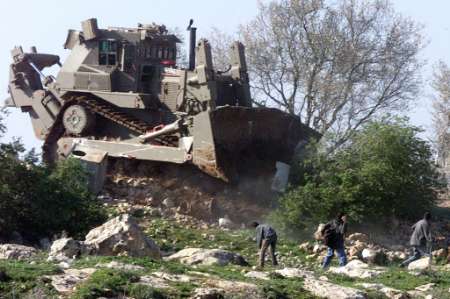
Since 1967, the Israeli military and illegal settlers have destroyed more than one million olive trees claiming that stone throwers and gunmen hide behind them to attack the settlers. [5] This is a specious argument because these trees grow deep inside Palestinian territory where no Israeli settler or soldier should be in any case. But, Israel is intent on appropriating even the last vestiges of land left to the Palestinians and so turns a blind eye to any methods used by settlers and soldiers alike to terrorize the farmers away from their farms and crops, even if that means razing their land. Farmers are constantly under threat of being beaten and shot at, having their water supplies contaminated (already scarce because 85 percent of renewable water resources go to the settlers and Israel), their olive groves torched and their olive trees uprooted. [6]

On a larger scale, the Israeli military brings in the bulldozers to uproot trees in the way of the "security" wall's route and where they impede the development of infrastructure necessary to service the illegal settlements. Some of these threatened trees are 700 to 1,000 years old and are still producing olives. [7] These precious trees are being replaced by roads, sewerage, electricity, running water and telecommunications networks, Israeli military barracks, training areas, industrial estates and factories leading to massive despoliation of the environment. If Israel has its way, neither the trees nor the Palestinians who have cared for them will survive the barbaric ethnic and environmental cleansing of Palestine.

The irony of it all is that Israel's uprooting of olive trees is contrary to the Jewish halakhic principle whose origin is found in the Torah: "Even if you are at war with a city ... you must not destroy its trees" (Deut 20:19). Under the pretext of "redeeming" the land the Jews claim God gave them and the trees they are supposed to preserve, Israel continues to violently expropriate Palestinian land. With each uprooted tree, another slab of concrete is put in place for the wall and the illegal Jewish settlements -- the landscape sculpted and changed beyond all recognition and no longer the sacrosanct place that has long given Israel its spurious Biblical justification for dispossessing the Palestinians of the land they have nurtured since time immemorial.

The agonizing pain of loss felt by Palestinians for their ravaged land is not expressed in the statistics. Only those who have suffered the same cruel violations or those who seek to protect and preserve the delicate balance of the world's environment can understand what it means for people off the land. International law, although on their side, remains ineffective as no world government, not even the United Nations, is prepared to pressure Israel to stop its illegal collective punishment of the entire Palestinian population. Today, there are campaigns all around the world to end the uprooting of trees in Palestine and to replant those which have already been uprooted. And each year, when the Palestinian olive harvest approaches, international volunteers join Palestinians to provide some human protection from the acts of violence visited on Palestinian farmers by Israeli settlers and soldiers who want to stop the harvesting of crops. These wonderful acts of solidarity help to heal the land, but they cannot heal the pain of those who have to watch the uprooting of age-old olive trees, the desecration of their land and their millennia-old heritage. Such heartbreaking reality has led the Palestinian poet, Mahmoud Darwish, to say, "If the olive trees knew the hands that planted them, their oil would have become tears ..."

Sonja Karkar is the founder and president of Women in Palestine in Melbourne, Australia.


Endnotes
[1] UN Office for the Coordination of Humanitarian Affiars, "The Olive Harvest in the West Bank and Gaza," October 2006.
[2] Applied Research Institute of Jerusalem (ARIJ), "Olive Harvest in Palestine. Another Season, Another Anguish," November 2004.
[3] Canaan Fair Trade, www.olivecoop.com/Canaan.html.
[4] OXFAM, "Forgotten Villages: Struggling to survive under closure in the West Bank," September 2002, p. 21.
[5] ARIJ, "Olive Harvest in Palestine. Another Season, Another Anguish," November 2004.
[6] UN Report of the Special Committee to investigate Israeli Practices affecting the Human Rights of the Palestinian People and other Arabs of the Occupied Territories, No. 40, September 2005.
[7] Atyaf Alwazir, "Uprooting Olive trees in Palestine," Inventory of Conflict and Environment (ICE), Case Number: 110, American University, November 2002.

giovedì 30 agosto 2007

What do Palestinians really think?

Salam Fayyad, the newly appointed Prime Minister of the "emergency government" signs an agreement with Condoleezza Rice granting 80 million dollars to the Palestinian Authority during her visit to Ramallah, 2 August 2007. (Omar Rashidi/POOL/MaanImages)

Ali Abunimah, The Electronic Intifada, 27/08/07. "Palestinian poll finds support for Fatah government over Hamas." That headline from the International Herald Tribune, one of many similar ones last week, must have warmed the hearts of supporters of the illegal, unelected and Israeli-backed Ramallah "government" of Salam Fayyad. Last June Palestinian Authority President Mahmoud Abbas dismissed Prime Minister Ismail Haniyeh of Hamas and the national unity government he headed, and appointed Fayyad without the legally required endorsement of the Palestinian legislative council. This followed Hamas' rout of the US and Israeli-backed militias of Fatah warlord Mohammed Dahlan in the Gaza Strip. Yet there are good reasons to believe that this poll, like all previous polls taken by JMCC and other organizations, overestimates support for Fatah and understates support for Hamas by a wide margin. (Recall that all the polls erroneously predicted a comfortable win for Fatah in the January 2006 legislative election, and the 2005 municipal elections). At the same time, Abbas and Fayyad are receiving hundreds of millions of dollars from their foreign patrons. Not really a fair comparison. But given their advantages Abbas and Fayyad are doing remarkably poorly even as measured by the poll.

Does this poll vindicate the US and Israeli strategy of funding and arming Palestinian collaborator leaders in Ramallah, and Abbas' strategy of embracing Israel, cracking down on the resistance, colluding in a cruel siege on his people in Gaza, and refusing all dialogue with Hamas? A closer look at the poll results as well as the context suggests the opposite.

The poll's publisher, the Jerusalem Media and Communications Centre (JMCC), trumpeted that a "majority" of Palestinians "said the performance of Fayyad's government is better" than that of the democratically-elected government of Haniyeh who is still the de facto prime minister despite Abbas' dismissal order.

In fact the results claim 46.5 percent preferring Fayyad's performance (a plurality not a majority) as against 24.4 percent preferring Haniyeh's performance since the events in June. (See JMCC poll number 62, August 2007 [www.jmcc.org/new/07/aug/poll.htm])

Still, if true, that would be an impressive achievement for Abbas and Fayyad. The poll also states that were new legislative elections held, 38 percent would vote for Fatah, while just 24 percent would vote for Hamas -- with Fatah retaining a lead in both the West Bank and Gaza.

Yet there are good reasons to believe that this poll, like all previous polls taken by JMCC and other organizations, overestimates support for Fatah and understates support for Hamas by a wide margin. (Recall that all the polls erroneously predicted a comfortable win for Fatah in the January 2006 legislative election, and the 2005 municipal elections).

According to its methodology, this poll included face-to-face interviews with 1,199 Palestinians in randomly selected households throughout the West Bank and Gaza. Let us suppose that is the case.

Abbas has effectively declared Hamas illegal and his Israeli-backed security forces are working alongside Israeli occupation troops to carry out mass arrests of its supporters. Israel continues to carry out mass kidnappings and extrajudicial executions of Hamas members and other Palestinian resistance activists, aided by an extensive network of collaborators working inside and outside Palestinian official institutions, and some non-governmental organizations. Under such circumstances it is not surprising that true support for Hamas (as measured by secret ballots in elections) has always been much higher than that to which people are willing to admit in face-to-face interviews with strangers whose affiliations they cannot easily assess.

Second, when Palestinians are being asked to evaluate "performance" it is not clear what they are being asked to assess. Does the question take into account the fact that the democratically-elected Hamas government was barely able to function from the time it took office in March 2006 due to the kidnapping of half its cabinet by Israel, the US-EU-Israeli siege which deprived it of its rightful revenues even to pay salaries, sabotage by Dahlan's gangs, and since June the total blockade of Gaza that has virtually shut down its economy? (The latest ploy was the apparent collusion by Israel, the European Union and Abbas advisors to cut off Gaza's electricity on the basis of accusations, denied by a Gaza electricity company official, that Hamas was siphoning off revenues).

At the same time, Abbas and Fayyad are receiving hundreds of millions of dollars from their foreign patrons. Not really a fair comparison. But given their advantages Abbas and Fayyad are doing remarkably poorly even as measured by the poll.

While 44 percent of Gaza residents polled said their own security situation has improved since Hamas took over (and 31 percent said it had gotten worse), only 17 percent of West Bank residents polled say their security situation has improved living under Abbas and Fayyad, while 36.5 percent said it had deteriorated.

More than half of those polled were "dissatisfied" with Abbas' performance, while just a fifth were "very satisfied."

Overall, 26 percent of Palestinians under occupation said the Fayyad government should be "canceled" and the national unity government (which had been headed by Haniyeh) restored to office (21 percent in the West Bank and 34 percent in Gaza). Only 17 percent thought the Haniyeh government should be "canceled" so that Fayyad could rule over the West Bank and Gaza (18 percent in the West Bank, 16 percent in Gaza). Read another way this suggests that just 17 percent of Palestinians under occupation view the Fayyad government as being the legitimate authority.

A majority of Palestinians wanted to see a return to dialogue and national unity -- a rejection of Abbas' intransigent refusal to talk to Hamas.

Asked which leaders they trust most, Abbas came highest with 18 percent (17 percent in the West Bank, 20 percent in Gaza). Haniyeh came a close second at 16 percent (11 percent in West Bank, 25 percent in Gaza). Salam Fayyad came in fifth at just 3.5 percent, scoring the same in both territories. Almost a third of Palestinians said they didn't trust anyone.

Asked who they would vote for in a presidential election, those polled gave statistically equal support to both Abbas and Haniyeh (21 percent and 19 percent), while Fayyad got five percent.

If the poll shows weak support for Abbas and Fayyad (and great disaffection with all political factions), it shows outright rejection of Abbas' capitulationist approach to peace negotiations with Israel. Canceling the right of return, allowing Israeli settlements to stay, and giving up most of Jerusalem in exchange for a Palestinian statelet on a fraction of the West Bank are reportedly at the heart of the "agreement of principles" that Abbas is negotiating with Israeli Prime Minister Ehud Olmert.

Almost 70 percent of Palestinians under occupation, according to the poll, adhere to the right of "return of all refugees to their original land." Another 12 percent envisage the return of only some refugees to their original lands. Just seven percent of those polled agreed with the position that no refugees should return home at all.

Eighty-two percent opposed allowing Israel to retain control of "major settlement blocs inside the West Bank in exchange for equal Israeli land," and 94 percent rejected "keeping Israel's authority in the area of Al-Aqsa mosque" in Jerusalem.

Peace process industry propagandists routinely claim that a two-state solution is overwhelmingly supported by the vast majority of Palestinians. This has never been true (millions of Palestinian refugees and exiles outside the country have never been included in elections, and are not regularly polled). This poll indicates that among Palestinians under occupation, support for a two-state solution is at just 51 percent (49 percent in the West Bank and 54 percent in Gaza). At the same time support for "a binational state in all of Palestine where Palestinians and Israeli [sic] enjoy equal representation and rights" is now supported by 30 percent (roughly similar in both territories).

Support for a two-state solution remains remarkably anemic, given the massive efforts invested in promoting it, while support for a one-state solution is impressively high and continues to creep upwards despite the fact that no major political faction or leader has openly endorsed it and so much effort is invested in discrediting it.

There are legitimate concerns about the methodology of the JMCC poll, the phrasing of questions and the context. At least one blogger cast doubt on it because the pollster, Ghassan Khatib, has served numerous times as a minister in the Fatah-led Palestinian Authority. [palestinianpundit.blogspot.com/2007/08/fabricating-palestinian-public-opinion.html]

Nevertheless, whatever doubts there are, this poll merely confirms that Palestinians under occupation remain united on the fundamentals of their cause. Despite the conspiracy they face to starve and brutalize them into giving up their rights, the Palestinian people are steadfast in defending them.

Ali Abunimah is co-founder of The Electronic Intifada and author of One Country: A Bold Proposal to End the Israeli-Palestinian Impasse.