giovedì 6 dicembre 2007

ISRAEL-OPT: Only 41 percent of Gaza's food import needs being met

JERUSALEM, 6 December 2007 (IRIN) - Food imports into the Gaza Strip are only enough to meet 41 percent of demand, the World Food Programme (WFP) has said, though critical UN humanitarian food supplies are being allowed in. The cost of many basic items, such as beef, wheat and some dairy products have increased significantly, while locally grown produce is fetching extremely low prices on the local market, as exports are banned, threatening the livelihood of farmers. "Unless all terminals are fully opened within the upcoming weeks, both for exports and imports, the agricultural sector in Gaza is facing a major catastrophe," said Santiago Rippoll, a FAO food security analyst. Since the Hamas takeover of Gaza in June, the commercial crossing points with Israel have been all but shut, except for the import of basic humanitarian goods. Israel said it could not operate the crossings with Hamas, which it deems a terrorist organisation, controlling the other side. Israel is imposing the restrictions in retaliation for the continued firing of missiles from Gaza into Israel. A spokesman for the Israeli Prime Minister's Office said there "cannot be business as usual" with the Gaza Strip as long as rocket attacks against southern Israel continue. "Israel is committed to the continued supply of the essential humanitarian support to the people of Gaza," said spokesman Mark Regev, who added that it was up to the ruling Hamas movement to stop the rockets. Rise in requests for charity Israeli travel and trade restrictions have led to a decline in purchasing power in Gaza. A recent WFP survey found that of the 62 percent of people who said they had reduced their expenditure in recent months, 97 percent reported a decrease in spending on clothing and 93 percent on food. "The number of people in need is increasing and the percentage of people we can help is low," said Nasser al-Sharqawi, from al-Falah, a local Islamic charity. Half of all non-refugees in Gaza receive WFP food aid, while UNRWA, the UN Palestinian refugee agency, helps over 80 percent of refugees. About 70 percent of Gaza's population are refugees from the 1948 Israeli-Arab war. Naheda Ghabaien, a mother of five in the Beach refugee camp in central Gaza, said her husband Yousef used to work three or four days a week bringing home about US$10 a day. Now, like tens of thousands of Gazans who have lost their jobs since June - when Hamas seized control and tight travel and trade restrictions were imposed on the territory - Yousef only works a few days a month. Every three months, Naheda said, the family receives from UNRWA amounts of rice, flour, oil and sugar that can last for four to six weeks. The family rarely eats meat anymore, relying mostly on vegetables. "When the agency food runs out, we buy the food we need on credit from the grocer. When my husband works, most of his daily earnings go to settling the debt," she told IRIN. Aid workers say these sorts of coping mechanisms are reaching their limits as the economy in Gaza continues its downward spiral. Agriculture hit The UN Food and Agriculture Organisation (FAO) has said farmers have so far lost $4.5 million due to the squeeze on imports and exports since June 2007. However, the main season for exporting cash crops began in November, and the Palestinian Ministry of Agriculture has estimated that farmers will lose another $50 million this season, if they cannot export to Israel and other foreign markets. According to the Palestinian Agricultural Relief Committees, about 25 percent of Gazans rely directly or indirectly on agriculture for their income. Farmers who used to export can only earn a fraction of their profits on the local market, which is now over-saturated, according to FAO. For example, last year strawberries were sold at $6 per kilogram, while now the price has dropped to 40 cents on the local market. Potatoes dropped from about $2.5 per kilo on the export market to only about 12 cents locally, according to aid workers and residents. "The potato business has been killed and the strawberry business is in the emergency room," said farmers recently in the northern Gaza town of Beit Lahiya. The significant drop in profit means some are working at a loss and many question if they will be able to replant next year. Israel recently allowed out several trucks of strawberries and carnations, but locals say this will hardly be enough. In addition, many goods, such as fertilizers and pesticides, are not making it into Gaza or in such small numbers that their cost is beyond the reach of most farmers. "Unless all terminals are fully opened within the upcoming weeks, both for exports and imports, the agricultural sector in Gaza is facing a major catastrophe," said Santiago Rippoll, a FAO food security analyst.

© IRIN. All rights reserved. More humanitarian news and analysis: http://www.irinnews.org

This item comes to you via IRIN, the humanitarian news and analysis service of the UN Office for the Coordination of Humanitarian Affairs.

Israeli Occupation Forces (IOF) Escalate Attacks against Palestinian Civilians and Property in the Occupied Palestinian Territory (OPT)


Fuel stations in the Gaza Strip are closed due to the lack of fuels caused by the total siege imposed on the Strip.

29.11-05.12.07 PCHR Weekly Report on Israeli Human Rights Violations in The OPT
  • 20 Palestinians, including one civilian, were killed by IOF in the Gaza Strip and the West Bank.

  • 18 of the victims are members of the military wing of Hamas and were killed by missiles and tanks shells.

  • 22 Palestinians, including a woman, were wounded by IOF in the West Bank and the Gaza Strip.

  • IOF conducted 19 incursions into Palestinian communities in the West Bank and 2 ones into the Gaza Strip.

  • IOF arrested 56 Palestinian civilians, including a child, in the West Bank and 3 others in the Gaza Strip.

  • IOF have continued to impose a total siege on the OPT.

  • IOF have isolated the Gaza Strip from the outside world and a humanitarian crisis has emerged.

  • The number of patients who died due to the denial of their access to medical treatment increased to 13.

  • The Gaza Strip is suffering a serious shortage of fuels.

  • IOF troops positioned at checkpoints in the West Bank arrested 2 Palestinian civilians, including 2 children.

  • IOF have continued to construct the Annexation Wall in the West Bank.

  • 4 Palestinian civilians were wounded IOF used force to disperse a peaceful demonstration organized in protest to the construction of the Wall.

  • IOF have continued settlement activities in the West Bank and Israeli settlers have continued to attacks Palestinian civilians and property.


Summary

Israeli violations of international law and humanitarian law continued in the OPT during the reporting period (29 November – 5 December 2007):

Shooting: During the reporting period, IOF killed 20 Palestinians, including one civilian, and wounded 222 others, including a woman, in the Gaza Strip and the West Bank.

In the Gaza Strip, IOF killed 18 members of the ‘Izziddin al-Qassam Brigades (the military wing of Hamas) and 17 others were wounded in 7 separate attacks throughout the Gaza Strip. A Palestinian civilian was also wounded and arrested by IOF that had moved into Wadi al-Salqa village in the central Gaza Strip on 3 December 2007.

In the West Bank, on 2 December 2007, IOF killed a Palestinian civilian near Ramallah, when they deliberately fired at him when he was having a picnic together with 2 of his relatives. On 5 December 2007, an IOF undercover unit shot dead a member of the Palestinian National Security Forces in Bethlehem. On 30 November 2007, 4 Palestinian civilians were wounded when IOF troops used force to disperse a peaceful demonstration organized by Palestinian civilians and international and Israeli human rights defenders in protest to the construction of the Annexation Wall in Bal’ein village, west of Ramallah.

Incursions: During the reporting period, IOF conducted at least 19 military incursions into Palestinian communities in the West Bank. During those incursions, IOF arrested 56 Palestinian civilians, including a child. Thus, the number of Palestinians arrested by IOF in the West Bank since the beginning of this year has mounted to 2,525. During the reporting period, IOF transformed 3 Palestinian houses into military sites.

In the Gaza Strip, IOF conducted 2 incursions into Beit Lahia town in the northern Gaza Strip, and Wadi al-Salqa in the central Gaza Strip. During those incursions, IOF wounded and arrested a Palestinian civilian, and arrested his two sons.

Restrictions on Movement: IOF have continued to impose a tightened siege on the OPT and imposed severe restrictions on the movement of Palestinian civilians in the Gaza Strip and the West Bank, including occupied East Jerusalem.

Gaza Strip

IOF have continued to close all border crossings of the Gaza Strip for nearly 17 months. The total siege imposed by IOF on the Gaza Strip has left disastrous impacts on the humanitarian situation and has violated the economic and social rights of the Palestinian civilian population, particularly the rights to appropriate living conditions, health and education. It has also paralyzed most economic sectors. Furthermore, severe restrictions have been imposed on the movement of the Palestinian civilian population. Moreover, the siege imposed on the Gaza Strip has severely impacted the flow of food, medical supplies and other necessities such as fuel, construction materials and raw materials for various economic sectors. IOF have further tightened the siege imposed on the Gaza Strip since Hamas’ takeover of the Gaza Strip, and the living and economic conditions of Palestinian civilians have further deteriorated. On 19 September 2007, the Israeli government declared the Gaza Strip as “a hostile entity” and accordingly measures of collective punishment against Gaza escalated. Since that time, IOF have limited the goods exported to the Gaza Strip to only 9 basic materials. As a consequence, local markets ran out of many goods, which caused a sharp increase in prices, which mounted to 500% for some goods. Israeli occupation forces have banned the flow of some medicines, furniture, electrical appliances and cigarettes into the Gaza Strip, and have decreased the amounts of some goods allowed into the Gaza Strip, such as fruits, milk and some dairy products. During the reporting period, IOF sharply decreased the amounts of fuels allowed entry into the Gaza Strip (for more details, see PCHR’s press release on 29 November 2007).

West Bank

IOF have continued to impose severe restrictions on the movement of Palestinian civilians to and from Jerusalem. Thousands of Palestinian civilians from the West Bank and the Gaza Strip have been denied access to the city. IOF have established many checkpoints around and inside the city. Restrictions of the movement of Palestinian civilians often escalate on Fridays to prevent them from praying at the al-Aqsa Mosque. IOF often violently beat Palestinian civilians who attempt to bypass checkpoints and enter the city. IOF have also tightened the siege imposed on Palestinian communities in the West Bank. IOF positioned at various checkpoints in the West Bank have continued to impose severe restrictions on the movement of Palestinian civilians. IOF also erected more checkpoints on the main roads and intersections in the West Bank. During the reporting period, IOF troops positioned at checkpoints and border crossings in the West Bank arrested at least 2 Palestinian civilians.

Settlement Activities: IOF have continued settlement activities and Israeli settlers living in the OPT in violation of international humanitarian law have continued to attack Palestinian civilians and property. On 29 November 2007, at least 10 Israeli settlers from “Ma’oun” settlement, south of Hebron, closed the road that links Yatta town with Kherbat Touba areas with rocks and sand. IOF troops were present in the area, but did not intervene to prevent the settlers from closing the road.

Israeli Violations Documented during the Reporting Period (22 – 28 November 2007)

The full report is available online at:

html format:

http://www.pchrgaza.org/files/W_report/English/2007/06-12-2007.htm

pdf format:

http://www.pchrgaza.org/files/W_report/English/2007/pdf/Weekly%20Report%2048.pdf

Public Document

For further information please visit our website (http://www.pchrgaza.org) or contact PCHR’s office in Gaza City, Gaza Strip by email (pchr@pchrgaza.org) or telephone (+972 (0)8 2824776 – 2825893).

PCHR Is Concerned over Measures Taken by Dismissed Government towards Gaza Municipality

06.12.07 PCHR is deeply concerned over the latest measures taken by the dismissed government in Gaza towards the Municipality of Gaza, and stresses that such measures, which contributes to further deterioration to the persistent inherited crisis of the municipality, like other municipalities that are managed by councils appointed by the Palestinian National Authority (PNA).


1) PCHR stresses that these latest measures are part of the political conflict between Fatah and Hamas movements, which has impacted the executive, the judiciary and the legislature.

2) PCHR rejects the intervention of the dismissed government in Gaza into the affairs of the Municipality of Gaza, emphasizing that such intervention does not solve the municipality’s persistent problems, rather it devastates them.

3) PCHR fully realizes the problems endured by the Municipality of Gaza, the largest city in the Occupied Palestinian Territory, especially the problem of salaries, which caused strikes that disrupted basic services provided by the municipality.

4) PCHR believes that the absence of democratic practice and the appointment of committees by the PNA to manage municipalities constituted a prelude for mismanagement and the absence of transparency, which reinforced affiliation to governmental bodies rather than maintaining the independence of professionalism of municipalities.

5) The persistent crisis of municipalities can only be resolved through democracy and free and fair elections. In this context, PCHR recalls that a number of major municipalities in the West Bank and the Gaza Strip, including the Municipality of Gaza, are managed by councils appointed by the PNA although elections were held for the majority of municipalities in the period December 2004 – December 2005.

6) Although PCHR believes that elections are the sole solution, it realizes the obstacles that obstruct holding such elections, including the lack of political will and compromise of the parties of the crisis.

Public Document

**************************************

For more information please call PCHR office in Gaza, Gaza Strip, on +972 8 2824776 - 2825893

PCHR, 29 Omer El Mukhtar St., El Remal, PO Box 1328 Gaza, Gaza Strip. E-mail: pchr@pchrgaza.org, Webpage http://www.pchrgaza.org

ISRAEL-OPT: From bad to worse in OPT Fewer resources for a worsening situation - UNRWA


Photo: Shabtai Gold/IRIN
A UNRWA aid worker in a warehouse. UNRWA says over 80,000 civilians in Gaza have lost their jobs in recent months and therefore rely on humanitarian aid
Israeli policies and lack of funds inhibit UN agency for Palestinian refugees
NEW YORK, 6 December 2007 (IRIN) - The UN agency supplying basic services for Palestinian refugees is in a funding crisis, and is facing a difficult year as the political situation continues to hamper its work in the Gaza Strip and West Bank.

Despite initial pledges towards the 2008 budget from 22 donors at a meeting in New York on 4 December, some US$1.21 billion is still required.

Filippo Grandi, the deputy commissioner general of the UN Palestinian refugee agency (UNRWA) - which provides education, health, relief and social services for some 4.5 million Palestinian refugees - said the refugees must not be forgotten.

“It’s a bad situation which becomes worse, and for which we seem to get less resources rather than more resources, to address,” said Grandi. In Gaza, this means that UNRWA is unable to provide a single high nutrient biscuit to 200,000 children in schools.

In a statement to the conference on 4 December, Grandi said UNRWA’s general budget was 20 percent under funded while its emergency funds were only half of what was required, with US$133 million committed towards a US$246 million budget.
More on OPT
Palestinian police boost security in Nablus
Inside the maze: movement restrictions in the West Bank
Proposed humanitarian terminals in West Bank could triple aid costs - UNRWA
Self-help Gazans still need outside world
Interview with Karen AbuZayd, Commissioner General of UNRWA

The agency said its work and the condition of the refugees had also been made harder by the broader political strife. Grandi said Israeli actions had hampered UNRWA’s work in the area and stifled economic activity.

“We understand the security situation very well and it is the right of Israel to implement measures to address these concerns, but we think if these measures become so operationally cumbersome and difficult to implement, it will be a problem for us to sustain the operation financially and to move around.”

UN criticises Israeli policy

Grandi also warned that Israeli policy, which includes economic sanctions, the closure of borders in Gaza and the checkpoints across the West Bank was counterproductive.

He asked that Israelis be mindful of the rights of the people and of the welfare of those who have no intention of committing any violence against the Israelis, because if these people are blocked from moving, from accessing employment, from earning a livelihood then their intentions may become really more aggressive than they would otherwise be, he said. “So we think that sometimes these measures are counter-productive rather than conducive to increased security.”

The Israeli view

The Israeli Foreign Ministry has said: "The Israeli government works on a daily basis to help UNRWA fulfil its mandate and allows the entrance of humanitarian goods into Gaza. However, one must keep in mind that Gaza is controlled by an enemy entity, a terror group, Hamas, which continues to fire rockets and attacks the crossing points.”

And on Israel’s contribution to UN finances, a recent ministry statement said: “While UNRWA's budget is not directly related to Israel, Israel does contribute to the UN budget, and in this way contributes to UNRWA."

On the humanitarian issue, an unnamed Israeli security official (Israeli policy is not to routinely disclose the names of such officials) said: "While steps are taken for the security of the Israeli population, Israel works to prevent a humanitarian crisis."

Palestinian politics

UNRWA says over 80,000 civilians in Gaza have lost their jobs in recent months and therefore rely on humanitarian aid.

The economic sanctions are seen to be creating poverty and a reliance on help, which would not be necessary if people were allowed the access to get to work and therefore rely on themselves.

The situation has been exacerbated by the internal politics of the Palestinians.


Photo: Shabtai Gold/IRIN
UNRWA says the closure of borders in Gaza and the checkpoints across the West Bank are hampering their efforts to deliver aid
Grandi described the split between the West Bank and Gaza as leading to disillusionment within the Palestinian people.

“There’s a political problem with the rift between Hamas and Fatah which affects people in Gaza, in particular through the intermittent episodes of violence. There are multiple layers of crisis that are worsening; there is a humanitarian crisis but more serious I think, even in Gaza, is an economic and institutional crisis which results in the progressive disillusionment of civil society. This is dangerous: it can lead to radicalisation. It can only play into the hands of those that have a negative agenda. Despair does not push people in the right direction.”

UNRWA was set up in 1948 to provide assistance to Palestinian refugees. It has become the largest operational agency of the UN and provides support to the displaced now living in the West Bank, Gaza Strip, Jordan, Syria and Lebanon.

© IRIN. All rights reserved. More humanitarian news and analysis: http://www.irinnews.org

This item comes to you via IRIN, the humanitarian news and analysis service of the UN Office for the Coordination of Humanitarian Affairs.

Abu Obaida, the English spokesman, answers important Questions about the Brigades

Ezzedeen Al Qassam Brigades, 04.12.07

What is the justification behind the martyrdom operations against the " Israeli" civilians?

There is no justification for targeting civilians. It is against Islam to deliberately kill unarmed civilians during jihad. In addition, our doctrine is to target the enemies army, security services, and support apparatus. But it is known that Zionist society is a militarized society. Service in the army is mandatory; and reserve duty continues past the age of 40. Our determined stance is that unarmed persons on both sides of the conflict should be left out of the fighting. However, we will not accept giving the enemy a free hand against our civilians.

What is the latest news about Shalit?

No news. Shalit is one enemy soldier captured from a combat position (from inside a tank) besieging the Gaza Strip. We have more than 10,000 prisoners, the majority of them taken from their homes in our occupied land.

How much your preparation to defend any aggression on the Gaza Strip? Are you in a dilemma under the siege?

We know that our enemy has support from all over the world. The Zionist army is very well equipped with the most modern weapons that include tanks, aircraft, artillery, and other equipment. But they are an occupying power; and we are an occupied people fighting to defend ourselves. We firmly believe in Allah the Almighty; and we pray for his support in our battle. That is our most important preparation against any future aggression. After that, we are exerting all possible effort to train our fighters and upgrade their capacities and equipment to confront any aggressors and inflict heavy and surprising casualties among their ranks.

The politicians in the Zionist entity have plans to execute more bloody operations against the brigades and Hamas, what can you say about that?

They have been doing that for 20 decades. Nothing new here. They have failed to eliminate us; and their failure, Allah-willing, will continue till we attain all our rights.

What if the Zionist entity executed its threatens and assassinated your leaders, How your response will be look like?

We do not and will not discuss details. But let us compare Hamas before and after the assassinations of Sheikh Yassin, Eng. Abu Shanab, and Dr. Rantisi. We have gained strength from these painful losses; and our organization has become more powerful. We are not a figurehead organization; we are a resistance movement with deep roots in our Palestinian, Arab and Islamic culture. We are only the tip of the iceberg of a nation of hundreds of millions of freedom-loving Muslims.

What is your message to the Zionist entity?

Our message is clear. We will not give up a single right of ours; and we will continue the struggle till our rights are restored. Till then the sword will be the judge between us.

Are Hamas working on developing better Qassam Rockets? I think this is very important.

Hamas is working to develop all its combat abilities. We do not and will not go into details.

Why doesn't Hamas get anti-aircraft weapons to shot down Zionist Helicopters.

No answer.

Why doesn't Hamas make more propaganda videos of Zionist Tanks being destroyed and Soldiers being shot?

We do our best to cover our operations; but we cannot cover every single operation we conduct against the enemy.

how does Hamas use in their bombs?

Our bombs are used against enemy armored vehicles and infantry.

How can we none-Muslims (who support Hamas anyway) make a fond to raise money for the troops of Al Qassam?

We advise giving general support to the victims of the Zionist occupation. There are tens of thousands of people who have lost family members, homes, and jobs as a result of the occupation. Helping them is a very good way of supporting the Palestinian people.

Why do the soldiers of Al-Qassam Brigades wear masks ?? what is the reason behind it ??

Our troops wear masks to conceal their identity. We are operating in an environment where there are more hidden enemies than visible ones. We try to take as many security measures as possible so as not to help the enemy target our troops.

How does one become a Member of Al Qassam In Gaza?

Al-Qassam chooses its members. We do not have an open registration policy.

Why does Hamas stay silent about kouffaar regimes who make their support for Abbas and al-Fatah?

Our struggle is against the Zionist enemy. We are not in a war against non-Muslims or against Muslims who support parties that act against the resistance. However, we make it clear that we will defend our resistance project with all our strength. We will not allow any party to interfere or hinder our resistance action.

How come Ezzedeen al-Qassam don't punish these regimes?

We take actions, covert and visible. However, our main enemy is the Zionist occupation. We will not let this enemy rest by getting involved in other conflicts.

What is the position of Ezzedeen al-Qassam Brigades about these speeches from Doctor al-Dhawahry where he makes attacks on the djehad and says that al-mokawama in palatine has given up on istshahadiya operations?

We do not tell Al-Dhawahry what to do in Afghanistan since we are not aware of his situation. And I'm sure that his knowledge of our circumstances is very limited. His judgments and opinions are his; but they are not correct. More importantly, we are not awaiting approval or blessing from anyone except Allah.

Why does he make all these attacks and this fitnaah?

Al-Dhawahry's impact is only in the media. Otherwise, we are not affected by his comments at all on the ground.

How do you deal with Jaysh al-Islam in al-Falasteen since the release of the Brittaani journalist?

They are treated like any resistance group actively seeking to target the Zionist enemy. But on the internal front, it is very clear for them that they cannot interfere in internal affairs or cause internal problems.

Will Hamas make the most of its weaponry and existing capabilities, by increasing the usefulness of its weapons? This can be done readily by adapting Qassam rockets to carry new warheads like smoke, teargas, anti tank, incendiary and cluster sub-munitions. It can also include the use of thermite warheads on rockets and hand grenades. Thermite will melt any Zionist armored vehicles and structures.

We are doing our best to upgrade our capabilities. However, we stress that our source of strength is Allah the All-Mighty. We will never have equipment comparable to our enemy; but we will have enough to make any aggression a regrettable adventure for the enemy.

Human Rights Organizations Condemn the Takeover of the Gaza Civilian Courts Compound

06.12.07 The undersigned Palestinian human rights organizations condemn in the strongest terms the attack on the civilian court compound in the Gaza Strip, and the break-in by members of the so-called “Higher Justice Council” formed by the dismissed government into the office of the President of the Higher Judicial Council and President of the High Court. These attacks and actions are illegal and contradict the Basic Law of the Palestinian National Authority (PNA). Human rights organizations call upon the dismissed government to immediately rescind the illegal decision to takeover the civilian judicial system in the Gaza Strip. These organizations hold this government fully responsible for undermining and destroying the Judicial Authority in order to establish illegal judicial bodies that are not independent.

Facts and information derived from sources in the Higher Judicial Council indicate that at approximately 13:00 on Monday, 26 November 2007, members of the “Higher Justice Council” Abd El-Ra’ouf El-Halabi (President), Adel Khalifa (member), and Omar El-Borsh (member) went to the Court Compound and med the Deputy Chief Justice Yehia Abu Shahla. El-Halabi informed Abu Shahla of the following:

1- All judges and staff in the civilian court system in the Gaza Strip are to be under his instructions in his capacity as the President of the Higher Justice Council.

2- Demanded receipt of the keys of the office of the President of the Higher Judicial Council in order to carry on with his work in the office.

Abu Shahla replied that their decision and status are illegal, that what they are doing is a violation of the law and Basic Law, and that he refused to follow their orders.
El-Halabi and his colleagues left Abu Shahla’s office and headed towards the office of the President of the Higher Judicial Council. They ordered one of the employees to open the office. A large police force was deployed in the Court Compound.
As a result, judges and staff left the Court Compound and the Higher Judicial Council announced an indefinite suspension of the work of the civilian court system in the Gaza Strip.
Since then, and due to the full understanding of the seriousness of the situation, human rights organizations exerted extensive efforts to save the civilian court system from total collapse, to go back to the situation prior to the takeover, and to neutralize the judicial system from the ongoing power struggle. Over the past 10 days, human rights organizations held extensive contacts with the dismissed government including the Prime Minister, Deputy Prime Minister, Minister of Justice, the head of the Legal Committee in the Palestinian Legislative Council (PLC), and the legal advisor to the Prime Minister.
Human rights organizations received positive signals in the first stage of contacts that led to understandings on rescinding the decision of the takeover and other illegal measures in exchange for the role of human rights organizations in finding solutions to some outstanding problems in the judicial system. Among these problems are the suspension of executing judicial decisions and collection of court fees.
Human rights organizations contacted the Higher Judicial Council, which agreed to work seriously to resolve the aforementioned problems.
Regrettably, the dismissed government did not respect these preliminary understandings. It became clear to us that it was not serious in reaching a solution other than its own, and is not keen to rescind its illegal decisions. Facts on the ground indicate that the Higher Justice Council is in a race against time to solidify its complete control over the judicial system. This council took over all civilian courts in the Gaza Strip. In addition, the council sent letters to judges urging them to return to work. The judges refused to heed this call and all 48 judges as well as court staff are abiding by the indefinite suspension of work.
Human rights organizations affirm that this serious attack is the culmination of a series of illegal steps and measures taken by the dismissed government in Gaza to undermine the Judicial Authority and justice system in the PNA. The most notable of these illegal steps were:

· 14 August 2007: Decision of this government’s Minister of Justice to suspend the Attorney-General (AG) from his work under the claim that the legal steps of his appointment were not completed. This was an illegal decision and no minister has the authority to undermine the AG who is performing his functions in accordance with the law.

· 16 August 2007: The Executive Force raided the AG’s office in Gaza, attacked the AG and detained him and his assistants.

· 29 August 2007: appointment of an Assistant-AG as well as new prosecutors illegally. They have been performing the functions of the AG and his assistants since 29 August.

· 4 September 2007: Formation of the so-called “Higher Justice Council” by a Cabinet Decision and the approval of this council’s members under the presidency of Abd El-Ra’ouf El-Halabi on 11 September. This council is illegal and it usurps the authority of the Higher Judicial Council that was formed and is operating according to the law. The dismissed government has no authority to form the Higher Judicial Council.

· Appointment of new judges illegally.

· Provocations by security forces against judges and the Judicial Authority.

Prior to these steps and immediately after the Hamas takeover of the Gaza Strip last June, the Palestinian leadership in Ramallah decided to suspend the work of the civilian police force and AG immediately, and the High Judicial Council decided to suspend the implementation of court judgments and to stop collection of court fees. At the time, warnings were issued against these decisions and their serious implications on the justice system and Judicial Authority. The interests of ordinary citizens are final victims of the decisions to suspend the work of the police and AG. It was warned then that these decisions will pave the ground for the dismissed government in Gaza to establish alternative judicial bodies.

Human rights organizations renew their strong condemnation of the attack on the Civilian Court Compound in Gaza and:

1. Affirm that the independence of the Judicial Authority is the safeguard of social order and that this independence must be preserved at all times and under all circumstances. The alternative is the rule of the jungle.

2. Call upon the dismissed government in Gaza to immediately rescind this very dangerous and illegal stop that is liable to destroy the Judicial Authority.

3. Fully support the position of the Higher Judicial Council to suspend the work of the civilian courts and fully support the decision of the Bar Association to suspend the work of lawyers.

4. Hold the dismissed government fully responsible for the result of the collapse of the Judicial Authority, and what that bears in the form of damaging the interests of the citizenry.

5. Affirm that the process of appointing new judges by the dismissed government violates the Judicial Authority Law despite the fact that these judges passed the tests held by the Higher Judicial Council. The law states that judges must be nominated by the Higher Judicial Council and appointed by Presidential Decree. These steps have not been fulfilled.

6. Remind that the Judicial Authority achieved justice for Hamas on many occasions and in many cases that were key junctures in the struggle for the rule of law against the arbitrariness of the Executive Authority then. These cases included political detention, closure of newspapers, and closure of associations affiliated with Hamas.

7. View this new attack as a pre-meditated action that could not have been possible without political cover from the dismissed government in Gaza so as to complete the takeover over the components of the Judicial Authority. This takeover comes within the context of the political crisis rocking the PNA. This crisis has created a deep abyss in the components of the Palestinian political system: Executive, Legislative, and Judicial. This will practically lead to the deepen the existing separation between the West Bank and Gaza Strip, the price of which is paid by the Palestinian people and the Palestinian national cause.

Addameer for Human Rights
Palestinian Centre for Human Rights
Palestinian
Independent Commission for Citizens Rights
Al-Mezan Center for Human Rights


martedì 4 dicembre 2007

Gaza traffic grinds to halt as fuel cuts bite

Nidal al-Mughrabi, Reuters, 3.12.07. What had been a gradual reduction has intensified, and in the last few days, supplies representing just 15 percent of the coastal strip's daily consumption were being allowed in. Petrol firms considered the amount "good for nothing" and were refusing to accept it in protest over the Israeli blockade. "Yesterday the situation was dark, today it is darker and it gets worse every single hour," said Mahmoud al-Khuzundar, chairman of Gaza's society of petrol company owners. Khaled Radi, spokesman for the Hamas-run Health Ministry in Gaza, said fuel shortages had already forced some ambulances off the road and threatened to close clinics, which rely on back-up generators during frequent electricity blackouts. "The Israeli decision is a death penalty," Radi said. "Our reserve of fuel is almost zero and maybe it will run out by the end of today," he said adding two health centres had already been forced to suspend treatment during power cuts. Israel's High Court of Justice last week rejected an appeal by human-rights groups to overturn the fuel cuts. The court found in favor of the Defence Ministry's argument that the fuel supply for vital "humanitarian needs" in Gaza had been maintained. Khuzundar said Gaza's water supply and sewage system could also be affected if fuel runs out altogether. (Editing by Michael Winfrey)

Gaza: la «cuisine» où se fabriquent les Qassam

Alain Campiotti, Jabaliya, LeTemps.ch, 4.11.07. PROCHE-ORIENT. Les groupes armés palestiniens menacent Israël de roquettes plus puissantes. Les plans d'une offensive israélienne sont prêts - C'est la cuisine du diable. Les marmitons sont cagoulés de noir, autour d'une grande cuve posée sur un réchaud, au centre de la pièce. L'un d'entre eux laisse couler un filet de poudre blanche d'un sac qu'il tient sous le bras: du nitrate de potassium. Un autre remue sans s'arrêter, avec une longue spatule, la pâte qui se forme au fond du récipient. Le troisième attend son tour, un autre sac dans les mains: «Du sucre», dit-il y en riant.

Braises ranimées

Le brouet qu'ils préparent est le combustible qui doit propulser une roquette Qassam en direction du territoire israélien. L'engin est à côté, posé sur un trépied. Un long tube noir, avec sa charge conique jaune au bout. Il ne manque que la pointe de percussion. Son nom est écrit sur le fuselage, en jaune aussi: «Quds». C'est un missile artisanal de la Brigade Al-Quds (Jérusalem) du Djihad islamique.

Dans la semaine qui a suivi la conférence d'Annapolis - celle qui voulait relancer les négociations de paix - les braises de Gaza ont été ranimées. Des Qassam sont tirées chaque jour vers Israël, et plus souvent des obus de mortier: c'est l'arme favorite de la milice du Hamas, qui depuis un an a décrété une sorte de trêve partielle, en ne tirant plus de roquettes. Le mouvement islamique laisse aux organisations alliées ou rivales (les Comités de résistance populaire, le Djihad islamique, les Brigades Al-Aqsa liées au Fatah) le choix des Qassam. L'armée israélienne réplique par des raids aériens et des opérations de commandos meurtriers: une vingtaine de morts dans les groupes palestiniens en une semaine; un obus de mortier a blessé quelques soldats israéliens dans une base à l'est de Khan Younis, de l'autre côté de la frontière.

Les deux camps - chacun accusant l'autre de tirer le premier - annoncent une escalade. Les Palestiniens, y compris le Hamas, affirment qu'ils ont développé de nouveaux types de roquettes d'une portée de 20km ou plus, au lieu de 10 à 12 aujourd'hui. Tsahal laisse planer la menace d'une opération massive. Gabi Ashkenazi, le chef d'état-major israélien, vient d'inspecter le front. Ehoud Barak, son ministre, a dit dimanche qu'il n'attendait plus qu'une décision du gouvernement pour passer à l'action.

Le Djihad islamique, qui a le soutien de l'Iran, se veut le fer de lance de «la résistance» - en même temps qu'il tente une médiation entre le Hamas et le Fatah. C'est peut-être pour le démontrer qu'il accepte des visites.

A côté, des enfants

Jabaliya est l'un des plus grands camps de réfugiés, entre la ville de Gaza et la frontière israélienne. L'intermédiaire, qui est venu à pied au rendez-vous après la tombée de la nuit, guide la voiture dans le dédale du camp. La fin du trajet se fait avec une cagoule sur la tête, en auto puis à pied, dans un sentier pierreux, puis un jardin, jusque dans l'atelier aux Qassam. C'est l'annexe d'une maison familiale. Des enfants crient à côté.

Les hommes masqués ont préparé une mise en scène: drapeaux noirs et slogans jaunes du Djihad islamique au mur, et sur une table qui sert de bureau. Le chef s'y est installé. Sa voix est jeune, artificiellement saccadée. Ils préparent deux roquettes parce qu'ils en ont reçu l'ordre. Ils ont été formés à cela, comme au maniement des armes et au combat de rue. «La lutte armée est le seul moyen, dit-il sous sa cagoule. Israël ne cédera rien par la négociation.» Le tir de ces roquettes imprécises et le plus souvent inoffensives ne fait-il pas le jeu d'Israël, qui justifie ainsi le déploiement de sa force supérieure? «Nous ne faisons que nous défendre. Quand ils tuent des enfants palestiniens, ils n'ont pas besoin de raisons.»

Devant la table, la grande spatule tourne toujours pour fluidifier la pâte combustible. Un échantillon est testé par une fenêtre ouverte, dégageant une âcre fumée. Puis la masse est versée dans un moule qui a la forme de la roquette. Une nuit pour que ça sèche, avant la mise en place dans le Qassam. Une autre équipe se chargera du tir. L'un des hommes de la «cuisine» l'accompagnera pour veiller jusqu'au bout à la «qualité du matériel».

Lundi matin, l'armée israélienne a annoncé que deux Qassam avaient été tirés au nord de Jabaliya. Les roquettes sont tombées dans un champ, sans faire de dégâts.

Barghouti reçoit la visite de députés israéliens

Serge Dumont, LeTemps.ch, 4.12.07. «La fin du conflit est proche [...]. Si un accord permanent est trouvé, il ne manque qu'un leader courageux pour le signer et pour le présenter à l'approbation populaire par voie de référendum. Croyez-moi, l'opinion approuvera tout accord valable.» Enfermé dans le quartier de haute sécurité de la prison d'Hasharon (grande banlieue de Tel-Aviv), le plus célèbre des détenus palestiniens, Marwan Barghouti, a pris une part active à la préparation du récent sommet d'Annapolis.

Dimanche, il a en tout cas reçu une délégation d'élus de la Knesset auxquels il a fait part d'un optimisme prudent. Certes, il a estimé que «libérer seulement 429 prisonniers est une plaisanterie», mais il a surtout affirmé que la paix est possible et que «nous sommes à portée de main d'une solution». Des propos importants puisque Marwan Barghouti est considéré par la presse israélienne ainsi que par les députés qu'il a reçus comme le seul leader palestinien à pouvoir faire respecter le calme dans les Territoires.

lunedì 3 dicembre 2007

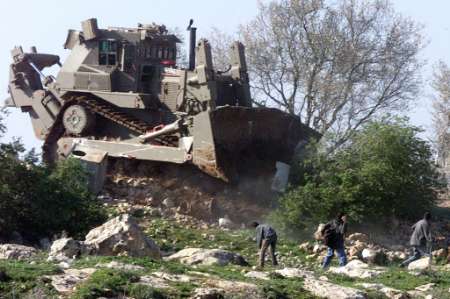
Caterpillar Bulldozer - Israel/Palestine

Caterpillar bulldozers have come to symbolise foreign involvement in Israel's occupation. But should the company be held liable if their products are used to break international law?

Bulldozers are the iron fist of the Israeli army, used to destroy Palestinian homes, uproot orchards and build illegal settlements. But it was the death of Rachel Corrie that brought to international attention a campaign to hold the company to account. Now a law suit has been launched accusing Caterpillar of human rights violations. (Inigo Gilmore)

Accettare Israele come stato ebraico?


Daniel Pipes, danielpipes.org, 29.11.07. Il riconoscimento da parte araba della natura ebraica di Israele deve avere la massima priorità diplomatica. Finché i palestinesi non accetteranno ufficialmente il sionismo, seguitando poi a porre fine a tutte le loro varie strategie per eliminare Israele, i negoziati dovrebbero essere interrotti e non riavviati. Fino ad allora, non c'è nulla di cui discutere.


A sorpresa, qualcosa di utile è emerso dalla combinazione del mal concepito vertice di Annapolis e un debole premier israeliano, Ehud Olmert (secondo il quale "la pace va raggiunta con le concessioni"). Rompendo con la tradizione dei suoi predecessori, Olmert ha coraggiosamente chiesto che i suoi partner negoziali palestinesi accettino l'esistenza di Israele come stato ebraico, suscitando così una eloquente reazione.

A meno che i palestinesi non riconoscano Israele come "stato ebraico", ha annunciato Olmert l'11 novembre scorso, i colloqui di Annapolis avrebbero subito una battuta d'arresto. "Non intendo in alcun modo trovare un compromesso sulla questione dello stato ebraico. Ciò costituirà una condizione per il nostro riconoscimento di uno stato palestinese".

Il giorno dopo, egli ha confermato questi punti definendo il "riconoscimento di Israele come stato per gli ebrei" come il "trampolino di lancio per tutti i negoziati. È assolutamente fuori discussione il fatto che Israele sia uno stato degli ebrei". La leadership palestinese, egli ha osservato, deve "voler fare pace con Israele, inteso come stato ebraico".

Sollevare tale questione ha il vantaggio di focalizzare finalmente l'attenzione su quello che costituisce il punto nevralgico del conflitto arabo-israeliano: il sionismo, il movimento nazionalista ebraico, un tema che come al solito viene ignorato nel parapiglia dei negoziati. Pressoché sin dalla nascita dello stato, l'attenzione è stata focalizzata su grovigli di questioni secondarie come i confini, dislocamento delle truppe, il controllo degli armamenti e delle armi, i principi sacrosanti, le risorse naturali, i diritti di residenza, la rappresentanza diplomatica e i rapporti esteri.

La leadership palestinese ha replicato prontamente e inequivocabilmente alle richieste di Olmert:

  • The Higher Arab Monitoring Committee, di Nazareth, ha chiesto all'unanimità all'Autorità palestinese di non riconoscere Israele come stato ebraico.
  • Salam Fayad, "premier" dell'Autorità palestinese, ha così asserito: "Israele può definirsi come vuole, ma i palestinesi non lo riconosceranno come stato ebraico".
  • Yasser Abed Rabbo, segretario generale del Comitato esecutivo dell'OLP, ha così chiosato: "Tale questione non è negoziabile; è stata sollevata ad uso e consumo interno [israeliano]".
  • Ahmad Qurei, capo-negoziatore palestinese, ha così commentato: "Tale richiesta è del tutto inaccettabile".
  • Saeb Erekat, a capo del Dipartimento Negoziati dell'OLP, ha così asseverato: "I palestinesi non riconosceranno mai l'identità ebraica di Israele (…) Non esiste alcun paese al mondo dove l'identità religiosa e quella nazionale si intrecciano".

La generalizzazione di Erekat è al contempo curiosa e significativa. Non solo 56 paesi e l'OLP fanno parte dell'Organizzazione della Conferenza islamica; ma la maggior parte di questi membri, inclusa l'OLP, considerano la Shari'a (la legge islamica) come la loro principale, se non unica, fonte di legislazione. L'Arabia Saudita esige perfino che ogni suddito sia musulmano.

Inoltre, il nesso religioso-nazionale si estende ben oltre i paesi musulmani. Jeff Jacoby del Boston Globe fa notare che la legislazione argentina "autorizza l'appoggio governativo alla fede cattolico-romana. La Regina Elisabetta II è il governatore supremo della Chiesa Anglicana. Nel regno himalayano del Bhutan, la Costituzione proclama il Buddismo ‘patrimonio spirituale' della nazione (…) ‘La religione predominante in Grecia', dichiara il paragrafo II della Costituzione ellenica, ‘è quella della Chiesa Ortodossa Orientale di Cristo' ".

E allora, perché il rifiuto camuffato da principio di riconoscere Israele come stato ebraico? Probabilmente perché l'OLP vuole ancora eliminare Israele come stato ebraico.

Si noti l'utilizzo del verbo "eliminare", non distruggere. Sì, è vero, l'antisionismo ha prevalentemente assunto fino ad ora una forma militare, dal proclama di Gamal Abdel Nasser di "gettare gli ebrei in mare" a quello di Mahmoud Ahmadinejad che "Israele deve essere cancellato dalle carte geografiche". Ma la potenza delle IDF ha spinto l'antisionismo verso un più sottile approccio volto ad accettare uno stato israeliano, ma smantellando il suo carattere ebraico. Gli antisionisti prendono in considerazione diversi modi per conseguire ciò:

Demografia. I palestinesi potrebbero sopraffare demograficamente la popolazione ebraica di Israele, un obiettivo evidenziato dalla loro pretesa di esercitare un "diritto al ritorno" e dalla loro cosiddetta guerra dell'utero.

Politica. I cittadini arabi di Israele ricusano sempre più la natura ebraica del paese ed esigono che esso diventi uno stato binazionale.

Terrorismo. Il centinaio di attacchi sferrati settimanalmente dai palestinesi dal settembre 2000 al settembre 2005 cercarono di provocare il declino economico, l'emigrazione e l'appeasement.

Isolamento. Tutte quelle risoluzioni delle Nazioni Unite, le condanne editoriali e le aggressioni nei campus intendono intaccare lo spirito sionista.

Il riconoscimento da parte araba della natura ebraica di Israele deve avere la massima priorità diplomatica. Finché i palestinesi non accetteranno ufficialmente il sionismo, seguitando poi a porre fine a tutte le loro varie strategie per eliminare Israele, i negoziati dovrebbero essere interrotti e non riavviati. Fino ad allora, non c'è nulla di cui discutere.

In working progress - The Trailer

In the shadow of the disengagement from Gaza, west from Ramallah, a new city is under construction, Kiriyat Sefer. In the early hours of the morning, some construction workers from a neighboring Palestinian village, Bilin, walk towards another day of work. Unemployed since the early days of the Second Intifada and drowned into financial debts, Maher Hatib, is forced to work, against his own conscience, in the new settlement that is being built on the village's lands. In a day's work, with scarce time for rest, the words tossed into the air and space open a window to the sentiments of the workers for the land they once cherished. The struggle of the workers remains silent given the paradox of their situation. Their employment supplies the occupation forces that allow the construction of the separation fence and the continuation of the future expansion plans. Written by Alexandre, Goetschmann & Davidi, Guy