giovedì 6 dicembre 2007

Human Rights Organizations Condemn the Takeover of the Gaza Civilian Courts Compound

06.12.07 The undersigned Palestinian human rights organizations condemn in the strongest terms the attack on the civilian court compound in the Gaza Strip, and the break-in by members of the so-called “Higher Justice Council” formed by the dismissed government into the office of the President of the Higher Judicial Council and President of the High Court. These attacks and actions are illegal and contradict the Basic Law of the Palestinian National Authority (PNA). Human rights organizations call upon the dismissed government to immediately rescind the illegal decision to takeover the civilian judicial system in the Gaza Strip. These organizations hold this government fully responsible for undermining and destroying the Judicial Authority in order to establish illegal judicial bodies that are not independent.

Facts and information derived from sources in the Higher Judicial Council indicate that at approximately 13:00 on Monday, 26 November 2007, members of the “Higher Justice Council” Abd El-Ra’ouf El-Halabi (President), Adel Khalifa (member), and Omar El-Borsh (member) went to the Court Compound and med the Deputy Chief Justice Yehia Abu Shahla. El-Halabi informed Abu Shahla of the following:

1- All judges and staff in the civilian court system in the Gaza Strip are to be under his instructions in his capacity as the President of the Higher Justice Council.

2- Demanded receipt of the keys of the office of the President of the Higher Judicial Council in order to carry on with his work in the office.

Abu Shahla replied that their decision and status are illegal, that what they are doing is a violation of the law and Basic Law, and that he refused to follow their orders.
El-Halabi and his colleagues left Abu Shahla’s office and headed towards the office of the President of the Higher Judicial Council. They ordered one of the employees to open the office. A large police force was deployed in the Court Compound.
As a result, judges and staff left the Court Compound and the Higher Judicial Council announced an indefinite suspension of the work of the civilian court system in the Gaza Strip.
Since then, and due to the full understanding of the seriousness of the situation, human rights organizations exerted extensive efforts to save the civilian court system from total collapse, to go back to the situation prior to the takeover, and to neutralize the judicial system from the ongoing power struggle. Over the past 10 days, human rights organizations held extensive contacts with the dismissed government including the Prime Minister, Deputy Prime Minister, Minister of Justice, the head of the Legal Committee in the Palestinian Legislative Council (PLC), and the legal advisor to the Prime Minister.
Human rights organizations received positive signals in the first stage of contacts that led to understandings on rescinding the decision of the takeover and other illegal measures in exchange for the role of human rights organizations in finding solutions to some outstanding problems in the judicial system. Among these problems are the suspension of executing judicial decisions and collection of court fees.
Human rights organizations contacted the Higher Judicial Council, which agreed to work seriously to resolve the aforementioned problems.
Regrettably, the dismissed government did not respect these preliminary understandings. It became clear to us that it was not serious in reaching a solution other than its own, and is not keen to rescind its illegal decisions. Facts on the ground indicate that the Higher Justice Council is in a race against time to solidify its complete control over the judicial system. This council took over all civilian courts in the Gaza Strip. In addition, the council sent letters to judges urging them to return to work. The judges refused to heed this call and all 48 judges as well as court staff are abiding by the indefinite suspension of work.
Human rights organizations affirm that this serious attack is the culmination of a series of illegal steps and measures taken by the dismissed government in Gaza to undermine the Judicial Authority and justice system in the PNA. The most notable of these illegal steps were:

· 14 August 2007: Decision of this government’s Minister of Justice to suspend the Attorney-General (AG) from his work under the claim that the legal steps of his appointment were not completed. This was an illegal decision and no minister has the authority to undermine the AG who is performing his functions in accordance with the law.

· 16 August 2007: The Executive Force raided the AG’s office in Gaza, attacked the AG and detained him and his assistants.

· 29 August 2007: appointment of an Assistant-AG as well as new prosecutors illegally. They have been performing the functions of the AG and his assistants since 29 August.

· 4 September 2007: Formation of the so-called “Higher Justice Council” by a Cabinet Decision and the approval of this council’s members under the presidency of Abd El-Ra’ouf El-Halabi on 11 September. This council is illegal and it usurps the authority of the Higher Judicial Council that was formed and is operating according to the law. The dismissed government has no authority to form the Higher Judicial Council.

· Appointment of new judges illegally.

· Provocations by security forces against judges and the Judicial Authority.

Prior to these steps and immediately after the Hamas takeover of the Gaza Strip last June, the Palestinian leadership in Ramallah decided to suspend the work of the civilian police force and AG immediately, and the High Judicial Council decided to suspend the implementation of court judgments and to stop collection of court fees. At the time, warnings were issued against these decisions and their serious implications on the justice system and Judicial Authority. The interests of ordinary citizens are final victims of the decisions to suspend the work of the police and AG. It was warned then that these decisions will pave the ground for the dismissed government in Gaza to establish alternative judicial bodies.

Human rights organizations renew their strong condemnation of the attack on the Civilian Court Compound in Gaza and:

1. Affirm that the independence of the Judicial Authority is the safeguard of social order and that this independence must be preserved at all times and under all circumstances. The alternative is the rule of the jungle.

2. Call upon the dismissed government in Gaza to immediately rescind this very dangerous and illegal stop that is liable to destroy the Judicial Authority.

3. Fully support the position of the Higher Judicial Council to suspend the work of the civilian courts and fully support the decision of the Bar Association to suspend the work of lawyers.

4. Hold the dismissed government fully responsible for the result of the collapse of the Judicial Authority, and what that bears in the form of damaging the interests of the citizenry.

5. Affirm that the process of appointing new judges by the dismissed government violates the Judicial Authority Law despite the fact that these judges passed the tests held by the Higher Judicial Council. The law states that judges must be nominated by the Higher Judicial Council and appointed by Presidential Decree. These steps have not been fulfilled.

6. Remind that the Judicial Authority achieved justice for Hamas on many occasions and in many cases that were key junctures in the struggle for the rule of law against the arbitrariness of the Executive Authority then. These cases included political detention, closure of newspapers, and closure of associations affiliated with Hamas.

7. View this new attack as a pre-meditated action that could not have been possible without political cover from the dismissed government in Gaza so as to complete the takeover over the components of the Judicial Authority. This takeover comes within the context of the political crisis rocking the PNA. This crisis has created a deep abyss in the components of the Palestinian political system: Executive, Legislative, and Judicial. This will practically lead to the deepen the existing separation between the West Bank and Gaza Strip, the price of which is paid by the Palestinian people and the Palestinian national cause.

Addameer for Human Rights
Palestinian Centre for Human Rights
Palestinian
Independent Commission for Citizens Rights
Al-Mezan Center for Human Rights


martedì 4 dicembre 2007

Gaza traffic grinds to halt as fuel cuts bite

Nidal al-Mughrabi, Reuters, 3.12.07. What had been a gradual reduction has intensified, and in the last few days, supplies representing just 15 percent of the coastal strip's daily consumption were being allowed in. Petrol firms considered the amount "good for nothing" and were refusing to accept it in protest over the Israeli blockade. "Yesterday the situation was dark, today it is darker and it gets worse every single hour," said Mahmoud al-Khuzundar, chairman of Gaza's society of petrol company owners. Khaled Radi, spokesman for the Hamas-run Health Ministry in Gaza, said fuel shortages had already forced some ambulances off the road and threatened to close clinics, which rely on back-up generators during frequent electricity blackouts. "The Israeli decision is a death penalty," Radi said. "Our reserve of fuel is almost zero and maybe it will run out by the end of today," he said adding two health centres had already been forced to suspend treatment during power cuts. Israel's High Court of Justice last week rejected an appeal by human-rights groups to overturn the fuel cuts. The court found in favor of the Defence Ministry's argument that the fuel supply for vital "humanitarian needs" in Gaza had been maintained. Khuzundar said Gaza's water supply and sewage system could also be affected if fuel runs out altogether. (Editing by Michael Winfrey)

Gaza: la «cuisine» où se fabriquent les Qassam

Alain Campiotti, Jabaliya, LeTemps.ch, 4.11.07. PROCHE-ORIENT. Les groupes armés palestiniens menacent Israël de roquettes plus puissantes. Les plans d'une offensive israélienne sont prêts - C'est la cuisine du diable. Les marmitons sont cagoulés de noir, autour d'une grande cuve posée sur un réchaud, au centre de la pièce. L'un d'entre eux laisse couler un filet de poudre blanche d'un sac qu'il tient sous le bras: du nitrate de potassium. Un autre remue sans s'arrêter, avec une longue spatule, la pâte qui se forme au fond du récipient. Le troisième attend son tour, un autre sac dans les mains: «Du sucre», dit-il y en riant.

Braises ranimées

Le brouet qu'ils préparent est le combustible qui doit propulser une roquette Qassam en direction du territoire israélien. L'engin est à côté, posé sur un trépied. Un long tube noir, avec sa charge conique jaune au bout. Il ne manque que la pointe de percussion. Son nom est écrit sur le fuselage, en jaune aussi: «Quds». C'est un missile artisanal de la Brigade Al-Quds (Jérusalem) du Djihad islamique.

Dans la semaine qui a suivi la conférence d'Annapolis - celle qui voulait relancer les négociations de paix - les braises de Gaza ont été ranimées. Des Qassam sont tirées chaque jour vers Israël, et plus souvent des obus de mortier: c'est l'arme favorite de la milice du Hamas, qui depuis un an a décrété une sorte de trêve partielle, en ne tirant plus de roquettes. Le mouvement islamique laisse aux organisations alliées ou rivales (les Comités de résistance populaire, le Djihad islamique, les Brigades Al-Aqsa liées au Fatah) le choix des Qassam. L'armée israélienne réplique par des raids aériens et des opérations de commandos meurtriers: une vingtaine de morts dans les groupes palestiniens en une semaine; un obus de mortier a blessé quelques soldats israéliens dans une base à l'est de Khan Younis, de l'autre côté de la frontière.

Les deux camps - chacun accusant l'autre de tirer le premier - annoncent une escalade. Les Palestiniens, y compris le Hamas, affirment qu'ils ont développé de nouveaux types de roquettes d'une portée de 20km ou plus, au lieu de 10 à 12 aujourd'hui. Tsahal laisse planer la menace d'une opération massive. Gabi Ashkenazi, le chef d'état-major israélien, vient d'inspecter le front. Ehoud Barak, son ministre, a dit dimanche qu'il n'attendait plus qu'une décision du gouvernement pour passer à l'action.

Le Djihad islamique, qui a le soutien de l'Iran, se veut le fer de lance de «la résistance» - en même temps qu'il tente une médiation entre le Hamas et le Fatah. C'est peut-être pour le démontrer qu'il accepte des visites.

A côté, des enfants

Jabaliya est l'un des plus grands camps de réfugiés, entre la ville de Gaza et la frontière israélienne. L'intermédiaire, qui est venu à pied au rendez-vous après la tombée de la nuit, guide la voiture dans le dédale du camp. La fin du trajet se fait avec une cagoule sur la tête, en auto puis à pied, dans un sentier pierreux, puis un jardin, jusque dans l'atelier aux Qassam. C'est l'annexe d'une maison familiale. Des enfants crient à côté.

Les hommes masqués ont préparé une mise en scène: drapeaux noirs et slogans jaunes du Djihad islamique au mur, et sur une table qui sert de bureau. Le chef s'y est installé. Sa voix est jeune, artificiellement saccadée. Ils préparent deux roquettes parce qu'ils en ont reçu l'ordre. Ils ont été formés à cela, comme au maniement des armes et au combat de rue. «La lutte armée est le seul moyen, dit-il sous sa cagoule. Israël ne cédera rien par la négociation.» Le tir de ces roquettes imprécises et le plus souvent inoffensives ne fait-il pas le jeu d'Israël, qui justifie ainsi le déploiement de sa force supérieure? «Nous ne faisons que nous défendre. Quand ils tuent des enfants palestiniens, ils n'ont pas besoin de raisons.»

Devant la table, la grande spatule tourne toujours pour fluidifier la pâte combustible. Un échantillon est testé par une fenêtre ouverte, dégageant une âcre fumée. Puis la masse est versée dans un moule qui a la forme de la roquette. Une nuit pour que ça sèche, avant la mise en place dans le Qassam. Une autre équipe se chargera du tir. L'un des hommes de la «cuisine» l'accompagnera pour veiller jusqu'au bout à la «qualité du matériel».

Lundi matin, l'armée israélienne a annoncé que deux Qassam avaient été tirés au nord de Jabaliya. Les roquettes sont tombées dans un champ, sans faire de dégâts.

Barghouti reçoit la visite de députés israéliens

Serge Dumont, LeTemps.ch, 4.12.07. «La fin du conflit est proche [...]. Si un accord permanent est trouvé, il ne manque qu'un leader courageux pour le signer et pour le présenter à l'approbation populaire par voie de référendum. Croyez-moi, l'opinion approuvera tout accord valable.» Enfermé dans le quartier de haute sécurité de la prison d'Hasharon (grande banlieue de Tel-Aviv), le plus célèbre des détenus palestiniens, Marwan Barghouti, a pris une part active à la préparation du récent sommet d'Annapolis.

Dimanche, il a en tout cas reçu une délégation d'élus de la Knesset auxquels il a fait part d'un optimisme prudent. Certes, il a estimé que «libérer seulement 429 prisonniers est une plaisanterie», mais il a surtout affirmé que la paix est possible et que «nous sommes à portée de main d'une solution». Des propos importants puisque Marwan Barghouti est considéré par la presse israélienne ainsi que par les députés qu'il a reçus comme le seul leader palestinien à pouvoir faire respecter le calme dans les Territoires.

lunedì 3 dicembre 2007

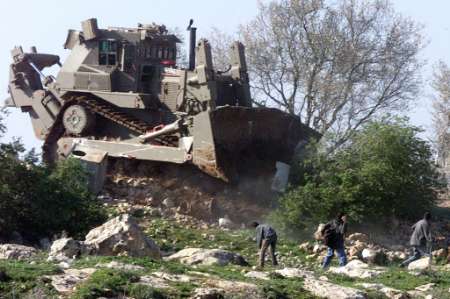
Caterpillar Bulldozer - Israel/Palestine

Caterpillar bulldozers have come to symbolise foreign involvement in Israel's occupation. But should the company be held liable if their products are used to break international law?

Bulldozers are the iron fist of the Israeli army, used to destroy Palestinian homes, uproot orchards and build illegal settlements. But it was the death of Rachel Corrie that brought to international attention a campaign to hold the company to account. Now a law suit has been launched accusing Caterpillar of human rights violations. (Inigo Gilmore)

Accettare Israele come stato ebraico?


Daniel Pipes, danielpipes.org, 29.11.07. Il riconoscimento da parte araba della natura ebraica di Israele deve avere la massima priorità diplomatica. Finché i palestinesi non accetteranno ufficialmente il sionismo, seguitando poi a porre fine a tutte le loro varie strategie per eliminare Israele, i negoziati dovrebbero essere interrotti e non riavviati. Fino ad allora, non c'è nulla di cui discutere.


A sorpresa, qualcosa di utile è emerso dalla combinazione del mal concepito vertice di Annapolis e un debole premier israeliano, Ehud Olmert (secondo il quale "la pace va raggiunta con le concessioni"). Rompendo con la tradizione dei suoi predecessori, Olmert ha coraggiosamente chiesto che i suoi partner negoziali palestinesi accettino l'esistenza di Israele come stato ebraico, suscitando così una eloquente reazione.

A meno che i palestinesi non riconoscano Israele come "stato ebraico", ha annunciato Olmert l'11 novembre scorso, i colloqui di Annapolis avrebbero subito una battuta d'arresto. "Non intendo in alcun modo trovare un compromesso sulla questione dello stato ebraico. Ciò costituirà una condizione per il nostro riconoscimento di uno stato palestinese".

Il giorno dopo, egli ha confermato questi punti definendo il "riconoscimento di Israele come stato per gli ebrei" come il "trampolino di lancio per tutti i negoziati. È assolutamente fuori discussione il fatto che Israele sia uno stato degli ebrei". La leadership palestinese, egli ha osservato, deve "voler fare pace con Israele, inteso come stato ebraico".

Sollevare tale questione ha il vantaggio di focalizzare finalmente l'attenzione su quello che costituisce il punto nevralgico del conflitto arabo-israeliano: il sionismo, il movimento nazionalista ebraico, un tema che come al solito viene ignorato nel parapiglia dei negoziati. Pressoché sin dalla nascita dello stato, l'attenzione è stata focalizzata su grovigli di questioni secondarie come i confini, dislocamento delle truppe, il controllo degli armamenti e delle armi, i principi sacrosanti, le risorse naturali, i diritti di residenza, la rappresentanza diplomatica e i rapporti esteri.

La leadership palestinese ha replicato prontamente e inequivocabilmente alle richieste di Olmert:

  • The Higher Arab Monitoring Committee, di Nazareth, ha chiesto all'unanimità all'Autorità palestinese di non riconoscere Israele come stato ebraico.
  • Salam Fayad, "premier" dell'Autorità palestinese, ha così asserito: "Israele può definirsi come vuole, ma i palestinesi non lo riconosceranno come stato ebraico".
  • Yasser Abed Rabbo, segretario generale del Comitato esecutivo dell'OLP, ha così chiosato: "Tale questione non è negoziabile; è stata sollevata ad uso e consumo interno [israeliano]".
  • Ahmad Qurei, capo-negoziatore palestinese, ha così commentato: "Tale richiesta è del tutto inaccettabile".
  • Saeb Erekat, a capo del Dipartimento Negoziati dell'OLP, ha così asseverato: "I palestinesi non riconosceranno mai l'identità ebraica di Israele (…) Non esiste alcun paese al mondo dove l'identità religiosa e quella nazionale si intrecciano".

La generalizzazione di Erekat è al contempo curiosa e significativa. Non solo 56 paesi e l'OLP fanno parte dell'Organizzazione della Conferenza islamica; ma la maggior parte di questi membri, inclusa l'OLP, considerano la Shari'a (la legge islamica) come la loro principale, se non unica, fonte di legislazione. L'Arabia Saudita esige perfino che ogni suddito sia musulmano.

Inoltre, il nesso religioso-nazionale si estende ben oltre i paesi musulmani. Jeff Jacoby del Boston Globe fa notare che la legislazione argentina "autorizza l'appoggio governativo alla fede cattolico-romana. La Regina Elisabetta II è il governatore supremo della Chiesa Anglicana. Nel regno himalayano del Bhutan, la Costituzione proclama il Buddismo ‘patrimonio spirituale' della nazione (…) ‘La religione predominante in Grecia', dichiara il paragrafo II della Costituzione ellenica, ‘è quella della Chiesa Ortodossa Orientale di Cristo' ".

E allora, perché il rifiuto camuffato da principio di riconoscere Israele come stato ebraico? Probabilmente perché l'OLP vuole ancora eliminare Israele come stato ebraico.

Si noti l'utilizzo del verbo "eliminare", non distruggere. Sì, è vero, l'antisionismo ha prevalentemente assunto fino ad ora una forma militare, dal proclama di Gamal Abdel Nasser di "gettare gli ebrei in mare" a quello di Mahmoud Ahmadinejad che "Israele deve essere cancellato dalle carte geografiche". Ma la potenza delle IDF ha spinto l'antisionismo verso un più sottile approccio volto ad accettare uno stato israeliano, ma smantellando il suo carattere ebraico. Gli antisionisti prendono in considerazione diversi modi per conseguire ciò:

Demografia. I palestinesi potrebbero sopraffare demograficamente la popolazione ebraica di Israele, un obiettivo evidenziato dalla loro pretesa di esercitare un "diritto al ritorno" e dalla loro cosiddetta guerra dell'utero.

Politica. I cittadini arabi di Israele ricusano sempre più la natura ebraica del paese ed esigono che esso diventi uno stato binazionale.

Terrorismo. Il centinaio di attacchi sferrati settimanalmente dai palestinesi dal settembre 2000 al settembre 2005 cercarono di provocare il declino economico, l'emigrazione e l'appeasement.

Isolamento. Tutte quelle risoluzioni delle Nazioni Unite, le condanne editoriali e le aggressioni nei campus intendono intaccare lo spirito sionista.

Il riconoscimento da parte araba della natura ebraica di Israele deve avere la massima priorità diplomatica. Finché i palestinesi non accetteranno ufficialmente il sionismo, seguitando poi a porre fine a tutte le loro varie strategie per eliminare Israele, i negoziati dovrebbero essere interrotti e non riavviati. Fino ad allora, non c'è nulla di cui discutere.

In working progress - The Trailer

In the shadow of the disengagement from Gaza, west from Ramallah, a new city is under construction, Kiriyat Sefer. In the early hours of the morning, some construction workers from a neighboring Palestinian village, Bilin, walk towards another day of work. Unemployed since the early days of the Second Intifada and drowned into financial debts, Maher Hatib, is forced to work, against his own conscience, in the new settlement that is being built on the village's lands. In a day's work, with scarce time for rest, the words tossed into the air and space open a window to the sentiments of the workers for the land they once cherished. The struggle of the workers remains silent given the paradox of their situation. Their employment supplies the occupation forces that allow the construction of the separation fence and the continuation of the future expansion plans. Written by Alexandre, Goetschmann & Davidi, Guy

Le test du cigare de Lieberman Avigdor Lieberman's settler friends can relax

Akiva Eldar, Haaretz, 3.12.07. Après Annapolis, les ambiguïtés du gouvernement Olmert. Trois tests qui révéleraient ses véritables intentions. Il semble que, pour l’instant du moins, Lieberman et ses amis colons peuvent dormir tranquilles. Les preneurs de décisions [les ministres israéliens] ont-ils tiré les leçons des échecs précédents, ou bien conduisent-ils (involontairement ou délibérément), au pire, à un régime d’apartheid, comme Olmert l’a déclaré lui-même, ou à un autre cycle de violences ? Voici trois tests pour nous aider à résoudre cette énigme.

1. Le test des positions d’ouverture des négociations

Avant même le début des pourparlers sur un accord définitif, le gouvernement doit clarifier ses positions d’ouverture sur chacun des points essentiels. S’il adopte l’approche selon laquelle les Palestiniens doivent se contenter de la clôture de sécurité comme frontière politique, accepter la souveraineté d’Israël sur le Mont du Temple et effacer totalement tout rappel du retour des réfugiés, nous pouvons économiser les frais entraînés par la mise en place d’une Administration de la paix.

Mahmoud Abbas et la direction palestinienne, qui a émergé d’Annapolis avec la mission de mener les négociations sur un accord de paix, est bien plus faible que la délégation emmenée par Yasser Arafat à Camp David en juillet 2000. Après sept ans de « pas de partenaire », la destruction des infrastructures du gouvernement central palestinien, la victoire du Hamas et la perte de Gaza, la marge de manœuvre du Fatah est très réduite.

Mahmoud Abbas ne peut pas se permettre de renoncer à un seul centimètre carré de plus qu’Arafat (les lignes de 1967), avec des ajustements de frontières sur la base de l’égalité et de l’accord mutuel des deux parties. Sur Jérusalem et les réfugiés, il ne servirait à rien de proposer aux Palestiniens moins que ce que le plan Clinton offrait en décembre 2000 [2]

2. Le test du tissu social

Les principes d’Annapolis renvoient les parties à la formule de Rabin : mener les négociations comme s’il n’y avait pas de terrorisme et combattre le terrorisme comme s’il n’y avait pas de négociations. Toutefois, l’expérience du processus d’Oslo nous enseigne qu’un canal diplomatique n’a aucune valeur s’il ne s’accompagne pas d’une amélioration pour la population occupée par Israël. Les limites imposées à la circulation, les expropriations pour la construction de la clôture aussi bien que pour les colons, les assassinats et les arrestations massives sapent le soutien de l’opinion palestinienne à Abbas, et réduisent encore sa marge de manœuvre, déjà étroite. Le démantèlement des colonies dites sauvages, un gel total de la construction dans les colonies, sans se cacher derrière son petit doigt (appel aux notions de « croissance et d’expansion naturelles »), et une application totale des recommandations du rapport Sasson sur les colonies sauvages ont toujours constitué le test des intentions du gouvernement israélien [3].

3. Le test du chef d’équipe

Au sein de l’état-major, nombreux sont les généraux qui partagent toujours la conception de « l’assèchement de la motivation » des Palestiniens qui avait cours sous Shaul Mofaz et Moshe Ya’alon. Dans les départements planification et renseignement, aussi bien qu’au bureau de liaison diplomatie-sécurité du ministère de la défense, on dit et l’on écrit que si l’armée devait se retirer de la Cisjordanie, nous serions obligés de protéger les maisons de Kfar Saba (ville proche de Tel-Aviv et près de la ligne Verte) des tirs de roquettes.

Si cela ne tenait qu’à eux, l’armée retournerait à Gaza. Ils n’ont aucune empathie pour le côté palestinien et ne pensent pas que des gestes généreux ni même un accord de paix feraient que les services de sécurité palestiniens remplaceraient convenablement les forces israéliennes dans les territoires. Or, bien qu’Olmert dise qu’il n’est pas impressionné par les scénarios d’horreur de l’establishment militaire, il envisage de nommer un ancien membre dudit establishment à la tête de l’administration de la paix, un homme qui, depuis des années, s’est habitué à voir les Arabes à travers une lunette de tir.

Lieberman n’est pas un imbécile. Après Annapolis, comme avant, il ne se presse pas de quitter le gouvernement. Tant qu’il peut fumer tranquillement ses cigares, ses amis de la colonie de Nokdim peuvent dormir sur leurs deux oreilles.

[1] Texte : ->http://www.lapaixmaintenant.org/article1725]

[2] Paramètres Clinton (résumé, sur les 3 principaux problèmes. Source : "Israël et Palestine : Plans de paix et propositions - d’Oslo au désengagement" par le Pr Galia Golan - pas d’éditeur pour l’instant). Ces paramètres ont été présentés par Clinton aux 2 parties comme non négociables, après l’échec de Camp David.
- Frontières : Israël se retire de 94 à 96% de la Cisjordanie, et échange territorial égal à 1 à 3% de la Cisjordanie qui viendrait compenser les Palestiniens.
- Réfugiés : deux propositions, toutes les deux fondées sur l’idée que la question des réfugiés devait être résolue, en gros, dans le cadre de l’Etat palestinien. La formule pouvait être, soit une reconnaissance par les deux partie du "droit au retour des réfugiés dans la Palestine historique", soit le "droit des réfugiés palestiniens à leur patrie". Dans un cas comme dans l’autre, il n’y aurait aucune ambiguïté quant au lieu où s’exercerait ce droit : ce serait Israël qui, d’après Clinton, avait le droit de déterminer sa politique d’immigration et de préserver son caractère juif. Supposant qu’Israël pourrait autoriser un petit nombre de réfugiés à entrer, il proposa cinq options, souvent discutées par le passé : "retour" dans l’Etat palestinien ; "retour" dans les zones transférées aux Palestiniens dans le cadre des échanges de territoires ; intégration dans les pays où ils se trouvaient actuellement ; réinstallation dans un pays tiers ; admission en Israël. Ces trois dernières options dépendraient de la politique d’immigration de chaque pays concerné, y compris Israël. La priorité serait donnée aux réfugiés du Liban, dont le sort était peut-être le pire, et dont la plupart avaient de la famille qui vivait toujours en Galilée (Israël). Prises dans leur globalité, ces dispositions étaient considérées comme une application de la résolution 194.
- Jérusalem : Les idées de Clinton ne tenaient aucun compte des arrangements géographiques compliqués imaginés par les Israéliens à Camp David, et allaient clairement dans le sens des exigences palestiniennes. Très simplement, Clinton suggéra : les quartiers arabes seraient sous souveraineté palestinienne et les quartiers juifs sous souveraineté israélienne(...). Les Palestiniens auraient réellement leur capitale à Jérusalem, et Israël, ainsi que le présenta Clinton, obtiendrait enfin la reconnaissance d’une grande partie de Jérusalem en tant que capitale de l’Etat d’Israël.

[3] Rapport Sasson : voir l’édito d’Ha’aretz "Fini de jouer"

Traduction : Gérard Eizenberg pour La Paix Maintenant


Israel errs in trying to impose its Jewish identity

Shulamit Aloni *, The Daily Star, 3.12.07. Jews are a people but not a nation; they are a religious ethnic group or as respected a tribe as may be. The Jewish citizens of Britain, including the orthodox, are British, and that is what is written in their passports and in the British population registry. The same is true of France: The Jews there are French. In Canada, they are Canadians, and in Holland they are Dutch. They uphold their Jewish lives in their communities, since in democratic nations there is freedom of religion and freedom from religion. If these states were to register their Jewish citizens as "Jewish" in the nationality category, we would accuse them of being anti-Semitic. There is a difference between a people, a religion, and a nationality, since nationality is decided by citizenship - a people as opposed to a nation - and therefore citizenship is nationality. The affinity of a citizen to the state is based on citizenship and not on religion; it is based neither on the tribe nor on maternal genes.

If among Israeli Cabinet ministers there are those who feel that they are more Jewish than Israeli, that is their right, and they can uphold all the religious precepts and pray all the prayers. But that is not relevant to the ties between Israel and its neighbors. There are people among us who like to repeat that Israel is a Jewish state and not a state for all its citizens. It is strange that this notion was to be imposed on the Palestinians in the document prepared for the Annapolis conference as a condition for ending the occupation. Palestinians are asked to recognize an Israel where some 20 percent of its citizens, the Arabs, have inferior status.

In the past, it was a great joy to be an Israeli. Israel was father to the nations. The word "Jewish" does not exist in any of the prayers. There is: "And I will restore the captivity of my people Israel." And there are the people of Israel, the land of Israel, the Torah of Israel, the God of Israel and the daughter of Israel.

The state of Israel was established as a civilian state, as a state of law, and not as a state of Halakha, or Jewish religious law. It was not established by ultra-orthodox Jews to whom the Cabinet ministers enslave themselves, and whose supporters they release from military service, from other work, and from tuition fees, and to whom they even pay a monthly wage.

In the document establishing the Israeli state, it was promised that there would be "complete equality of rights for all its citizens regardless of origin, race or gender." And another reminder: On Israel's Independence Day, citizens light 12 beacons, the number of the tribes of Israel.

Let the Cabinet ministers feel at home as Jews as much as they want to; let them raise their voices in prayer, but they must remember that they serve the government of Israel, which still represents itself as being democratic. In other words, they are the representatives of all its citizens and are responsible for them. Therefore, it would be better to demand of the Palestinians to recognize Israel as a sovereign state, and not to coerce them in the same way as the citizens coerce us, through the imposition of religion and the word of rabbis.

The existing arrangement in Israel was suitable for the Catholic Spain of Isabella and Ferdinand at the end of the 15th century. That is when the expulsion of Jews from Spain took place, since only Catholics, or those who converted to Catholicismm could be Spanish. If it is more important to be a Jew than it is to be an Israeli, then why do we demand of the Jews of the world to come here at a time when they have it so good in the democratic countries in which they live as Jews?

Shulamit Aloni is a former Israeli education minister. She has been awarded both the Israel Prize and the Emil Grunzweig Human Rights Award by the Association for Civil Rights in Israel. THE DAILY STAR publishes this commentary in collaboration with the Common Ground News Service.

Jordan's king urges Israel to withdraw from Arab land

IHT, 2.12.07, AMMAN, Jordan: Jordan's King Abdullah II inaugurated a new parliament Sunday with a call on Israel to relinquish war-won Arab lands, saying that would help peace and security to prevail in the volatile Mideast. The king also urged unity among feuding Palestinian factions, saying the time has come for statehood. "We emphatically tell Israel that ending the occupation of Arab and Palestinian lands, withdrawing from there and implementing legitimate international resolutions are the only way to realize just, permanent and comprehensive peace," said the staunch U.S. ally who maintains cordial relations with Israel under a 1994 peace treaty. Abdullah said a peaceful Arab-Israeli settlement would "guarantee a safe future for the region's peoples and its coming generations." "We also say to the Palestinians that strength is in unity and weakness in disunity; so, unite your ranks and seize the available opportunity to realize peace and establish your independent state in the West Bank and Gaza Strip," he said.


Israel's Premier Rejects Peace Deadline

JERUSALEM (AP) 3.12.07. Prime Minister Ehud Olmert said Sunday that Israel is not bound by a December 2008 target for a peace agreement set at last week's U.S.-hosted Mideast summit, telling his Cabinet that progress will depend on the Palestinians' ability to rein in militants.

The comments reflected Olmert's internal political weakness. Hard-liners have threatened to bring down his coalition government if he makes too many concessions in peace talks with the Palestinians. Olmert spoke a day before Israel was set to release 429 Palestinian prisoners in a gesture to moderate President Mahmoud Abbas, a step that has drawn criticism from the same hard-line members of Olmert's Cabinet.

In a message that could further anger Israeli hawks, Olmert's defense minister, Ehud Barak, said he supports a measure to give compensation to Jewish settlers in the West Bank who leave their homes voluntarily, according to the Defense Ministry.

The measure would apply to settlements outside Israel's separation barrier along the West Bank. The contentious barrier is meant to enclose main settlement blocs Israel plans to retain in a peace agreement, where two-thirds of the settlers live. The others, about 80,000, could claim compensation if they leave.

Settler leaders condemned the proposal. They oppose any building freeze or evacuation of settlements, even unauthorized outposts that dot West Bank hilltops.

The 2003 "road map" peace plan, reaffirmed at the Annapolis summit, requires Israel to remove dozens of outposts and halt all construction in the settlements.

Although Olmert's coalition is strong on paper, commanding 78 of parliament's 120 seats, it threatens to collapse over peace talks. Two parties in the five-party team oppose almost all concessions to the Palestinians, especially giving up West Bank territory or control over any part of Jerusalem.

At the Mideast conference sponsored by President Bush, the leaders agreed that "an effort will be made to hold accelerated negotiations in the hope that it will be possible to conclude them in 2008," Olmert told his Cabinet, according to a statement. He added, "However, there is no commitment to a specific timetable regarding these negotiations." The target coincides with the end of Bush's term.

"Israel will not have to carry out any commitment stemming from the agreement before all of the road map commitments are met," Olmert told his Cabinet.

Separate but Unequal in Palestine: The Road to Apartheid

Mohammed Khatib, Dissident Voice, 2.11.07. When United States Secretary of State Condoleezza Rice visited the Middle East a few weeks ago, people from our small village of Bil’in joined neighboring villages to send her a message. We protested peacefully against a West Bank highway near us that is reserved for Jewish Israeli settlers, and off-limits to Palestinians, though it was built on Palestinian land. Our banner read: “Condi, What would Rosa Parks do?”

We know that Dr. Rice experienced the bitter taste of discrimination growing up in the South during the US civil rights struggle. In Bil’in, we’ve drawn inspiration from the US civil rights movement as we’ve carried out a three year nonviolent resistance campaign against the discriminatory policies of Israel’s military occupation.

We share Dr. Rice’s admiration for the courage of Rosa Parks who was arrested in Alabama, Rice’s home state, for refusing to give her bus seat to a white man. As Palestinians we aren’t even allowed in buses on many roads in our own country, because 200 miles of the best West Bank roads are reserved for Israeli Jewish settlers.1 The color of Palestinian license plates is different from the licenses of Israelis. Palestinian plates are not allowed on most of the highways crisscrossing the West Bank, many of which were built with US government funding. Palestinians have been banned for five years now from Highway 443 where we protested.

According to the United Nations Office for the Coordination of Humanitarian Affairs (OCHA), there are 561 physical obstacles and checkpoints inside the West Bank restricting Palestinian movement within the West Bank,2 in comparison with only eight checkpoints which separate the West Bank from Israel proper. Nearly all the obstacles and checkpoints are located along the West Bank roads reserved for Israelis. This makes getting to the hospital, school and work or visiting relatives painstakingly difficult or impossible for us. This fragmentation of the West Bank has devastated our economy.

In 2001, Israeli developers began building settlement homes on land seized from Bil’in, calling them a neighborhood of the Modi’in Illit settlement bloc. Four years later, Israel’s segregation wall separated Bil’in from 50% of our agricultural land under the pretext of protecting this new settlement. In response, we held over 200 nonviolent protests together with Israeli and international supporters. Hundreds of us were injured and arrested. After our protests, Israel’s Supreme Court ruled that the wall’s route in Bil’in must be changed to return around half of our seized land. Though we celebrated this success, Israel continues to build on our land that wasn’t returned and plans to annex it as part of the Modi’in Illit settlement bloc.4

Israel has already de facto annexed the 10.2% of the West Bank that lies between the Green Line and the segregation wall, including the major settlement blocs and 80% of Israel’s 450,000 settlers. The segregation wall, settlements and settlement roads carve Palestinian areas into isolated enclaves.

We pray that our children will not spend their lives under Israeli military occupation. We hope that the Annapolis meeting will bring our dreams of freedom closer to fulfillment. But we are concerned that if Israel is allowed to keep most of its settlements and the roads that connect them, then the existing system of “separate but unequal” will be cemented in place in a Palestinian state.

  1. Forbidden roads: The discriminatory West Bank road regime, B’Tselem. #
  2. OCHA Closure Update: October 2007, The UN Office for the Coordination of Humanitarian Affairs. #
  3. West Bank settlements ‘expanding’ BBC, 7 November 2007. #
  4. One Palestinian Village Struggles Against Israel’s Ever-Expanding “Settlements”, Alternet, 26 September 2007. #
Mohammed Khatib is a leading member of Bilin's Popular Committee Against the Wall and the secretary of its village council. Read other articles by Mohammed, or visit Mohammed's website.

Can We Blame Them…?

Heba, IslamOnline, 26.11.07. Now that Annapolis conference is approaching, people in Gaza react to it in the strangest manner. Everybody I talk to believes it will bring no positive changes to us. You get in a car and the driver says "If I were the president, I would not go. We are sick of conferences." I talk to my colleague and she says, "we have been there before thinking of Palestine, and now we will be there talking about Gaza Siege." Can we really blame people for bleak anticipations and a very low ceiling of expectations? And I have to end up with a desperate women's sentence that echoed in my office for a while after her departure, "We shall sign anything but let our cancer patients travel for treatment" — and that as a response to the young man who died of cancer waiting for a permit!

November 25th marks the beginning of the 16 day campaign of combating Violence against Women worldwide. For our work, this is a very important occasion as we do have multiple media campaigns and awareness raising activities to reduce levels of violence against women. Doing arrangements, coordinating with organizations, attending events, and all, I was actually moving mechanically with this hollow gap between body and mind. Observing all the negative deteriorations on the ground, I had to wonder about the reasonable justification of doing such activities.

As I said before; and to make myself clearer, construction and deconstruction go hand in hand in the Gaza strip now. Donors fund all these programs to address violence and try to reduce its levels. However, this money does not support eliminating its causes. How can it when the causes are at the policy level and when they are, apparently, political situation bound. So I can sit among women — watching a play about VAW nodding their heads in consent or laughing in disbelief — without being able to see through their minds if it ever happened to them and if it did, why? With unemployment, poverty, seclusion, and inexistent opportunities of self-expression at hand, what do we expect of people? We, as NGOs, should start in my opinion understanding the difference between treating the pain and numbing it. Nevertheless, if we do, we have nothing else but to work as the balance of the equation depends on people still acting normal towards abnormalities.

IOF Impose additional Collective Punishment Measures and Reduce Gaza’s Fuel Supply

29.11.07. 70% of the Fuel Stations Shutdown and the Humanitarian Crisis Deepens
PCHR strongly condemns the decision by Israeli Occupation Forces (IOF) on Wednesday (28 November) for a new reduction in the supply of fuel to the Gaza Strip, which already suffers from serious shortages in fuel. The Centre calls upon the international community, especially the High Contracting Parties of the Fourth Geneva Convention, as well as UN organizations and international humanitarian organizations to intervene immediately to force IOF to stop this decision. This intervention is necessary to avert a humanitarian crisis threatening all aspects of civilian life including the functioning of healthcare facilities, drinking water wells, and sewage disposal. The fuel cuts threaten to impact the operation of several sectors including health services, environmental services, transportation, education, commerce, industrial production, and agriculture.

It is noted that this decision is preempted a pending decision by the Israeli High Court on a petition submitted by PCHR and several human rights organizations against the IOF decision on 25 October 2007 to reduce the fuel and electricity supplies to the Strip. The Israeli High Court held a session today to review the petition. However, the decision was delayed.

Sources in the Association of Owners of Petrol and Gas Companies and Fuel Stations” indicated that the Association rejected receipt of the fuel amounts delivered on Wednesday, 28 November 2007, due to the new reductions implemented by the Israeli supplier, Dor Alon Co. The Israeli company informed the Association of reducing the daily fuel supply to Gaza to 90,000 liters of kerosene, 25,000 liters of benzene, and 100 tons of natural gas. The Association’s board held a meeting yesterday, and replied to the Israeli supplier that it rejects receipt of such amounts, citing that the reduction will result in a humanitarian crisis on all aspects of civilian life.

As a result, nearly 70% of the Strips fuel stations (approximately 100 out of 145) shutdown on this afternoon after their stock of fuel ran out. The remaining stations are expected to close tomorrow evening.

Statistics indicate that the Strip’s fuel supply was reduced by more than 50% since the IOF decision was issued on 25 October 2007. Kerosene supplies dropped from 333,000 liters to 170,000 liters a day (49% decrease); benzene supplies dropped from 76,000 liters to 46,000 liters a day (40% decrease); whereas natural gas supplies increased by 27% from 228 tons to 290 tons.

It is noted that the daily fuel needs of the Gaza Strip are 350,000 liters of kerosene, 120,000 liters of benzene, and 350 tons of natural gas.

PCHR is extremely concerned by the deterioration of the economic and social situation resulting from the complete closure imposed by IOF on the OPT in general and the Gaza Strip in particular. The Centre is concerned that the food and health conditions of the civilian population will deteriorate further if the reduction of fuel supplies is enforced.

The Centre reminds the High Contracting Parties of the Fourth Geneva Convention, including Israeli authorities, of their responsibilities, especially:

- Responsibility under Article 1 to ensure that the Convention is respected under all circumstances;

- Responsibility to ensure that first article of the First Optional Protocol to protect victims of international armed conflicts;

- Responsibility under Article 54 of the Protocol Additional to the Geneva Conventions (1949) to ensure:

o Starvation of civilians as a method of warfare is prohibited.

o It is prohibited to attack, destroy, remove or render useless objects indispensable to the survival of the civilian population, such as foodstuffs, agricultural areas for the production of foodstuffs, crops, livestock, drinking water installations and supplies and irrigation works, for the specific purpose of denying them for their sustenance value to the civilian population or to the adverse Party, whatever the motive, whether in order to starve out civilians, to cause them to move away, or for any other motive.

- Responsibility under Article 33 stating, “No protected person may be punished for an offence he or she has not personally committed. Collective penalties and likewise all measures of intimidation or of terrorism are prohibited. Pillage is prohibited. Reprisals against protected persons and their property are prohibited.”

- Responsibility under Article 55 stating, “To the fullest extent of the means available to it the Occupying Power has the duty of ensuring the food and medical supplies of the population; it should, in particular, bring in the necessary foodstuffs, medical stores and other articles if the resources of the occupied territory are inadequate. The Occupying Power may not requisition foodstuffs, articles or medical supplies available in the occupied territory, except for use by the occupation forces and administration personnel, and then only if the requirements of the civilian population have been taken into account.”

- Reminds the High Contracting Parties of the right of every individual to Everyone has the right to a standard of living adequate for the health and well-being of himself and of his family, including food, clothing, housing and medical care and necessary social services, and the right to security in the event of unemployment, sickness, disability, widowhood, old age or other lack of livelihood in circumstances beyond his control.

The Palestine that we struggle for

Jamal Juma', The Electronic Intifada, 2.12.07 Last Tuesday's demonstrations, which brought thousands onto the streets of Ramallah, Hebron, Tulkarem, Nablus and Gaza in defiance of the Palestinian Authority's (PA) attempt to silence the peoples' voice, represented a crucial moment for Palestine.

Our demonstration, which was supported by the Popular Committees of the Refugee Camps and over 150 civil society organizations and representatives, called for the upholding of the fundamental principles of our struggle: the right of the refugees to return, the right to Jerusalem as the Palestinian capital, and the right to our land. We were refusing the recognition of Israel as a Jewish state, as this would legitimize the Zionist ideology of colonialism, racism and ethnic cleansing, and effectively exonerate Israel from the crimes of the Nakba, waiving the right of return. Such recognition would justify and reinforce the Israeli system of apartheid against Palestinian citizens of Israel.

The Palestine that we are fighting for is one which upholds the fundamental principles of our national rights and equality, and which respects the democratic right of the people to express their views in protest on the streets. The PA has shown that they do not share this vision. On Tuesday they attempted to prevent the people from asserting their rights, first by banning demonstrations and then by attacking us with tear gas, batons and military jeeps.

The departure of the occupation from our land and the right of the refugees to return is non-negotiable, as is the question of Jerusalem. For the oppressed and occupied, ongoing struggle and resistance using all necessary means is not only our right, it is our obligation. It is our only tool to ensure that "negotiations" talk about how to achieve our rights and not how to abandon them step by step. Yet for the first time in the sixty years of our struggle, those who claim to represent us at a national level are no longer talking about resistance to the attacks of the occupiers. Instead, they are disingenuously opening up negotiations relying on the US, the occupation's most ardent backer, to act as an "honest broker."

Tuesday's actions were important in themselves as an expression of the voices raised against Annapolis, but also because by defying the ban on demonstrations, the popular committees, representatives of civil society and political parties threw down a powerful challenge to the Palestinian leadership: as the pressure for normalization grows, so the grassroots anti-normalization movement is growing. Last week, Ramallah hosted a conference strategizing to beat the occupation through boycott, divestment and sanctions. Palestinians from within the Green Line voiced their powerful opposition to recognition of a Jewish state on their lands in a unanimous decision made by the Higher Arab Monitoring Committee, the senior representative body of Palestinian citizens in Israel. The demonstrations on Tuesday were not an isolated protest; they were part of a wide popular movement against concessions on basic principles, and against an apparent acceptance on the part of the Palestinian leadership of the isolation of Palestinians within the Green Line, Palestinians in Gaza and the West Bank and in the Diaspora from each other. At the Cyprus conference in October, Palestinians inside Israel called Palestinians from all over their homeland and the diaspora together to build unified strategies and follow up mechanisms, as a powerful counterpoint to Israeli bantustanization.

In Annapolis, in this so-called "peace process," only a tiny portion of Palestinians are represented.

The so-called "peace process" demands not only that the PA clamp down on armed resistance: it is also becoming clear that it will require the repression of all of us who reject the abandonment of our rights. The Palestinian people who are confronting the Israeli occupation day after day have not been consulted or informed about the negotiations: they only are to feel the batons when they disagree and call out for their rights. Tuesday was a testing ground to determine whether the PA will be able to make the Palestinian people swallow a second Oslo, further compromising our rights.

The gulf between the PA and the Palestinian people is becoming increasingly obvious. Indeed the whole range of Palestinian political and social forces joined in condemning the repression on Tuesday. The choice for the PA is clear: either to go along with the dictates of the US and the occupation; or to radically alter their course, to return to the people and remember that they are leaders of the Palestinian national struggle. The grassroots movement against normalization with the occupiers will continue to grow. Resistance will continue as the Palestinian people assert their fundamental rights.

Jamal Juma' is coordinator of the Palestinian Grassroots Anti-Apartheid Wall Campaign.


Related Links


Latest articles on EI:

Palestine : Multimedia: Audio: Crossing the Line interviews Ramallah activist Sam Bahour (3 December 2007)
Palestine : Business & Economy: Palestinian shepherds' livelihoods in jeopardy (3 December 2007)
Palestine : Opinion/Editorial: The Palestine that we struggle for (2 December 2007)
Palestine : Art, Music & Culture: Shades of grey: Nusseibeh's "Once Upon A Country" (30 November 2007)
Palestine : Human Rights: After 40 years of occupation "solidarity" is not enough (29 November 2007)
Palestine : Activism News: The One State Declaration (29 November 2007)
Palestine : Opinion/Editorial: Mission accomplished (29 November 2007)
Palestine : EI in the Press: Ali Abunimah discusses Annapolis on KPFA (29 November 2007)
Palestine : Activism News: Hundreds converge on Ramallah for boycott summit (29 November 2007)
Palestine : Development: Palestinians protest the Annapolis summit (28 November 2007)