AMY GOODMAN: Mustafa Barghouti, your response to the summit at the US Naval Academy in Annapolis?
MUSTAFA BARGHOUTI: Well, the only official thing that came out of this is the statement, the joint statement, and in that statement, the Palestinian delegation failed to present any of the Palestinian demands. Basically, the Palestinian delegation, being very weak and with great doubts about how representative it is, made one concession after the other. And everything they promised the Palestinian people, they failed to achieve. They didn’t mention the issue of Jerusalem; the issue of borders; the freeze of settlements, which we’ve been asking for. And basically the whole document and the whole outcome of the meeting has practically met every Israeli need or demand. What Livni promised has happened, which is that security comes before negotiations, and it becomes a condition of negotiations. What is most drastic is that after all this big gathering and all these expenses on such a conference, or a meeting, all we get is the same road map that was there back in 2003 and that was never implemented.
And in my opinion, what happened was very risky, because instead of discussing the real issues, the Israeli side managed to mobilize the American side; to marginalize completely the Quartet, which has no role from now on; to completely ignore and omit any mentioning of the basis and reference of negotiations, like UN resolutions, United Nations decisions—everything that used to be mentioned, like international law, international humanitarian law. Everything was dismissed. The only reference that remains is what Israelis accept and what they don’t accept. And the whole issue becomes an issue of how the Palestinian Authority will be transformed to become a security subagent for occupation. And that is a condition. If the Palestinian Authority does not fulfill that, which is objectively impossible, then there will be no progress on any field. In my opinion, that is very dangerous. And it is really quite dangerous that the Israelis managed to get everything they want without any balance.
venerdì 30 novembre 2007
Democracy Now: Mustafa Barghouti and Daniel Levi on Annapolis


Path to Mideast Peace Lies in Popular Organizing Against U.S.-Israeli “Rejectionism”
MIT Professor Noam Chomsky, speaking recently in Boston at a conference called “The Apartheid Paradigm in Palestine-Israel,” sponsored by the Palestinian Christian organization Sabeel.
giovedì 29 novembre 2007
Al Mezan Condemns Restricting Peaceful Assembly and Assaults on Journalists; Calls for Investigation in the Police Attacks in Ramallah and Hebron

28.11.07. Palestinian police and security forces attacked two peaceful marches in the West Bank towns of Ramallah and
Demands of a thief
Lawyers, philosophers, writers, lecturers, intellectuals and rabbis, who are looked upon for basic knowledge about moral precepts, participate in this distorted discourse. What will they tell their children - after the occupation finally becomes a nightmare of the past - about the period in which they wielded influence? What will they say about their role in this? Israeli students stand at checkpoints as part of their army reserve duty, brutally deciding the fate of people, and then some rush off to lectures on ethics at university, forgetting what they did the previous day and what is being done in their names every single day. Intellectuals publish petitions, "to make concessions" or "not to make concessions," diverting attention from the core issue. There are stormy debates about corruption - whether Prime Minister Ehud Olmert is corrupt and how the Supreme Court is being undermined. But there is no discussion of the ultimate question: Isn't the occupation the greatest and most terrible corruption to have taken root here, overshadowing everything else?
Security officials are terrified about what would happen if we removed a checkpoint or released prisoners, like the whites in South Africa who whipped up a frenzy of fear about the "great slaughter" that would ensue if blacks were granted their rights. But these are not legitimate questions: The incarceration must be ended and the myriad of political prisoners should be released unconditionally. Just as a thief cannot present demands - neither preconditions nor any other terms - to the owner of the property he has robbed, Israel cannot present demands to the other side as long as the situation remains as it is.
Security? We must defend ourselves by defensive means. Those who do not believe that the only security we will enjoy will come from ending the occupation and from peace can entrench themselves in the army, and behind walls and fences. But we have no right to do what we are doing: Just as no one would conceive of killing the residents of an entire neighborhood, to harass and incarcerate it because of a few criminals living there, there is no justification for abusing an entire people in the name of our security. The question of whether ending the occupation would threaten or strengthen Israel's security is irrelevant. There are not, and cannot be, any preconditions for restoring justice.
No one will discuss this at Annapolis. Even if the real core issues were raised, they would focus on secondary questions - borders, Jerusalem and even refugees. But that would be escaping the main issue. After 40 years, one might have expected that the real core issue would finally be raised for honest and bold discussion: Does Israel have the moral right to continue the occupation? The world should have asked this long ago. The Palestinians should have focused only on this. And above all, we, who bear the guilt, should have been terribly troubled by the answer to this question.
Rice: "Al via negoziati per la pace" Ma Olmert: "Difficile la scadenza 2008"
mercoledì 28 novembre 2007
Il sogno dei due Stati
L’area in questione ricopriva pressappoco ventisettemila chilometri quadrati. La decisione dell'Onu prevedeva che gli ebrei avrebbero avuto il controllo di quattordicimila chilometri quadrati (all'incirca la metà dei quali occupati da deserto), e i palestinesi dei rimanenti tredicimila. Tale ripartizione fu stabilita in base alla concentrazione della popolazione e, nonostante a quell'epoca il numero dei palestinesi fosse quasi il doppio di quello degli ebrei (un milione e trecentomila mila contro 600.000), si prevedeva che dopo l'apertura delle frontiere del nuovo stato centinaia di migliaia di profughi israeliti rimasti senza casa e senza patria al termine della seconda guerra mondiale vi si riversassero.
Cosa spinse le due superpotenze rivali ad adottare questa decisione, criticata e respinta dagli stati arabi che dichiararono che avrebbero fatto il possibile per sabotarla e distruggere la neonata nazione ebraica?
Il motivo di una così ampia coalizione non era dovuto a interessi geopolitici. Al contrario, sia gli Stati Uniti che l'Unione Sovietica erano ben intenzionati a evitare uno scontro con il vasto e ricco mondo arabo e musulmano. E se malgrado tutto fecero fronte comune per sostenere la creazione di uno stato ebraico la ragione, a mio avviso, è da ricercarsi nello shock profondo provocato dalla Shoah. La decisione del 29 novembre, oltre a essere un tentativo di risarcire moralmente i sopravvissuti, intendeva probabilmente neutralizzare, anche se solo in parte, il terribile e pericoloso virus dell'antisemitismo, tanto distruttivo per le vittime quanto per i loro carnefici.
Lo sterminio di sei milioni di ebrei, all'origine del quale non c'erano controversie territoriali, ideologiche, religiose o economiche, ma una fantasiosa teoria razziale che li considerava una razza inferiore (quando invece non sono mai stati una razza a parte) e il fatto che, benché ideato e messo in atto dai nazisti, l'Olocausto avesse riscontrato un'eco positiva e goduto persino della collaborazione parziale dei popoli da loro assoggettati, dimostrava che il «problema ebraico» non era puramente tedesco ma mondiale, antico, esteso e in grado di innescare brutalità devastatrici. Basta rileggere la biografia di Hitler per rendersi conto di quanto il suo odio patologico per gli ebrei fosse alla base di ogni sua azione e lo avesse ossessionato fino alla fine dei suoi giorni. Per debellare l'antisemitismo, dunque, non bastava combattere forme violente di razzismo, ma era necessario collaborare a livello internazionale per aiutare gli ebrei a cambiare radicalmente il loro sistema di rapporti con il mondo che li circondava, a costruire una realtà indipendente e sovrana in un territorio sul quale essi potessero esercitare l'autodeterminazione alla quale ogni popolo ha diritto.
Ma dove si sarebbe potuto trovare questo territorio? Persino gli arabi moderati, che avevano accettato il presupposto che gli ebrei fossero un popolo e non solo gli affiliati a una religione, e, a fatica, e meramente a livello teorico, che avessero diritto all'auto determinazione, rifiutavano fermamente l'eventualità che uno stato ebraico potesse occupare una parte (seppur minima) del loro territorio. Non solo perché tale esproprio sarebbe stato lesivo dell'identità araba, ma anche perché il problema ebraico ai loro occhi era sostanzialmente europeo. L'antisemitismo e la Shoah erano nati dallo scontro tra il mondo cristiano e gli ebrei in Europa, nella quale la maggior parte di questi ultimi aveva vissuto nel secondo millennio. La decisione di spartire la Palestina dal loro punto di vista era dunque un'ingiustizia e un sopruso ancor prima che ci fosse anche un solo profugo palestinese sulla faccia della terra. Nei secoli precedenti gli ebrei erano stati una minoranza insignificante nella minuscola regione del Medio Oriente denominata Palestina e la creazione di uno stato ebraico avrebbe fatto sì che milioni di essi vi si trasferissero da ogni parte della diaspora e, in seguito alla pressione demografica, potessero sconfinare anche in zone arabe adiacenti. La risoluzione delle Nazioni Unite proclamava infatti a chiare lettere che lo stato ebraico sarebbe stato essenzialmente sionista, ossia aperto a tutto il popolo ebraico (e d'altro canto sarebbe stato ingiusto privare il popolo palestinese di una parte del suo territorio per costituire una nazione destinata solamente ai seicentomila ebrei lì presenti nel 1947). La valenza morale di tale risoluzione scaturiva quindi dal desiderio che il nuovo stato risolvesse, o alleviasse almeno in parte, il problema ebraico e ogni israelita perseguitato potesse trovarvi rifugio.
L'opposizione arabo palestinese era naturale e logicamente comprensibile. Ogni altro popolo si sarebbe probabilmente comportato allo stesso modo. L'affermazione del diritto storico degli ebrei sulla Palestina, dove duemila anni prima avevano mantenuto uno regno sovrano, era priva di un valido fondamento etico, tanto più che molti di loro avevano lasciato volontariamente la terra di Israele già nel quinto secolo a.C. e per duemila anni dopo la distruzione del secondo Tempio, avvenuta nel settanta d.C., non vi erano tornati nonostante avessero potuto farlo. Solo in seguito alle pressioni create da violente manifestazioni antisemitiche avevano compreso la necessità di normalizzare la loro situazione, di tornare a esercitare una propria sovranità e di essere responsabili del proprio destino come ogni altro popolo.
È vero che dopo la Shoah fu spiegato agli arabi che, siccome il problema ebraico non era esclusivamente europeo ma mondiale, anche loro dovevano sobbarcarsene il peso, e che gli ebrei potevano ricostruire una loro sovranità unicamente nella terra di Israele, loro patria storica, e in nessun altro luogo al mondo (in ogni caso non era stato proposto loro un luogo alternativo giacché nessun popolo avrebbe accettato di rinunciare a una parte del proprio territorio per concedere l'autonomia a un altro). I palestinesi, quindi, non avevano altra scelta che accogliere il piano di spartizione.
Così, a partire dal novembre 1947, questa decisione è stata all'origine di problemi, complicazioni e guerre che vanno avanti ormai da sessant'anni, malgrado fosse motivata da una sincera volontà di risolvere, o alleviare, uno dei problemi più profondi e antichi del mondo: la questione ebraica. Né l'Onu, né ogni altro stato suo membro fecero però qualcosa per renderla effettiva. Gli inglesi, che per trent'anni avevano avuto il controllo politico e militare della Palestina, dopo essersi astenuti dal voto durante l'assemblea delle Nazioni Unite, si astennero anche da ogni tentativo di tradurre in pratica la delibera e di creare una separazione ragionevole tra i due stati che sarebbero sorti. Sei mesi dopo la votazione lasciarono la regione e le due parti nel caos più totale.
I palestinesi, che sapevano che non avrebbero potuto fronteggiare da soli lo stato ebraico, chiamarono in aiuto le nazioni arabe e dopo il ritiro della Gran Bretagna gli eserciti di sette stati invasero la Palestina per ributtare a mare gli ebrei e, già che c'erano, annettere magari una parte dei territori palestinesi. Le grandi potenze, dal canto loro, ormai quasi pentite della risoluzione presa, rimasero a guardare, senza cercare di imporre in alcun modo la decisione ai palestinesi, o di risarcirli economicamente per le aree espropriate. Non tentarono nemmeno di fermare gli eserciti arabi e lasciarono che gli ebrei si difendessero da soli dalla massiccia invasione che minacciava di sterminarli.
A partire da quel giorno, dunque, si può dire che in Medio Oriente siano entrati in gioco quattro fattori devastanti che il tempo non riesce a placare.
1.Un sentimento di profonda ostilità dei palestinesi nei confronti dell'Occidente per aver imposto loro la spartizione. Tale sentimento filtra in tutto il mondo arabo ed è alla base di una posizione di irremovibilità che pone come condizione al riconoscimento della legittimità di Israele il ritorno dei profughi della guerra del '48 nelle loro case. Accettare questa condizione per Israele significherebbe decretare la propria fine.
2.Un latente senso di colpa dell'Onu nei confronti dei palestinesi che lo ha portato a perpetuare assurdamente il loro problema anziché risolverlo. A causa infatti del suo regolare sostegno economico ai profughi la maggior parte di costoro da sessant'anni continua a vivere in squallidi campi in Palestina, talvolta a dieci o venti chilometri di distanza dalle loro case di origine, ed è questa situazione di degrado che attizza la fiamma che rende vana ogni possibilità di soluzione o rappacificazione tra le parti.
3.La sensazione di abbandono che gli ebrei provarono subito dopo l'approvazione della spartizione quando si ritrovarono costretti a combattere da soli contro gli eserciti arabi per assicurare la propria sopravvivenza. Tale sensazione li ha resi aggressivi, sospettosi e sprezzanti di ogni decisione dell'Onu diretta a risolvere il conflitto, soprattutto della 242, votata subito dopo la guerra dei sei giorni che li impegna a restituire tutte le zone occupate durante la guerra in cambio di pace e sicurezza.
4.L'incomprensione del mondo arabo e musulmano del tentativo di risolvere il doloroso problema ebraico mediante la spartizione. Da sessant'anni infatti gli arabi non considerano quella decisione come uno sforzo di migliorare in qualche modo la situazione di un popolo duramente colpito, ma una cospirazione dell'occidente imperialista ai loro danni. Una manovra per innestare nel loro territorio una roccaforte ebraica «crociata» e indebolire l'identità arabo-musulmana.
Ancora oggi ricordiamo, e a ragione, l'importante e fondamentale data del 29 novembre 1947 e comprendiamo le complesse e gravi conseguenze che la mancata messa in atto della risoluzione dell'Onu ha avuto per la regione e per il mondo intero. La conclusione può essere dunque questa:
la comunità internazionale deve impegnarsi a implementare il piano di spartizione e a creare due stati entro i confini del 1967. Per rendere più effettiva la soluzione tali stati, a tempo debito, saranno accettati come membri della comunità europea. I profughi del '48 torneranno nella loro patria, la Palestina, ma non nelle loro case in Israele, che in ogni caso non esistono più. Israele si ritirerà entro i confini del 1967 - che lasciano comunque in suo possesso tre quarti del territorio della Palestina storica -, ma non oltre, e le zone restituite ai palestinesi saranno smilitarizzate (seguendo l'esempio di ciò che fu attuato dopo la pace firmata con l'Egitto) per garantire la sicurezza dello stato ebraico da ogni possibile minaccia futura.
Dernière chance ?

Edito du Monde, 28.11.07. Sept ans après son arrivée à la Maison Blanche, George Bush s'est finalement décidé à s'emparer du dossier israélo-palestinien, dont il avait concédé jusqu'à présent la gestion aux gouvernements israéliens successifs. La tâche de Mme Rice, qui va superviser les discussions israélo-palestiniennes, sera ardue. Elle ne part pas sans expérience, pour avoir déjà négocié avec acharnement, en novembre 2005, après le retrait unilatéral israélien, un accord qui aurait peut-être pu sauver Gaza de la faillite s'il n'avait pas été réduit à néant par les préalables sécuritaires imposés par les Israéliens.
Ce pari est périlleux aussi parce qu'il s'agit sans doute, pour l'Etat palestinien, des discussions de la dernière chance. La colonisation et le maillage sécuritaire israéliens imposés en Cisjordanie ont créé une situation presque irréversible. Si l'administration américaine bute là où toutes les précédentes ont échoué, la solution des deux Etats cessera d'être une option crédible.
Cet ultime fiasco provoquerait, en retour, une puissante lame de fond qui placera les alliés des Etats-Unis dans la région dans une situation intenable. Lorsque Mme Rice indiquait lors de ses visites à Jérusalem et à Ramallah que l'échec n'était pas une option, il ne s'agissait certainement pas d'une figure de rhétorique ni de l'expression d'un volontarisme de circonstance. Un revers condamnerait définitivement la Palestine et propulserait l'Iran au premier rang des puissances du Proche et du Moyen-Orient.
Michel Bôle-Richard, Jerusalem correspondant, Le Monde, 28.11.07. Il s'agit en effet des négociations de la dernière chance après beaucoup de tentatives ratées. Si elles échouent, le camp modéré palestinien sera anéanti. Les chances de créer un Etat palestinien seront nulles. Elles sont déjà extrêmement réduites en raison des réalités sur le terrain auxquelles les deux protagonistes vont devoir se confronter.
Si les deux camps sont laissés seuls, les chances de succès sont minces comme en témoigne leur incapacité pendant des semaines à parvenir à un test commun. Tout dépendra des pressions que Washington pourra exercer. La non-imposition d'un calendrier représente un vrai danger. Le sommet à peine terminé, Ehoud Olmert a déjà laissé entendre à la radio publique américaine que l'objectif d'un accord de paix en 2008 ne sera peut-être pas atteint.
25 Nov. 2007: Army demolishes village housing over 200 Palestinians, west of the Barrier
Most of the residents are now homeless and have had to find temporary housing in the nearby town of Idhna .
The villagers lived in tents and caves and gained a livelihood from raising sheep and goats. Since construction began on the Separation Barrier, separating the village from the rest of the West Bank , the army has harassed the residents and denied them access to the grazing fields and other facilities that lie beyond the Barrier. About a year and a half ago, the army warned the residents that it intended to demolish their homes on the grounds that they were built without a permit.
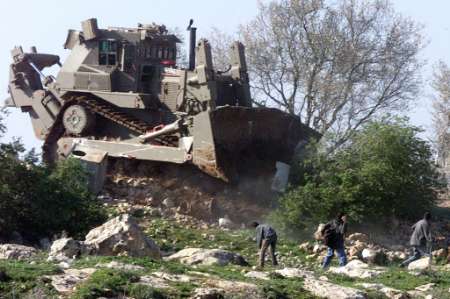
On 25 October, the army left demolition orders under stones at the entrances to homes in the village. On 29 October, soldiers in jeeps and bulldozers began to demolish the tents and caves without giving the residents leave to remove their possessions. According to testimonies villagers gave to B'Tselem, soldiers beat a villager who tried to protect his flock, which he kept in one of the caves. Only after an officer intervened was he allowed to evacuate his livestock.
Demonstrations for the protection the fundamental rights of Palestinians turned ugly

Apartheid Masked as Peace, 28.11.07. For the declaration of principles and endorsers of the Ramallah demonstration click here. On Tuesday, the 27th of November, non-violent demonstrations calling to uphold the fundamental rights of Palestinians turned ugly. In demonstrations across the West Bank, from Ramallah, to Bethlehem, to Hebron, protesters were set upon by Palestinian police for stating their opinions.
The non-violent protesters came from all walks of life. One of the Ramallah demonstrations that was organized by the Grass Roots Anti-Aparthied Wall Campaign and dozens of Palestinian civil society organizations from throughout the West Bank, Gaza, and inside Israel.
The demonstration called for a process of negotiation “aimed at the implementation of the rights of our people, and the establishment of a timeline for such implementation, not negotiation on the rights themselves.” The people present, as well as the things they chanted, were consistent in supporting a just peace and national unity.

In Ramallah 200 people were detained, including Jamal Juma’, Coordinator of the Popular Campaign against the apartheid wall and 30 people were injured. Police began attacking and arresting people for holding signs, and speaking their mind. Signs and banners were confiscated, and journalists, or even people filming with their cellphones, were particularly targeted for violent oppression by the police. Live fire was used to threaten the demonstration, and police drove by with machine guns raised.
In Bethlehem 50 people were detained, and the police used water cannons to subdue the crowd. Here, like elsewhere, journalists were specifically targeted. In Hebron 37 year old protestor Hisham Barad’i was killed. According to Palestinian news agency Maan medical sources said that Palestinian security forces shot Barad’i in the heart during a 2500 strong demonstration organized by the Islamic group Hizeb Ut-Tahrir .

photo by PENGON/Anti-Apartheid Wall Campaign
Hamas: statehood Bush promised
Ezzedeen Al Qassam Brigades, 28.11.07. The Islamic resistance movement Hamas expressed its deeply condemnation of Abbas word at Annapolis. The movement said that Abbas speech included an abusive sentences to the Palestinian history, to their struggle and to its leaders.
Islamic Hamas movement described the Palestinian statehood which U.S. President George W. Bush has called for creating as "vague and illusory." Speaking at the opening of Annapolis conference, Bush said it was time for a new Palestinian statehood.
"Bush did not clarify the boundaries of the Palestinian statehood and did not set a timetable for its creation," Salah Al-Bardaweel, a spokesman for Hamas lawmakers.
"Bush did not speak about the statehood's form, nature and the refugees and he did not specify the capital either."
Al-Bardaweel added Hamas understands from Bush's speech that the Palestinian statehood will not be created since Palestinian President Mahmoud Abbas and his men did not apply the security plans that aim at protecting the Zionist entity.
Meanwhile, Al-Bardaweel criticized Abbas for going to Annapolis amid solid opposition by Hamas, the biggest Palestinian faction. "Abbas is not authorized to make decision on behalf of the Palestinian people
Annapolis agreement: full text
"In furtherance of the goal of two states, Israel and Palestine, living side by side in peace and security, we agree to immediately launch good-faith bilateral negotiations in order to conclude a peace treaty, resolving all outstanding issues, including all core issues without exception, as specified in previous agreements.
"We agree to engage in vigorous, ongoing and continuous negotiations, and shall make every effort to conclude an agreement before the end of 2008. For this purpose, a steering committee, led jointly by the head of the delegation of each party, will meet continuously, as agreed.
"The steering committee will develop a joint work plan and establish and oversee the work of negotiations teams to address all issues, to be headed by one lead representative from each party. The first session of the steering committee will be held on 12 December 2007.
"President Abbas and Prime Minister Olmert will continue to meet on a biweekly basis to follow up the negotiations in order to offer all necessary assistance for their advancement.
"The parties also commit to immediately implement their respective obligations under the performance-based road map to a permanent two-state solution to the Israel-Palestinian conflict, issued by the Quartet on 30 April 2003 - this is called the road map - and agree to form an American, Palestinian and Israeli mechanism, led by the United States, to follow up on the implementation of the road map.
"The parties further commit to continue the implementation of the ongoing obligations of the road map until they reach a peace treaty. The United States will monitor and judge the fulfillment of the commitment of both sides of the road map. Unless otherwise agreed by the parties, implementation of the future peace treaty will be subject to the implementation of the road map, as judged by the United States."
L'intégralité de la déclaration israélo-palestinienne lors du sommet d'Annapolis
Testo in italiano della "dichiarazione comune d'intenti" <http://www.infopal.it/testidet.php?id=6930>
Un assegno in bianco
UN Director of operations: UNRWA cannot feed 200,000 Palestinian children in its schools
Translated by Manar Jibrin-IMEMC News
Omelettes into Eggs
As we said then, before the partition resolution: the Palestinian people exists. Even after 60 years, in which they have suffered catastrophes which few other peoples have ever experienced, the Palestinian people clings to its country with unparalleled fortitude. True, the dream of living together in one state is dead, and will not come to life again. But I have no doubt that after the Palestinian state comes into being, the two states will find ways to live together in close partnership. The walls will be thrown down, the fences will be dismantled, the border will be opened, and the reality of the common country will overcome all obstacles. The flags of the country - the two flags of the two states - will indeed wave side by side.
The UN resolution of November 29, 1947, was one of the most intelligent in the annals of that organization. As one who strenuously opposed it, I recognize its wisdom.
martedì 27 novembre 2007
Striscia di Gaza, almeno sette morti negli scontri delle ultime 24 ore
A Rafah sarebbe morto inoltre un civile, colpito accidentalmente da una cannonata, ma l'episodio non ha per il momento conferma ufficiale. Contemporaneamente sono aumentati i lanci di razzi e di colpi di mortaio contro villaggi israeliani del Neghev. Stamane un razzo è esploso presso il Kibbutz di Nir-Am, senza provocare vittime.
Miliziani palestinesi hanno anche cercato a ripetizione di deporre ordigni ai margini dei reticolati di confine. Ieri due di loro che tentavano di sistemare dell'esplosivo presso il kibbutz di Kfar Azza sono stati colpiti dal fuoco di un elicottero da combattimento. Un palestinese che cercava di fare altrettanto oggi presso il valico di Sufa è stato ucciso da una pattuglia di confine.
Sempre oggi due miliziani di Hamas sono stati intercettati nella zona di Jabalya (a nord di Gaza) da una pattuglia della brigata israeliana Golani. Uno dei due, a quanto pare, indossava un corpetto esplosivo. Un portavoce dei Comitati di resistenza popolare ha intanto avvertito che gli attacchi contro Israele sono destinati a proseguire nelle prossime ore, in concomitanza con la Conferenza di Annapolis a cui Hamas - che governa la intera striscia di Gaza - si oppone strenuamente. Nella giornata di oggi a Gaza si svolgerà una grande manifestazione di protesta contro quella conferenza.