lunedì 1 ottobre 2007

A Qassam ambush in the Gaza Strip against the occupation soldiers

A Zionist special force from the Zionist occupation army was ambushed when it was trying to sneak to Jabalia camp, by Ezzedeen Al Qassam Brigades, the military wing of the Islamic Resistance Movement "Hamas", which caused casualties, in the early morning of Monday.

Al Qassam Brigades said that the Zionist special forces were moving on foot behind the cemetery east of the Jabalia camp (northern Gaza Strip), when the Mujahideen surprised it and detonated two explosive devices. Then they clashed with the Zionist forces.

According to a communiqué issued by Al Qassam Brigades, the operation began after the midnight on Monday. The Mujahideen ambushed Zionist forces behind the cemetery east of the eastern Jabalia. The mujahideen detonate two explosive devices and clashed face to face with the soldiers.

Qassam sources reported that the soldiers was heard screaming and the Helicopters were landing to took out the injures. Also, A huge number of vehicles attacked the area of the operation to save the injured soldiers.

Ezzedeen Al Qassam Brigades, 01/10/07.Al-Qassam Brigades confirmed that this operation came as a response to the continued Zionist attacks in the Gaza Strip and a defense to any violation in the liberated Strip.

Al-Qassam Added " After the declaration of this operation, we warned the Zionist enemy of any trying to attack any part of the Gaza Strip as our responses will be harsh and painful to the occupations' soldiers and vehicles …"

Al-Qassam Brigades mourns the death of two mujahideen in the operation: Bilal Jamal Abu Shkiyan ,22 years from Jabalia camp and Ahmed A'ish Al Amodi ,22 years from the same camp in northern Gaza Strip, who were martyred when they detonate two explosive devices on Zionist special forces. After that, they clashed with the Zionist occupation forces.

The Zionist media admitted the injured of one soldier in the operation and Al-Qassam Brigades expected a huge number of injures and deaths inside the Zionist soldiers.

Al Mezan Commends Hanniyeh's Instructions to Security Personnel in Gaza; Calls for Enforcing Them

30.09.07. Al Mezan received a copy of a decision issued on 26 September 2007 by the deposed Prime Minister and acting Minister of Interior, Mr. Ismail Hanniyeh. The decision includes instructions directed to the commanders of the 'Internal Security Forces'. Notwithstanding the positive content of this decision, the information retrieved by Al Mezan from the field shows that many of the illegal conducts that preceded its issuance have continued. The Executive Force (EF), Hamas' policing body, carried out dozens of arrests in the towns of Khan Younis and Rafah, south of the Gaza Strip, in which the EF's members did not observe the due process in terms of the arrest procedures, the conditions and places of detention, the rights of the detained people or the limitations on the interrogation procedures.

Al Mezan welcomes this decision, which instructs the internal security under the command of the deposed government to respect the rule of law, respect and protect freedoms, political activism and peaceful assembly. It also instructs them to respect and follow the due process as far as arrest and detention are involved, and to respect the rights of all individuals under their custody; including informing them of the reasons of their detention and the places where they are detained. The decision states that arrest warranties can only be issued by a legally authorized body, and that persons under detention must be allowed access to a legal counsel.

Al Mezan asserts the significance of issuing these instructions which, if implemented, could produce positive impacts on human rights in Gaza. Al Mezan therefore calls for creating adequate mechanisms to ensure full implantation on the ground of these instructions. Effective tools for monitoring and accountability for non-abidance by these instructions are crucial for ensuring their effective implementation.

Notwithstanding the positive content of this decision, the information retrieved by Al Mezan from the field shows that many of the illegal conducts that preceded its issuance have continued. The Executive Force (EF), Hamas' policing body, carried out dozens of arrests in the towns of Khan Younis and Rafah, south of the Gaza Strip, in which the EF's members did not observe the due process in terms of the arrest procedures, the conditions and places of detention, the rights of the detained people or the limitations on the interrogation procedures.

According to field sources, at approximately 7pm on Saturday 29 September 2007, confrontations broke out between prayers and members of the EF, when the EF arrived at the scene to defuse a dispute between prayers supporting Fatah and others supporting Hamas in a mosque near Nasser Hospital in Khan Younis. Over 20 people were injured and 14 others arrested; of whom seven were released after being subjected to torture and degrading treatment. The other seven have been kept under the EF's custody. Members of the EF also broke into four homes in the neighborhood without observing the relevant legal procedures as stipulated in the Palestinian Penal Law and the Basic Law. This despite that the above-mentioned decision asserts the full respect of both laws.

In the town of Rafah, the EF arrested eight persons. The arrests occurred at approximately 11.05pm on Thursday 27 September 2007, after a grenade had been thrown at Raja'i and Mahmoud Hussein and injured them. At approximately 1am, on the next day, the EF prevented their family from visiting them at Abu Yousif An-Najar Hospital on the pretext that they were affiliated with Fatah. A dispute started between the family members and the EF. According to eyewitnesses, an EF's member opened fire at 23-year-old Mousa Hussein, who was injured in left leg. Further, the EF beat seven members of the family. Medical sources reported that the condition of one of them; Imad Ad-Din Hussein, was critical as he sustained fractures in the skull and right arm.

Al Mezan Center for Human Rights views with much concern the excessive and disproportionate use of force, as well as other illegal conducts, that have been carried out by the EF. Many of these conducts have occurred after the issuance of the above-mentioned decision; a fact that necessitates the creation of adequate mechanisms to monitor its implementation and hold accountable those who do not observe its full respect on the ground.

Al Mezan renews its commendation of Mr. Hanniyeh's decision, and views it as a step in the right direction. However, Al Mezan believes this step will fall short the expectations without adequate implementation, monitoring and accountability mechanisms that ensure its respect and implementation on the ground to guarantee respect of the rule of law.

The Morning After: IDF, Police Evacuate 5 Activists' Outposts


Settlers Star of David at Ma'alot Halhul
Tzvi Ben Gedalyahu

Hana Levi Julian. (IsraelNN.com). 19 Tishrei 5768, October 1, '07. After a chilly night in the hills of Judea and Samaria, dozens of activists awoke to find themselves being evicted from the sites where they hope to build new Jewish communities in the near future.

Hundreds of Jews had spent Sunday night celebrating the holiday of Sukkot on the breezy hilltops, where sparks of light twinkling in the inky darkness were the only signs of other Jewish communities already well-established in the areas.

Although determined to stay, activists at two of the sites were removed by IDF soldiers and police in the early morning light. However, some of the activists fled to nearby vineyards to escape evacuation.

Police swooped down on the dozens of people who camped out in Judea at Ma’alot Halhul in the Judean Hills south of Hevron, evicting them by 8:00 a.m.

One young woman activist said that five black-suited police officers tried to force them off the site Sunday night, but that the activists far outnumbered them. The police later returned with reinforcements and wrecked two sukkot that had been erected, but no serious violence took place. One soldier told IsraelNN.com, "Most of us support you."

Those who stayed overnight at Nofei Hashmonaim, in the Binyamin district, were taken out of the area by police in two groups. One was dropped off at the nearby community of Gamzu and the other was taken to roads leading to Jerusalem.

Activists at three other sites – Harchivi near Elon Moreh, Shvut Ami near Kedumim and Givat HaEitam on the outskirts of Efrat--were joined by supporters from nearby communities as they prayed the morning service. IDF soldiers and police officers were making preparations to carry out evictions there as well.

The ascent to the sites of the five hoped-for communities was carried out Sunday with smiles and song as activists celebrated Sukkot, when holiday booths are built as a reminder of the clouds of glory that protected the Jews in the desert on their way to the Promised Land.

Chief Rabbi Shlomo Riskin led hundreds of Efrat residents to the site of Givat Eitam (Eitam Hill), earmarked to become the city’s newest neighborhood. The site is located within the city limits at the northern edge of Efrat and is intended to connect the eastern and western parts of Gush Etzion.

Another group of activists marched to Shvut Ami (“the return of my people”), to be built in western Samaria, and more hiked their way to to the hilltop of Harhivi (meaning “expand”, based on the passage in Isaiah 54: “Expand the place of thy tent… for thou shalt break forth both right and left”), located in eastern Samaria.

Those who marched to the sites included dozens of children under age 12 and hundreds of teens. “But there were many adults in their 30’s, 40’s and 50’s,” said one activist. “Some were in their 70's.”

Plans are still on for Tuesday’s march to Homesh, one of the four northern Samarian towns destroyed during the Disengagement of 2005.

The organizers have made no secret of their plans to rebuild the town, and have made dozens of ascents to the area over the past several months. MK Aryeh Eldad (National Union) called on the Defense and Public Security Ministers to instruct the police and army to permit and protect the marchers.

Tzvi Ben Gedalyahu and Hillel Fendel contributed to this story

Pioneers on Their Way to 5 New Towns

Hillel Fendel, IsraelNationalNews, 30.09.07 18 Tishrei 5768. All eyes are on the clock, with 1:30 PM set as H-hour for the ascent to five new hilltop outposts in Judea and Samaria. Clashes with soldiers and police are expected. As of 12 noon Sunday, a group of idealistic youths was already climbing the hilltop near Kiryat Arba set to be named Maalot Halhoul. Near Hashmonaim, in western Binyamin, hundreds of people are making their way to a site they wish to build as the community of Nofei Hashmonaim, just ten kilometers east of Ben Gurion International Airport. The army has declared the area a closed military zone, and is out in force to prevent the Jews from arriving.

In Efrat, Rabbi Shlomo Riskin and hundreds of townspeople are set to gather at 1 PM, preparing to march to the site of Eitam Hill, in the northern end of the city. The organizers say the hill, which connects eastern and western Gush Etzion, "belongs to Efrat, but is being stolen from us by the political [partition] fence. Handing it over to the Arab enemy will endanger all of Gush Etzion and Jerusalem."

Similar attempts to create new Jewish towns are underway in western Shomron, near Kedumim, at a site to be called Shvut Ami ("the return of my nation"), and in eastern Shomron, near Elon Moreh, at a hilltop already named Harhivi (meaning "Expand," based on Isaiah 54: "Expand the place of thy tent... for thou shalt break forth both right and left").

"It would seem that the Israel Defense Forces would be interested in defending Israeli interests," one of the leading organizers, Datit Yitzchaki, told Arutz-7, "and would allow us to build these new towns. Instead, the Olmert government makes plans to turn over these areas to our enemy - repeating the mistakes of the Disengagement and similarly endangering hundreds of thousands more Israelis - and gives political orders to the army to stop us."

Asked what the pioneers are bringing with them to the sites, Yitzchaki said, "They are bringing what they need to remain out in the fields or hills for 24 hours. It depends on how violent the army is going to be. We don't think the army will be able to stay in the area in such force for 24 hours - so we'll wait them out if we have to. We have time. As the motto goes, the Nation of Israel does not fear a long trek."

Three planners of the new Hashmonaim community were arrested in a Wednesday morning raid. The police also confiscated from their homes items such as orange hats (orange being the color of the Land of Israel movement), bumper stickers and T-shirts promoting settlement in Yesha. The most common slogan: "Eretz Yisrael (Land of Israel) - We Continue With Our Heads Held High."

For more information on the plans to start the new Jewish towns, click here.

Some 20 rabbis of Gust Etzion have signed a proclamation in favor of the attempts to build the new towns. The rabbis state that the next step in settling the Land of Israel - "a commandment that is equal to all the others in the Torah" - is now to "build the hilltops, whose construction and development are being held up for various strange reasons stemming primarily from the weakness of our leadership, and also from a failure to see the reality religiously, politically and demographically."

Plans are also underway to march to Homesh, one of the four Shomron towns destroyed during the Disengagement of 2005. The organizers have made no secret of their plans to rebuild the town, and have made dozens of ascents to the area over the past several months. MK Aryeh Eldad (National Union) called on the Defense and Public Security Ministers to instruct the police and army to permit and protect the marchers.

domenica 30 settembre 2007

OPT: Dozens of Palestinians sift through rubbish tips to survive


Photo Shabtai Gold/IRIN
Palestinians looking for re-usable materials, especially metals, at the Psagot landfill near Ramallah

SAGOT, WEST BANK, 30 September 2007 (IRIN) - For some West Bank Palestinians rubbish has become not only a livelihood but the only method of survival they know. Many dozens of Palestinians across the territory, including children, work at landfill sites, trying to earn a meagre living.

"This is very hard work here. My hands are all cut up, it smells. But what can I do? There's no work in Ramallah," said Muhammad, from Al-Bireh, a nearby town.

Aged 43, he has worked for the last 30 years - apart from a stint in jail - in the Psagot landfill site, sifting through the rubbish in search of scrap metal.

Muhammed, like the other 40 or so workers, including 20 children, is not officially employed by anyone, but he sells what he can to dealers he knows.

Another man, Akram, aged 32, drives the tractor which takes the scrap away to the dealers. He, like the others, works at the site from early morning until dusk.
More on Palestinian children
Israeli incursion into West Bank refugee camp causes destruction, fear
UN moves to counter deteriorating Gaza education levels
Hamdi Aman: "Her injuries are forever, for the rest of her life”
Poverty driving Palestinian children onto the streets

"I was a regular truck driver. But then I lost my job. This was the only work I could find, working with the rubbish," he told IRIN as he revved his engine to cart away an industrial fan and leftover beams from a building project.

Child labour, illiteracy

Two children, happy with their luck, found the fan, which came on a newly arrived dump truck, and dragged it over to Akram.

"None of the children here can write. They can't read. They never spent any time at school," said Muhammad.

Shadi, who first claimed he was 16 and then said he was 12, became enraged at Muhammad's accusation.

"I can write," he screamed, and began to sketch his name, in Arabic, in the sand. However, it soon became clear this was the only word he knew and he could not recognise individual characters. The other children did not even try.

When asked why he did not attend school, Shadi said: "My father is sick. I have a big family and someone needs to support them. I left school after one year to work here."

Legal issues
''None of the children here can write. They can't read. They never spent any time at school.''

The Psagot site is named after the nearby Israeli settlement on the outskirts of Ramallah. Mostly, the landfill is used by Israeli trucks bringing in refuse from settlements or towns inside Israel.

"There is much more garbage from Israel than from the Palestinians. Much, much more," said Muhammad.

Health threats

Vultures glide overhead, waiting to grab whatever the workers do not.

In the summer, the heat bakes the garbage, sending a vile smell through the air, which sticks to the workers. While some have families, others realise their line of work may not help their personal lives.

"I don't think I will get married," said Ahmed, aged 20. He said the smell never comes off.

In the winter, the workers fight the cold, rain, wind and frost to carry out their work. This is particularly hard since the metals they collect get very cold. A few live in shacks on the site, as they have nowhere else to go.

Besides the elements, the workers face other dangers.

Photo: Shabtai Gold/IRIN
A Palestinian child carries metal scraps to a pile he has collected from sifting through garbage at the Psagot landfill. He also saves plastic chairs and used toys

"The children suffer greatly," said Ahmed Qunnam, a public health expert and medical doctor, who volunteers with the Palestine Red Crescent Society. "Psychologically speaking, they have no normal social system. Also, they don't eat right and they don't develop properly. They work all day, overexerting themselves. And the sites are extremely unhygienic."

At the Psagot site, for example, the workers found a can of olives. It was immediately opened and devoured, although the expiry date had long passed and the hands used to eat were the same ones used to sift the rubbish.

"This whole thing, it just ruins them for later in life. They are losing their childhood," said Qunnam. "It is easy for them to get into drugs."

The workers also face threats from other people's drug use. While sifting through the rubbish, it is not uncommon to find syringes. "They can get HIV or hepatitis," Qunnam said.

He thinks the Palestinian Authority (PA) must do more for the children, but said it is hard for the PA to exert control over Area C - where the sites are - which remained under Israeli security control, according to the Oslo accords.

Ibrahim Atieh, from the Palestinian Ministry of Health, said the number of children at the landfills was proportionately much smaller than in neighbouring countries. "But, this is a very difficult, painful issue. Who knows what diseases they can get," he told IRIN.

"There is no PA [Palestinian Authority] programme to stop this phenomenon right now, but maybe in the future," he said.

Resistenza nonviolenta, due manifestazioni contro il Muro dell'Apartheid.

Ramallah/Gerusalemme - Infopal. 29/09/07. A dispetto della recente sentenza dell'Alta Corte di Giustizia israeliana, che ha sentenziato l'illegalità della costruzione del Muro a Bil'in e ne ha chiesto la rimozione, i lavori stanno continuando.

Durante la manifestazione settimanale nonviolenta, che da oltre due anni si svolge nella cittadina Bil'in, nei pressi di Ramallah, 9 civili sono stati feriti dall'esercito israeliano.

Come consueto, cittadini di Bil'in, stranieri e pacifisti israeliani hanno marciato, dopo la preghiera del venerdì, verso il Muro che il governo di Israele sta facendo erigere per sottrarre altre terre palestinesi.

I militari hanno attaccato la folla con bastoni, bombe a gas e al suono, ferendo nove persone.

Sempre nella giornata di ieri, un centinaio di cittadini palestinesi, di stranieri e israeliani hanno manifestato in modo pacifico contro la costruzione illegale del Muro di Separazione sulle terre di al-Walaja, nei pressi di Gerusalemme.

I soldati israeliani hanno circondato i manifestanti, ma li hanno lasciati marciare.

I pacifisti sono rimasti per un'ora e mezza davanti al Muro, tenendo discorsi e sventolando bandiere palestinesi.

JVP News Roundup September 30

Jewish Voice for Peae. The United States' military action in Iraq as well as the simmering conflict between Israel and Syria, the worsening situation with the Palestinians and on top of last summer's war between Israel and Hezbollah have greatly increased the instability in the never-stable Middle East. The prospect of an attack on Iran would greatly magnify the already considerable instability even by Mideast standards. While a strike on Iran is still much less likely than one might believe from the headlines, those pressing for such an attack have increased their efforts greatly, so the possibility is greater than ever.

When Iranian president Mahmoud Ahmadinejad came to Columbia University and the United Nations in New York this week, the response was powerful. Many protests and calls for Ahmadinejad to be barred from entering the country were heard. Columbia president Lee Bollinger embarrassed both the university and the country with his scathing attack on Ahmadinejad when he was supposed to be introducing him to the audience. No matter how deep the enmity is for a visiting foreign dignitary, this was inappropriate behavior. Either don't invite him or maintain an air of civility. Bollinger need not have praised Ahmadinejad, but his behavior was unnecessary and, in the end, it didn't stop petitions from circulating that he be fired for having allowed Ahmadinejad to speak at Columbia anyway.

On September 21, Iran challenged the international community to devote the same scrutiny to Israel's nuclear arsenal, the worst-kept secret in the world, as it does to Iran's nuclear efforts. One actually wonders what took Iran so long to issue this challenge. Israeli officials responded by not responding, simply repeating that Iran just hates Israel and should not be heeded, but not denying its own nuclear ability nor admitting that it escapes standard scrutiny.

In the end, the hysteria over Ahmadinejad is misplaced; whatever he is or is not (and it is obvious that the man is a loose cannon, a Holocaust denier, and dogmatic but not very learned religious fundamentalist), he does not control Iran's military or its foreign policy. That is left to Supreme Leader, Ayatollah Ali Khameini. Moreover, Iran has never attacked another country directly, and its posture against Israel, while certainly hostile, has remained within the confines of defensive statements. The oft-repeated threat to "wipe Israel off the map" was a mistranslation and, while the statement (which was actually Ahmadinejad quoting the Ayatollah Khomeini) was certainly belligerent, it was not a threat. In any case, the Iranian president does not have the power to back any of this up and both history and current actions indicate that Iran's political elite, which disapproves of Ahmadinejad in any case, has not changed its historically defensive orientation.

For a more detailed exposition of the tensions with Iran, click here.

Meanwhile, the Israeli government is tightening the squeeze on the Gaza Strip. By declaring Gaza a "hostile entity," Israel now has the option to diminish or cut off completely all the services on which Gaza depends, such as water and electricity. It is a sharp reminder of why Jewish Voice for Peace has long insisted that a complete separation of Israelis and Palestinians is neither possible nor practical. Israel needs a healthy Palestinian entity if it is ever to find peace and security and both Gaza and the West Bank will take many years to be able to survive completely independently as both areas have relied on infrastructure from outside those areas for many decades, since well before the occupation began.

If you did not get a chance to act on the JVP action alert last week calling on the US government to ensure that Israel does not cause further suffering for innocent Palestinians in its quest to combat Hamas, you can still act on it by clicking here. It seems far more likely that this move will harden feelings in Gaza in support of Hamas, and it is certain to make Hamas more resolute.

The raid on Syria earlier this month remains shrouded in mystery, but it has also continued to breathe and create fallout. An exceedingly foolish resolution supporting an Israeli action whose goals and circumstances are still completely unclear was introduced in Congress this week by Rep. Robert Wexler (D-FL). While the resolution would have no effect other than issuing a statement, it is highly irresponsible for Congress to make such a statement based, as Wexler himself said, only on the scant reports that have appeared in the media, many of which are unconfirmed.

The attack on Syria can be taken as fact, at this point, but the circumstances, and especially the target, remain unclear. The Times of London published a report that alleged that elite Israeli commandoes had slipped into Syria and confirmed the presence of nuclear material, at which point Washington gave the go-ahead for an Israeli operation. But the Times report remains unconfirmed and the sources ambiguous.

The November Peace Conference

Mahmoud Abbas has reaffirmed his commitment to attend a peace conference this fall despite pressures from some quarters and the absence of a clear set of goals and an agenda. Abbas also believes that Saudi Arabia will attend after all.

The United States finally cleared up whether or not Syria would be invited to the conference, saying it would be. It might have been interesting to see how Syria would have reacted to such an offer before the Israeli attack. In the event, Israel as well said it welcomed Syrian participation. But Syria stated that it believed Israel's overtures were insincere and that it would not attend the conference.

The conference continues to appear to be little more than a showpiece for the Bush Administration to seem like it is making a genuine effort at peace, and perhaps a bone being thrown to Condoleezza Rice. The content appears questionable, although Ehud Olmert, realizing that his earlier statements were clearly diminishing the significance of the conference, has started to talk a bit more about the concessions he is willing to make. His statement regarding making "heavy concessions" shows once again the vast difference between an Israeli generous offer and minimal Palestinian requirements. While Olmert assures everyone he will not give up all of the West Bank, Mahmoud Abbas continues to talk about the borders being the same or very close to those that existed before the 1967 war. It was this same disconnect that doomed the Camp David II talks before they ever started. Those who fail to learn from history...

Gaza Truce Offers?


An unconfirmed report that Israel had explored opening dialogue with Hamas with the goal of attaining the release of Gilad Shalit, held by Hamas since June 2006 and achieving a truce were quickly followed by more solid reports of a Hamas appeal to Israel for a cease-fire. Israel rejected any such talks with Hamas. The approach was Hamas' response to Israel's declaration that Gaza was a "hostile entity."

Soon after this, a group of Israeli intellectuals led by A.B. Yehoshua, Amos Oz and David Grossman (whose son was killed last year in Lebanon) sent an open letter to Ehud Olmert urging him to engage Hamas in talks. "In the past Israel has negotiated with its worst enemies," the petition reads. "And now, the correct course of action is to negotiate with Hamas in an effort to foment a general cease fire that will prevent further suffering on both sides."

Dividing Jerusalem

Vice Prime Minister Haim Ramon caused something of a stir when he presented a plan for dividing Jerusalem as part of a future agreement with the Palestinians. The issue remains a sensitive one, which only shows how difficult it will be politically to reach an agreement on an issue which must be resolved if there is ever to be peace. The plan Ramon presented was similar to plans that had been discussed after the Camp David talks and lines up well with the Clinton Parameters and the subsequent discussions at Taba in 2001.

In the seventh anniversary of Al-Aqsa Intifada: Abu Obiada gives details about stages of resistance and making weapons

Ezzedeen Al-Qassam Beigades, 30/09/07. A message to the Palestinian people on the anniversary of the Intifada?

Greetings to the people of martyrs and prisoners, who proved their ability to do great sacrifices in order to achieve their objectives. We are ready to sacrifice ourselves in the fields of Jihad, honor and heroism. We will defend our land till liberation or Martyrdom.
full text

Abu Obiada is the spokesman of Ezzdeen Al-Qassam Brigades

Twilight Zone / The children of 5767


Gideon Levy, Haaretz, 28/09/07. It was a pretty quiet year, relatively speaking. Only 457 Palestinians and 10 Israelis were killed, according to the B'Tselem human rights organization, including the victims of Qassam rockets. Fewer casualties than in many previous years. However, it was still a terrible year: 92 Palestinian children were killed (fortunately, not a single Israeli child was killed by Palestinians, despite the Qassams). One-fifth of the Palestinians killed were children and teens - a disproportionate, almost unprecedented number. The Jewish year of 5767. Almost 100 children, who were alive and playing last New Year, didn't survive to see this one. One year. Close to 8,000 kilometers were covered in the newspaper's small, armored Rover - not including the hundreds of kilometers in the old yellow Mercedes taxi belonging to Munir and Sa'id, our dedicated drivers in Gaza. This is how we celebrated the 40th anniversary of the occupation. No one can argue anymore that it's only a temporary, passing phenomenon. Israel is the occupation. The occupation is Israel.

And this was the year of the children that were killed. We didn't get to all of their homes, only to some; homes of bereavement where parents weep bitterly over their children, who were climbing a fig tree in the yard, or sitting on a bench in the street, or preparing for an exam, or on their way home from school, or sleeping peacefully in the false security of their homes.

A few of them also threw a rock at an armored vehicle or touched a forbidden fence. All came under live fire, some of which was deliberately aimed at them, cutting them down in their youth. From Mohammed (al-Zakh) to Mahmoud (al-Qarinawi), from the boy who was buried twice in Gaza to the boy who was buried in Israel. These are the stories of the children of 5767.

The first of them was buried twice. Abdullah al-Zakh identified half of the body of his son Mahmoud, in the morgue refrigerator of Shifa Hospital in Gaza, by the boy's belt and the socks on his feet. This was shortly before last Rosh Hashanah. The next day, when the Israel Defense Forces "successfully" completed Operation Locked Kindergarten, as it was called, leaving behind 22 dead and a razed neighborhood, and left Sajiyeh in Gaza, the bereaved father found the remaining parts of the body and brought them for a belated burial.

Mahmoud was 14 when he died. He was killed three days before the start of the school year. Thus we ushered in Rosh Hashanah 5767. In Shifa we saw children whose legs were amputated, who were paralyzed or on respirators. Families were killed in their sleep, or while riding on donkeys, or working in the fields. Operation Locked Kindergarten and Operation Summer Rains. Remember? Five children were killed in the first operation, with the dreadful name. For a week, the people of Sajiyeh lived in fear the likes of which Sderot residents have never experienced - not to belittle their anxiety, that is.

The day after Rosh Hashanah we traveled to Rafah. Dam Hamad, 14, had been killed in her sleep, in her mother's arms, by an Israeli rocket strike that sent a concrete pillar crashing down on her head. She was the only daughter of her paralyzed mother, her whole world. In the family's impoverished home in the Brazil neighborhood, at the edge of Rafah, we met the mother who lay in a heap in bed; everything she had in the world was gone. Outside, I remarked to the reporter from French television who accompanied me that this was one of those moments when I felt ashamed to be an Israeli. The next day he called and said: "They didn't broadcast what you said, for fear of the Jewish viewers in France."

Soon afterward we went back to Jerusalem to visit Maria Aman, the amazing little girl from Gaza, who lost nearly everyone in her life to a missile strike gone awry that wiped out her innocent family, including her mother, while riding in their car. Her devoted father Hamdi remains by her side. For a year and a half, she has been cared for at the wonderful Alyn Hospital, where she has learned to feed a parrot with her mouth and to operate her wheelchair using her chin. All the rest of her limbs are paralyzed. She is connected day and night to a respirator. Still, she is a cheerful and neatly groomed child whose father fears the day they might be sent back to Gaza.

For now, they remain in Israel. Many Israelis have devoted themselves to Maria and come to visit her regularly. A few weeks ago, broadcast journalist Leah Lior took her in her car to see the sea in Tel Aviv. It was a Saturday night, and the area was crowded with people out for a good time, but the girl in the wheelchair attracted attention. Some people recognized her and stopped to say hello and wish her well. Who knows? Maybe the pilot who fired the missile at her car happened to be passing by, too.

Not everyone has been fortunate enough to receive the treatment that Maria has had. In mid-November, a few days after the bombardment of Beit Hanoun - remember that? - we arrived in the battered and bleeding town: 22 killed in a moment, 11 shells dropped on a densely packed town. Islam, 14, sat there dressed in black, grieving for her eight relatives that had been killed, including her mother and grandmother. Those disabled by this bombardment didn't get to go to Alyn.

Two days before the shelling of Beit Hanoun, our forces also fired a missile that hit the minibus transporting children to the Indira Gandhi kindergarten in Beit Lahia. Two kids, passersby, were killed on the spot. The teacher, Najwa Khalif, died a few days later. She was wounded in clear view of her 20 small pupils, who were sitting in the minibus. After her death, the children drew a picture: a row of children lying bleeding, their teacher in the front, and an Israeli plane bombing them. At the Indira Gandhi kindergarten, we had to bid good-bye to Gaza, too: Since then, we haven't been able to cross into the Strip.

But the children have come to us. In November, 31 children were killed in Gaza. One of them, Ayman al-Mahdi, died in Sheba Medical Center at Tel Hashomer, where he had been rushed in grave condition. Only his uncle was permitted to stay with him during his final days. A fifth-grader, Ayman had been sitting with friends on a bench on a street in Jabalya, right by his school. A bullet fired from a tank struck him. He was just 10 years old.

IDF troops killed children in the West Bank, too. Jamil Jabaji, a boy who tended horses in the new Askar refugee camp, was shot in the head. He was 14 when he was killed, last December. He and his friends were throwing rocks at the armored vehicle that passed by the camp, located near Nablus. The driver provoked the children, slowing down and speeding up, slowing down and speeding up, until finally a soldier got out, aimed at the boy's head and fired. Jamil's horses were left in their stable, and his family was left to mourn.

And what did 16-year-old Taha al-Jawi do to get himself killed? The IDF claimed that he tried to sabotage the barbed-wire fence surrounding the abandoned Atarot airport; his friends said he was just playing soccer and had gone to chase after the ball. Whatever the circumstances, the response from the soldiers was quick and decisive: a bullet in the leg that caused him to bleed to death, lying in a muddy ditch by the side of the road. Not a word of regret, not a word of condemnation from the IDF spokesman, when we asked for a comment. Live fire directed at unarmed children who weren't endangering anyone, with no prior warning.

Abir Aramin was even younger; she was just 11. The daughter of an activist in the Combatants for Peace organization, in January she left her school in Anata and was on the way to buy candy in a little shop. She was fired upon from a Border Police vehicle. Bassam, her father, told us back then with bloodshot eyes and in a strangled voice: "I told myself that I don't want to take revenge. Revenge will be for this 'hero,' who was so 'threatened' by my daughter that he shot and killed her, to stand trial for it." But just a few days ago the authorities announced that the case was being closed: The Border Police apparently acted appropriately.

"I'm not going to exploit my daughter's blood for political purposes. This is a human outcry. I'm not going to lose my mind just because I lost my heart," the grieving father, who has many Israeli friends, also told us.

In Nablus, we documented the use of children as human shields - the use of the so-called "neighbor procedure" - involving an 11-year-old girl, a 12-year-old boy and a 15-year-old boy. So what if the High Court of Justice has outlawed it? We also recorded the story of the death of baby Khaled, whose parents, Sana and Daoud Fakih, tried to rush him to the hospital in the middle of the night, a time when Palestinian babies apparently mustn't get sick: The baby died at the checkpoint.

In Kafr al-Shuhada (the "martyrs' village") south of Jenin, in March, 15-year-old Ahmed Asasa was fleeing from soldiers who had entered the village. A sniper's bullet caught him in the neck.

Bushra Bargis hadn't even left her home. In late April she was studying for a big test, notebooks in hand, pacing around her room in the Jenin refugee camp in the early evening, when a sniper shot her in the forehead from quite far away. Her bloodstained notebooks bore witness to her final moments.

And what about the unborn babies? They weren't safe either. A bullet in the back of Maha Qatuni, a woman who was seven months pregnant and got up during the night to protect her children in their home, struck her fetus in the womb, shattering its head. The wounded mother lay in the Rafidiya Hospital in Nablus, hooked up to numerous tubes. She was going to name the baby Daoud. Does killing a fetus count as murder? And how "old" was the deceased? He was certainly the youngest of the many children Israel killed in the past year.

Happy New Year.

We set out each week in the footsteps of the fighters, in the West Bank and the Gaza Strip, trying to document the deeds of Israel Defense Forces soldiers, Border Police officers, Shin Bet security service investigators and Civil Administration personnel - the mighty occupation army that leaves behind in its wake horrific killing and destruction, this year as every year, for four decades.

Gaza's deadly guardians

The Sunday Times, 30/09/07. Ahmed Al-Naba’at, 24, sits in his courtyard in an oversized Barcelona shirt. He looks too young to be the father of the three young children who toddle barefoot round the tiny dirt courtyard.

His feet still hurt. Hamas came for him at 2am.

About 30 armed men, their faces masked but wearing the black uniforms and badges of the Izzedine al-Qassam Brigade, the military wing of Hamas, had surrounded the house. They covered his eyes and took him away in a car.

“They took me somewhere, I don’t know, a room,” Naba’at says. He has high cheekbones and the near-black skin of his Sudanese ancestry. “They were screaming and beating me, punching me, slapping me on the face,” he says. “Then they tied my legs together and started falaka” – a traditional Arabic torture where the soles of the feet are beaten with sticks. “I relaxed.”

He sees the surprise in my face. “I thought they were going to kill me,” he explains.

“When I realised it’s just falaka, I thought, okay, it’s just torture.”

Qassam dumped him near his home, hours later. It took him half an hour to walk what usually takes two minutes. “You were lucky,” interjects his unsympathetic father, who is sitting against a courtyard wall. “Most of the people they beat, they throw them unconscious in the street and they are not found until the morning.”

His crime? Earlier that night at a party for a friend’s wedding, Naba’at had danced and played a song popular in Gaza – an over-romanticised ballad to Samih al-Madhoun, a Fatah commander executed by Hamas during the fighting. Hamas cameramen had filmed as Madhoun was dragged down the street amid spitting crowds, shot in the stomach, beaten and shot some more. It was shown on Hamas television that night.

The overblown ballad of his death – “Your blood is not for free Samih/You left behind an earthquake/We will not forget you Samih” – is such a Gazan hit that many young people have it on their mobile phones. Hamas, predictably, is furious. Three of Al-Naba’at’s friends who had danced at the wedding were also beaten.

Al-Naba’at, who left school at 14 and worked as a farm labourer and painter, has little recourse. He is too afraid to sleep at home any more. His father is clearly exasperated – like many of the older generation, he thinks his sons should shut up. He points to another son, 17-year-old Mustafa. Hamas came after him when he burnt a Hamas flag: they arrested his father and twin brother until he gave himself up.

Hamas is not just going after the poor. Azil Akhras is a sophisticated 24-year-old woman with heavily kohled eyes, thick, flowing black hair and rouged lips, comfortable in her jeans and tight red shirt. Life used to be shopping, going out – maybe to Roots, a popular Gaza nightclub even though it now serves only soft drinks – and going to the beach. Her life changed dramatically three months ago when Hamas took over Gaza.

“Now, I cover my head when I go in a car. Hamas is at the checkpoints. Last week, they stopped a girl who was not covered and they beat her brother when he tried to protect her.”

She and her sister must be careful; they are alone. Their father, a former government health minister, has fled Gaza to escape Hamas. He has holed up in Ramallah, the West Bank capital, and is unable to return.

It’s not just shopping trips she misses. A university graduate, Akhras had wanted to sit her master’s degree; she wanted to travel. “I had an idea, I wanted to be famous in history. Maybe a journalist,” she says. “Now, there’s no chance, I can’t even go outside.” She resents Hamas’s repression. “If I decide to cover [my head], it will be for my God, not some Qassam soldier.”

Gazans are living in a climate of fear. The place is eerily serene, not only because of the presence of disciplined Hamas security forces on the streets but, as in all successful police states, because everyone has started policing themselves, afraid of the consequences of stepping over a line not defined in formal law.

full text

Israel-Gaza: Ceasefire Now!

29/07/07. Why is this so important right now? First, there is a humanitarian dimension which should apply anywhere in the world. In this instance it applies to the civilians of both Gaza and Southern Israel. Gideon Levy in Haaretz pointed out that if it was legitimate for Israel to maintain channels with Hamas for the release of Shalit, then it is surely acceptable to exercise those contacts in order to relieve the situation for Sderot residents.

Second, the basic alternative is to wait for a disaster to happen in the full knowledge that it will set in motion a sequence of events in which both Israelis and Palestinians lose. A reason the IDF hesitates in launching a full-scale invasion is their assessment that the costs would be high (in Palestinian suffering, for which Israel would be criticized, and in IDF losses), and the results in the long term are very limited. Nevertheless, if the Israeli casualty threshold for "restraint" (a fluid measure) is breached, then the ground operation scenario kicks in. Every day without a ceasefire brings that undesirable outcome closer.

Third, one of the core ingredients for launching a sense of peace process momentum and making November a success is to improve the situation on the ground. This applies not only to Gaza, but also to the West Bank, and here is the link. If there is a ceasefire with Gaza, and the political option again resonates for the Hamas leadership, the incentive to torpedo the November process is reduced. The IDF is pointing to the heightened tension with Hamas as part of its explanation for non-removal of checkpoints and non-easing of closures in the West Bank. If escalation on the Gaza border is driving the atmosphere pre-November, then the effect is felt in the West Bank and the summit may well be overshadowed. If there is relative quiet on the Gaza border, then this removes an excuse for not easing conditions in the West Bank, and creates a setting in which a positive message in November may be absorbed.

Fourth, and finally, Secretary Rice's famous reference to the birth pangs of a new Middle East must not be allowed to produce twins: the supposedly neglected infant Palestine in Gaza and pampered infant Palestine in the West Bank. Ultimately Gaza and the West Bank must be reintegrated under one governing entity. Condi's predecessor at the State Department, Colin Powell recognized this recently in referring to the need to engage Hamas. The further the situation deteriorates, the more difficult it will be to remedy. The conveners and key protagonists of the November meeting are displaying little interest in a ceasefire, but this is precisely the agenda item that others – in Europe, the Arab world, and concerned global citizens – should be tirelessly pushing and pursuing.

sabato 29 settembre 2007

High Court orders state to reconsider freeze on family unification in the West Bank and Gaza

B'Tselem, 24/09/07. The State of Israel will inform its High Court of Justice within sixty days if it will change its policy on family unification in the West Bank and Gaza . Currently, the authorities do not consider any requests made by Palestinians in these areas to live with their foreign spouses. In the hearing held yesterday [24 September], Justices Beinisch, Rubinstein, and Fogelman strongly criticized the policy, which has been in force for seven years, and ordered the state to submit an additional response, which may include a change in the policy. The petitioners' attorney, Yossi Wolfson, of HaMoked: Center for the Defence of the Individual, pointed out that the apparatus for forwarding requests for family unification and visitor's permits from the Palestinian Authority to the Israeli authorities exists, and that the freeze results from the Israeli Civil Administration's refusal to receive these requests. The petitioners also argued that the right to family life is a fundamental and universal right under both Israeli and international law, and that Israel has frozen this right for seven years.

The hearing dealt with four petitions filed by HaMoked: Center for the Defence of the Individual on behalf of families in which one of the spouses is a resident of the West Bank or Gaza and the other is a foreigner. Since the beginning of the second intifada, Israel has frozen family unification in these cases. In addition, Israel has ceased issuing visitor's permits, which enabled families to live together legally in the West Bank and Gaza . As a result of the freeze policy, the foreign spouses of Palestinians, mostly women, have faced a cruel choice: leave the Occupied Territories and not be allowed to return to their spouses and children, or stay illegally and not be able to see their parents, siblings, and other relatives living in their native land. Many chose to remain in the West Bank and Gaza, and have thus been sentenced to a life of fear and constant threat of deportation; the problems inherent in moving in the West Bank without any valid identity document virtually makes them prisoners in their own homes and villages.

Because of the important principles involved, eight other human rights joined HaMoked as petitioners in this case.

Video testimonies of women from the former USSR married to residents of the Territories
http://www.youtube.com/watch?v=8ZjzRKfe2KU

Video testimonies of a Jordanian citizen married to a resident of the Territories
http://www.youtube.com/watch?v=et2muVDhIrY

Cabinet decision will impose collective punishment on a civilian population, lead to grave breach of International Law

B'Tselem, 20/09/07. Seven Israeli human rights organizations jointly warn that yesterday's Cabinet decision to limit the electricity and fuel supply to the Gaza Strip and to further restrict movement in and out of Gaza will exacerbate the existing humanitarian crisis there. In addition, the sanctions constitute a grave breach of the foremost principle of international humanitarian law: the obligation to distinguish between combatants and civilians. In addition, the decision is liable to constitute a violation of one of the absolute prohibitions of international law: the ban on collective punishment. The coalition believes that these sanctions will also not prevent armed groups from launching rocket attacks on Israeli communities.

The Israeli Cabinet's claim that the proposed sanctions will not affect the humanitarian situation in the Gaza Strip is false. Limiting the electricity supply will drastically reduce the functioning capacity of hospitals and health clinics. In addition, limited electricity will reduce Gaza 's water pumping system, and will cripple its sewage system and water supply. Thus, the Cabinet's decision not to cut Gaza 's water supply is not a humane gesture because the other sanctions will effectively diminish it in any case.

The human rights organizations urge the Cabinet to reverse its decision to impose collective punishment on the Gaza Strip – a grave violation of international humanitarian law.

The coalition of human rights groups consists of: The Association for Civil Rights in Israel; Bimkom – Planners for Planning Rights; B'Tselem – the Israeli Information Cent e r for Human Rights in the Occupied Territories; Gisha: Legal Center for Freedom of Movement; HaMoked: The Center for the Defense of the Individual; Physicians for Human Rights; The Public Committee Against Torture in Israel.

La demolizione di case


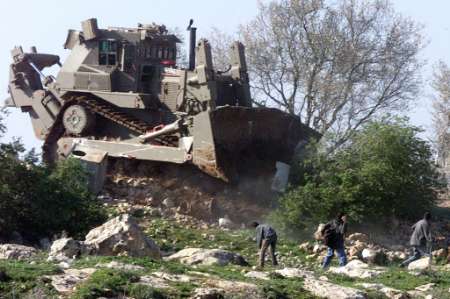
February 22, 2005 - The destruction of a seven-story house in a-Tur neighbourhood, in East Jerusalem. The building, which belonged to the Harhish and Qursh families, was demolished on 22 February 2005, on the grounds that it was built without a permit.
Photo credit: Kareem Jubran, B'Tselem


Uruknet, 27/09/07, da MIFTAH, Tradotto da Gianluca Bifolchi (Tlaxcala). Il 10 Giugno 1967 il governo israeliano distrusse il quartiere marocchino nella Città Vecchia di Gerusalemme Est per rendere più facile l'accesso al Muro Occidentale. Dopo che l'esercito israeliano emise l'ordine di evacuazione per gli abitanti del quartiere due ore prima dell'inizio della demolizione, un ordine che non arrivò a tutti, 135 case furono demolite insieme a due moschee e ad altri siti. 650 residenti rimasero senza casa, e molti altri morirono sotto il crollo della propria casa. Questa demolizione non fu la prima nei Territori occupati, ma fu quella che segnò l'inizio di una lunga lotta contro la demolizione illegale di case da parte delle forze di occupazione israeliane.


Dal 1967 nei territori occupati palestinesi sono state demolite 18.000 case per tre principali ragioni: la punizione collettiva, e le ragioni cosiddette operative o amministrative.

La demolizione ebbe inizio prima del 1967 da parte del mandato Britannico per espellere i Palestinesi dalle loro case. Segue una breve storia della demolizione di case in Palestina:

- Anni 30: L'amministrazione britannica in Palestina usa la demolizione di case come mezzo punitivo contro le proteste indigene verso il dominio britannico.

- 1936-1939: le autorità britanniche demoliscono più di 5.000 case palestinesi.

- 1948: il nuovo stato d'Israele inizia a demolire le case dei rifugiati palestinesi per impedire il loro ritorno. Più di 125.000 case, alcune delle quali danneggiate durante la guerra, vennero sistematicamente distrutte in un processo a cui ci si riferiva come "cleaning up the national views" ["repulisti delle opinioni nazionali" -- ndt].

- Anni 50: Israele espelle i Palestinesi dalle aree di frontiera e dai villaggi dove parte della popolazione palestinese era rimasta dopo la guerra, e demolisce le case palestinesi.

- 1967: la distruzione di blocchi abitativi durante la guerra incluse 373 case a Imwas, 535 a Yalu, 550 case a Beit Nuba, circa 135 case nel quartiere marocchino della Città Vecchia di Gerusalemme, 1000 case a Qalqilya, in aggiunta a migliaia di case a Beit Marsam, Beit Awa, Jiftlik, e al-Burj, come anche nei campi profughi dell'area di Gerico e nella Striscia di Gaza.

- Anni 70 e 80: Israele demolisce più di 10.000 rifugi per i profughi della Striscia di Gaza per creare il cosiddetto corridoio di sicurezza tra il sud della Striscia di Gaza e il Sinai, e per ampliare le strade usate dalle pattuglie dell'esercito israeliano nei campi profughi. Le demolizioni erano anche parte di una campagna per mandare via dai campi con la forza i rifugiati.

- 1993-2000: Israele demolisce più di 1000 case nei territori occupati palestinesi.

- 2003: Israele continua a demolire case palestinesi all'interno d'Israele. Le demolizioni delle case dei Beduini nel Naqab (Negev) aumentano di otto volte. Più di 100 case vengono demolite. Altre 280 case vengono distrutte nella Galilea e nel Triangolo. In totale vengono distrutte più di 500 case. Gli ordini di demolizione finora sono stati di 12.000 in Galilea e circa 30.000 nel Negev.

- La demolizione di case procede.


Pretesti con cui viene giustificata la demolizione di case

Punizione collettiva:


Il governo israeliano usa la demolizione di case come punizione collettiva in risposta ad attacchi a Israele; le famiglie degli attaccanti o le persone sospettate di aver condotto attacchi, come anche i loro vicini, o in qualche caso l'intero quartiere, sono soggetti a questa violazione dei diritti umani. In base alla Quarta Convenzione di Ginevra alla potenza occupante è proibito distruggere proprietà o ricorrere alle punizioni collettive. L'Articolo 53 prevede: "Ogni distruzione da parte della potenza occupante di proprietà appartententi a gruppi o persone è proibita". Secondo l'organizzazione per i diritti umani israeliana B'Tselem il 47% delle case demolite come punizione collettiva non appartenevano agli attentatori o ai sospetti attentatori, ma erano solo case adiacenti alle loro. Inoltre, solo il 3% di tutti gli occupanti delle case demolite erano stati preventivamente avvertiti che le loro case e quelle adiacenti sarebbero state abbattute.

Prima che la politica di punizione collettiva per mezzo della demolizione di case venisse ripresa durante la seconda Intifada (al-Aqsa), le demolizioni venivano compiute solo dopo l'emissione di un ordine militare. In base alla legge israeliana l'ordine di demolizione va notificato alla famiglia e la famiglia può fare appello al comando militare entro 48 ore. Anche se l'appello è respinto, alla famiglia deve essere permesso di rivolgersi all'Alta Corte prima che la casa sia demolita. In realtà, questo non accade quasi mai. Durante l'attuale Intifada, Israele ha considerato la demolizione di case come un imperativo militare, per cui la maggior parte delle demolizioni di case hanno avuto luogo di notte, senza alcun avviso preventivo o ordine di demolizione.

Operazioni militari:

La seconda ragione fornita dal governo israeliano per la demolizione di case è di tipo operativo e prese piede durante le operazioni militari chiamate "operazioni di pulizia". In base alle leggi umanitarie internazionali, la distruzione di proprietà durante il combattimento non è illegale in quanto tale. La distruzione è proibita a meno che non vi sia una necessità assoluta. E' stato comunque osservato che le operazioni su larga scala di demolizione di case civili nel nome di necessità militari a seguito di attacchi contro gli Israeliani suggeriscono qualcos'altro. Gaza, più che qualsiasi altro posto in Palestina, è diventata il teatro di queste azioni e false giustificazioni. Miloon Khotari, un'osservatore speciale delle Nazioni Unite, parlando a Diakonia in reazione all'attacco di Israele a Beit Hanoun l'8 Novembre 2006, ha detto: "Dal 25 Giugno 2006, data della più recente incursione israeliana nella Striscia di Gaza, ho continuato a ricevere rapporti allarmanti sui deliberati attacchi da parte delle forze di Israele risultanti in distruzione di case, proprietà civili e infrastrutture nella Striscia di Gaza, e creato insicurezza e traumi pricologici.
Such acts have a devastating impact on civilians particularly, women and children, and create insecurity and psychological trauma. Pertanto, questi sfratti forzati e ingiustificabili distruzioni costituiscono violazioni del diritto internazionale in materia di diritti umani, guerra e norme umanitarie. Il diritto internazionale proibisce severamente la distruzione di proprietà pubblica o privata nel corso di operazioni militari, quando non è assolutamente necessario". Dall'inizio della sollevazione al 2004, 14.852 palestinesi sono rimasti senza tetto per le operazioni di Israele.

Politiche amministrative:

La giustificazione più frequente per la demolizione di case a Gerusalemme Est e all'interno di Israele ha a che fare con ragioni amministrative. Il governo Israeliano demolisce case nell'area C (Aree della Palestina sotto controllo civile e militare israeliano) per la mancanza di permessi di costruzione anche se a Gerusalemme Est e all'interno d'Israele è quasi impossibile per i palestinesi ottenere permessi di costruzione. Il colonnello Shlomo Politus, consigliere legale dell'esercito israeliano, ha detto al parlamento israeliano nel giugno del 2003 che: "... non ci sono più permessi di costruzione per i Palestinesi", e il portavoce dell'esercito israeliano ha detto nel 1999 ai delegati di Amnesty International: "La nostra politica è di non rilasciare licenze per l'area C [della West Bank]". Le case vengono demolite perché Israele vuole espandere gli insediamenti israeliani nella West Bank, e creare fatti permanenti sul terreno. Secondo B'Tselem le case palestinesi vengono demolite in base a questa giustificazione per tre esigenze:

- Costruzione di bypass stradali: servono a permettere il movimento dei coloni e delle forze militari che proteggono gli insediamenti. Le case vicine a un bypass stradale esistente o da costruire sono destinate alla demolizione.

- Evacuazione dei Palestinesi dalle aree adiacenti agli insediamenti israeliani: le autorità israeliane hanno sempre distrutto strutture palestinesi percepite come ostacoli allo stabilimento o all'espansione di insediamenti israeliani. La prossimità delle case agli insediamenti ovviamente non viene presentata come ragione ufficiale per la loro demolizione.

- Per impedire trasferimenti di terra ai Palestinesi: Israele demolisce le case in aree su terra che vuole riservare a se stesso negli accordi per lo status finale. Perseguendo una simile politica, Israele sta impedendo all'Autorità Palestinese di richiedere quelle terre in base alla presenza di residenti palestinesi. La demolizione di case è un comodo espediente per l'espulsione della gente da quelle aree.

Le forze israeliane stanno ancora distruggendo case in grande numero dietro pretesti e false giustificazioni per servire lo scopo generale dello stato sionista di sradicare e scacciare quanti più Palestinesi possibile dalla loro terra, e costruire ancor più insediamenti illegali. Secondo recenti statistiche di B'Tselem, negli ultimi due anni (2006-2007) solo nella West Bank 165 case sono state demolite lasciando 724 persone senza tetto, e tra il 2004-2005 solo a Gerusalemme Est 300 case sono state distrutte lasciando 939 persone senza tetto. La demolizione di case ha un duro impatto sul popolo palestinese, colpendo l'economia e l'agricoltura e causando gravi traumi ai bambini, alle donne e agli uomini vittime di questo crimine di guerra.


Fonti:
Amnesty International
B'Tselem
Diakonia
Electronic Intifada - A history of destruction Report, BADIL, May 18 2004
ICAHD
POICA


Articolo originale pubblicato il 24 settembre 2007
http://www.miftah.org/Display.cfm?DocId=14882&CategoryId=4

Tradotto dall'inglese da Gianluca Bifolchi, un membro di Tlaxcala ( www.tlaxcala.es ), la rete di traduttori per la diversità linguistica. Questa traduzione è in Copyleft per ogni uso non-commerciale : è liberamente riproducibile, a condizione di rispettarne l'integrità e di menzionarne l'autore e la fonte.


Palestinian captives revolt against IOA humiliating policies in jails

The Palestinian Information Center, 28/09/07. "Jail conditions of the Palestinian captives from Gaza Strip are indeed tragic and unfortunate as they are denied family visits even for receiving new dresses for their families", the lawyer of the Nafha society that caters for Palestinian captives and ex-prisoners' affairs affirmed after meeting with a number of Palestinians in the Israeli Ashkilon prison..

The lawyer also quoted the captives as complaining of "quality and quantity" of the food offered to them in the jail, affirming that most of the time the prisoners refrain from getting their food being rotten and inedible.

More than 210 Palestinian captives, including secretary of the PA legislature and Hamas's legislator Dr. Mahmoud Al-Ramahi among other captives, were locked in the
in the the said jail.