L'accusa di uno scrittore americano-nigeriano che vive tra Lagos e gli Usa Nel mirino star, ong e mobilitazioni studentesche: "Basta umanitarismo sexy - Uzodinma Iweala, la Repubblica.it, 31/07/07. Perché i media parlano spesso dell'indipendenza "concessa agli Stati dell'Africa dai dominatori coloniali", dimenticando le lotte e il sangue sparso dagli africani per conquistarla? Come mai l'impegno per l'Africa di Bono o Angelina Jolie sono oggetto di smisurate attenzioni, mentre l'opera di africani come Nwankwo Kanu o Dikembe Mutombo è praticamente ignorata? E come si spiega che in Sudan le esibizioni da cow boy di un diplomatico Usa di medio livello ricevano più attenzione degli sforzi di numerosi Paesi dell'Unione africana, che hanno inviato aiuti alimentari e truppe, e si sono impegnati in negoziati estenuanti nel tentativo di raggiungere un accordo tra le parti coinvolte in questa crisi? Il mese scorso, il Vertice degli 8 Paesi industrializzati si è incontrato in Germania con un gruppo di celebrità per discutere, tra l'altro, su come salvare l'Africa. Io mi auguro che prima del prossimo incontro di quest'organizzazione ci si renda conto di una cosa: l'Africa non vuol essere salvata. Ciò che l'Africa chiede al mondo è il riconoscimento della sua capacità di avviare una crescita senza precedenti, sulla base di un vero e leale partenariato con gli altri membri della comunità globale.
martedì 31 luglio 2007


Inside Gaza: An Arms Dealer's Tale
As U.S. plans to sell arms to Saudi Arabia make waves in the Middle East, NEWSWEEK’s Kevin Peraino visits a Gaza arms dealer.
WEB-EXCLUSIVE COMMENTARY
By Kevin Peraino
Newsweek
Updated: 5:37 p.m. ET July 30, 2007
July 30, 2007 - It is not a fact that he particularly likes to advertise, but, if pressed, Abdel Hamid Bahar will acknowledge that his business is at its best when people are dying. Last Sunday I went to see the black-market arms dealer at his home, a squat, dilapidated structure made of cinderblocks and tin sheeting, in the central Gaza village of Moghraga. We sat on pink plastic chairs in the shade, next to a slightly sickly garden with a couple of banana plants and a slender olive tree. The weapons merchant's business varies widely, of course, depending on how much fighting is going on. Last summer, when Gaza was at war with Israel after the kidnapping of Gilad Schalit, Bahar was pulling in almost $3,000 per month, more than most Gazans earn in a year. How is business now, I asked, with Hamas in power and the streets relatively calm? "Zero," the gun dealer complained, without bothering to hide his frustration.
Bahar nodded to one of his sons, who had been leaning against a cinderblock wall and watching us without saying anything. The lanky young man disappeared for a moment inside the house, and then returned carrying a new-looking semiautomatic rifle, slick with resin and grease. For my notes, I asked for the kid's name and age. The arms dealer frowned. "I don't know how old he is," he said, a little disdainfully. "I have 13 children. I don't even know all their names." He paused for a second, and then added: "All my children, the girls and the boys, know how to use guns." He took the rifle, a Chinese-manufactured Kalashnikov, and slid out the clip. "This is well made," he told me. "Seventeen-hundred dollars each. If you need 50, I'll bring them to you. While you're drinking tea, I can get you 100. I am the No. 1 for weapons in Gaza."
The arms dealer has a rangy, mangy look to him. His head is almost entirely shaved, but he wears a long, scraggly black beard over his gaunt features, which makes him resemble a Palestinian Abraham Lincoln. A net of thick veins bulges from his sinewy forearms. He smiles every now and then, but the desired effect is lost when he reveals a mouthful of yellowed and rotting teeth. He chain-smokes cigarettes from a pack of Royals stashed in his left breast pocket, and keeps a 70-year-old, German-made 9 mm pistol tucked into the waistband of his jeans. (He refers to it as a "Hitler.") The arms dealer is 43 years old, and has been selling guns for the past two, since just before Hamas won the territory's legislative elections.
Bahar grew up in Gaza's Bourej refugee camp, and eventually moved to Moghraga, a poor farming village of about 5,000. He married when he was 16 and got a job as a construction worker with his father in Israel for a while. Later he earned a living as a taxi driver and auto mechanic. During the first intifada he fought against Israel as a militant in the Tanzim, the Fatah-affiliated militia. Still, despite his youthful loyalties, it is bad business for an arms dealer to be taking sides; he says he now sells to both Hamas and Fatah. One of his kids had scrawled the word HAMAS in black spray paint on the side of the house. "I started my business in order to feed my children," he told me. As the rivalry between Hamas and Fatah intensified last spring, "all the factions began to buy weapons."
I had come to see Bahar because arms sales were the talk of the Middle East over the weekend. On Friday the Bush administration said it would like to sell Saudi Arabia and its regional allies billions of dollars worth of sophisticated weaponry. Washington has also promised Israel –which, in a sign of its concern about Iran possibly obtaining nuclear weapons, has dropped its traditional objections to U.S. arms sales to Saudi Arabia—another $30.4 billion in weaponry. Secretary of State Condoleezza Rice and Defense Secretary Robert Gates were set to tour the region this week to help work out the details of the proposal. Israel also promised to allow 1,000 M-16s to pass from Jordan to Palestinian Authority security forces in the West Bank—an effort to prop up the Palestinian president, Mahmoud Abbas.
Against that backdrop, it seemed like a good idea to visit one of the trade's real-world practitioners. In the news stories about American support for proxies in the region, the recipients of such weaponry are usually described as "moderate," while their antagonists are inevitably "radical." Those are cartoon descriptions, of course, and are often carelessly applied. In the four years since I've been working in the Middle East, I've met plenty of radical American proxies, and just as many moderate "radicals." The labels "Islamist" and "secular" don't reveal all that much about character either, although they're slightly better than "terrorist" and "stooge." If I were forced to divide and classify the Gazans I meet, I'd say they tend to be better described as hawks and doves, and there are both of those in all camps. Bahar, the arms dealer, is one of the former by trade.
The frustrating, inconvenient thing about all this is that, when you meet the people up close, it is often the hawks who seem the most shrewd and competent, at least tactically. They sometimes appear a little paranoid, but in the unforgiving Middle East they are also often the most determined survivors, the ones you would want on your side in a street fight. At one point while we talked the other day, Bahar jumped up out of his chair in one quick movement and darted over to his garden. He tore a branch off his olive tree, and then stuffed the whole thing into his mouth—wood, leaves and all. He chewed it and swallowed hard. "I can eat the grass and the trees, but I will never hold the white flag," he said. "There are many here like me who are ready to eat anything." Sanctions against Hamas won't work, he argued. He told me that he considered Abbas feckless and weak, too unwilling to resist the Israeli occupation. "We will never return to Abu Mazen," he added, using the president's nickname. "Israel and America are so foolish." There was some obvious theater in the tree-eating bit, but it was effective all the same. I tried to imagine Abbas—the quiet former schoolteacher—jumping up and eating a tree, but the image would not come.
About halfway through our conversation, my translator, Hassan, pointed out a faint buzzing sound in the air overhead—an Israeli drone. Bahar shrugged. "Before you hear the noise of the plane, I hear it," he said. "I'm sensitive to it." After drinking cups of thick, sweet coffee, Hassan and I eventually got up to leave and walked back to the car. On my way out I noticed that Bahar's front yard was almost entirely scorched. A few lonely blades of grass shot up through the large black stains covering the turf like oil spots. I asked the arms dealer what had happened to his yard. "I burned it," he told me. "So I can see the snakes." He said it without the slightest hint of irony.
URL: http://www.msnbc.msn.com/id/20042003/site/newsweek/?from=rss
After Bush's Speech, Tony Blair Would Be Well Advised To Stay Home
Henry Siegman. Al-Hayat. 30/07/07. To read President Bush's speech of July 16 in which he sought to inject new life into the Middle East peace process is to understand why his policies in Iraq have been such an unmitigated catastrophe. In the Israel-Palestine conflict as in Iraq, he is completely out of touch with the most fundamental realities on the ground.
President Bush: "In Gaza, Hamas radicals betrayed the Palestinian people with a lawless and violent takeover."
The facts: The Palestinian people were betrayed not by Hamas, whom they elected to run their government in the first truly democratic elections in the Arab world, but by Bush and Prime Minister Ehud Olmert who, with a typically colonial mindset, planned to overthrow the Palestinian people's democratic choice by financing and arming Fatah, the party that lost the elections.
President Bush: "Hamas has demonstrated beyond all doubt that it is more devoted to extremism and murder than to serving the Palestinian people."
The facts: The Palestinian people elected Hamas, overwhelmingly, because the organization "demonstrated beyond all doubt" its devotion to the Palestinian people through a network of social institutions - educational, medical and economic - which the dominant Fatah party was unable to match. Indeed, the Palestinian public was convinced that a corrupt Fatah leadership was simply using the peace process to enrich itself.
The savageries committed by Hamas merit unqualified condemnation. What they do not merit are the hypocrisies of Bush and Olmert. Did Bush and Olmert imagine that Mohammed Dahlan and the militias under his control, whom the U.S. and Israel were training and arming, would have treated Hamas militants any more gently than Hamas treated Dahlan's people had they succeeded in mounting their putsch?
President Bush: "We are strengthening our political and diplomatic commitments. Again today, President Abbas and Prime Minister Olmert sat down together to discuss priorities and resolve issues…[Secretary Rice] has worked with both sides to sketch out a 'political horizon' for a Palestinian state."
The facts: Olmert has rejected every effort by Secretary Rice to get him to discuss with Abbas any of the elements that might define a political horizon - i.e. borders, settlements, Jerusalem, refugees. Bush has consistently failed to back up Rice's efforts. In his speech, he suggested to Olmert that he finally define Israel's position regarding borders. The very next day, Olmert's spokesperson publicly told Bush, in effect, don't even think about it.
President Bush: "The Palestinian government must arrest terrorists, dismantle their infrastructure and confiscate illegal weapons - as the road map requires."
The facts: The road map also requires that Israel not only halt the expansion of settlements but dismantle them. Furthermore, it explicitly obliges each side to implement its obligations, within each of the three phases of the process that it established, without regard to the pace of implementation of the other. Thus, Palestinians cannot delay measures to end violence until Israel stops settlement-building, and Israel cannot delay ending the expansion of settlements by demanding that Palestinians first complete their efforts to end all violence. While Bush and Israel have advocated and imposed draconian sanctions for Palestinian violations, they have failed to do the same for Israeli violations. Bush has also prevented Security Council attempts to deal with the parties in a more balanced way.
President Bush: "[By supporting Hamas], the Palestinian people would surrender their future to Hamas' foreign sponsors in Syria and Iran."
The facts: Hamas is not a natural ally of either Iran or Syria; Iran is Shiite and Syria advocates a secular Arab nationalism that is anathema to Islamists. Bashar Assad's father slaughtered thousands of members of the Islamic Brotherhood in the city of Hama for their opposition to his government. Hamas has never expressed support for violence directed against U.S. and Western interests by Iran and Syria, or Al Qaeda for that matter. Hamas has turned to Iran and Syria for financial support in reaction to Israel and Bush's efforts to strangle it.
The one potentially hopeful element in Bush's speech was his statement that negotiations must lead to a "territorial settlement with mutually agreed borders reflecting previous lines and current realities, and mutually agreed adjustments." Optimists read this passage as U.S. endorsement of the principle enshrined in previous resolutions and in the road map that no territorial changes can be made unilaterally by Israel without Palestinian agreement. Unfortunately, while Bush is painfully precise when it comes to spelling out conditions that Palestinians must meet to get their state, he remains painfully imprecise when dealing with Israel's obligation to return to the pre-1967 border.
The distortions and misinformation in the president's speech aside, this latest initiative has no chance of advancing the peace process. For all of his gestures to Abbas, Olmert has not the slightest intention of getting "trapped" in a peace process that might oblige Israel to dismantle a significant part of its settlement enterprise. As in the past, he will not find himself at a loss for pretexts to postpone the beginning of negotiations.
More importantly, there is not the slightest chance that a peace process from which Hamas is excluded will get anywhere.
President Bush's proposal for an international conference in the fall has all the earmarks of a last minute, half-baked idea that no one at the White House or the Department of State thought through. Clearly, none of the "neighbors" Bush plans to invite to this conference were consulted in advance. And if, as Bush said, only those who recognize Israel's right to exist and accept all previous agreements will be invited, then not only most of Israel's neighbors but Israel itself would not qualify. Having exhorted Israel in his speech - however gently - for the umpteenth time to stop expanding settlements and to dismantle "illegal" outposts, Bush should know that Israel is in flagrant violation of virtually all previous agreements and UN resolutions.
If, as Bush apparently expects, his speech will in fact define Tony Blair's mandate as the Quartet's emissary, the former prime minister would be well advised to stay home.
The Five Percent Solution
John V. Whitbeck, Arab News, 31/07/07. To prevent such a manipulation and deformation of the Arab Peace Initiative, the “carrot” must be complemented with a credible and effective “stick”. The Arab League should make it clear that, if Israel does not accept the Arab Peace Initiative, without reservations, by a specific near-term date, it will lapse and be “off the table”. At the same time, the major Arab and Muslim oil producers should state that, if Israel rejects the Arab Peace Initiative, then, until Israel complies fully with international law and UN resolutions by withdrawing from all occupied Arab land to its internationally recognized borders, they will reduce their petroleum exports by increments of five percent each month — month after month after month.
It would, of course, be preferable if the United States, whose unconditional support of Israel has made possible its continuing occupation of Arab lands, were to undergo a moral and ethical transformation and if Americans were suddenly to realize both that Palestinians are human beings entitled to basic human rights and that international law should be complied with by all, not only by the poor, the weak and the Arab. Realistically, after so many years of antithetical attitudes, such a transformation is most unlikely to occur.
However, if Americans cannot be reached through their hearts or minds, they can be reached through their wallets. If oil prices, already near historic highs, were to soar and stock market prices were to plunge, Americans would be certain to start asking why, precisely, Israel should be permitted to continue defying international law and UN resolutions and denying Palestinians their basic human rights and why the United States, alone, should be unconditionally supporting it in doing so — at the cost of both worldwide anti-American rage and sharply higher oil prices for Americans.
Since no American national interests are served by Israel’s continuing occupation of Arab lands, no credible, nonracist answers could be offered, and, with oil prices rising, stock market prices falling and no reversal of these trends in sight, these questions would become more insistent and Israel’s defiant position could rapidly become untenable.
Israel, E.U. sign academic pact
JTA. 30/07/07. Israel has signed an agreement with the European Union that thwarts efforts to impose a British academic boycott of Israel. The agreement will allow Israeli universities to take part in a new six-year research program called the Seventh Research Framework, or FP7. Israel is the only nation outside the European Union that will participate in the major public/private research partnership to develop green air transport, which will be funded under the FP7 program.
The deal effectively thwarts efforts by Britain’s University and College Union to impose an academic boycott of Israel in Britain, having voted at its recent annual congress to campaign for "a moratorium on research and cultural collaborations with Israel via E.U. and European Science Foundation” as part of its Israeli boycott policy. The union’s continued campaign against academic collaborations with Israel has come under fire by some academics, the Jewish community, Britain’s prime minister and members of the British Parliament.
Le Fatah veut asphyxier le Hamas
Karim Lebhour. radiofranceinternationale. 30/07/07. Mahmoud Abbas, le président de l'Autorité palestinienne n'entend pas baisser les bras face au Hamas. Il a décidé de geler les salaires de tous les fonctionnaires palestiniens qui travaillent pour le Hamas. Après la bataille des armes, le Hamas et le Fatah sont désormais engagés dans une guerre économique. Mahmoud Abbas n'a pas caché son intention d'asphyxier financièrement les islamistes de Gaza et a ordonné que les salaires des fonctionnaires qui travaillent pour le Hamas, ou qui ont simplement été recrutés par un ministre Hamas, ne soient pas versés.
Environ 10 000 personnes sont concernées à Gaza et le Hamas a décidé de les payer lui-même, sans donner de précisions sur l'origine de ses fonds. Parmi ces fonctionnaires, figurent notamment les 7000 hommes de la force exécutive. La police du Hamas assure désormais la sécurité dans la bande de Gaza.
Par le passé le mouvement islamiste a reçu le soutien de l'Iran, allant parfois jusqu'à faire transporter l'argent dans des valises depuis l'Egypte. Mais le Hamas montre, par ce geste, que même coupé du monde et boycotté par la communauté internationale, il pense être capable de gérer tant bien que mal la bande de Gaza.
Inside Gaza: Who Killed the Juha Sisters?
In the six weeks since Hamas took power in Gaza, the territory has become neither a model of efficient justice nor a repressive Islamist state. That doesn’t explain why so few care about the killing of the Juha sisters.
WEB EXCLUSIVE
By Kevin Peraino
Newsweek
Updated: 5:17 p.m. ET July 26, 2007
July 26, 2007 - Yehia Abu Moghaseb knew something wasn't right almost as soon as he saw the headlights. The Gaza Strip gravedigger watched from his house as two cars turned down the sloping dirt driveway of the Martyrs' Cemetery in his village of Wadi Salgah, where he works. It was almost 10 p.m. last Saturday, too late for a funeral. He walked down the hill toward the lights and found several men gathered around the hatchback of a blue and white Mitsubishi Magnum. The men were polite but a little harried. As Moghaseb looked on, they lifted three large bundles wrapped in black plastic from the back of the car, and carelessly dropped them into freshly dug pits lined with cinderblocks. They shoveled a few scoops of sand on top, before driving off into the warm Gaza night.
The gravedigger wasn't exactly sure what to do next. "There's no police," he recalled later; shortly after the Islamist Hamas organization seized power in June, Gaza's police chief, who is loyal to Fatah, suspended all civilian law enforcement. Abu Moghaseb asked a neighbor to call the Hamas-controlled "Executive Force," a network of troops composed mostly of former militants from the group's Izzedine al-Qassam militia. When the Hamas men arrived, wearing their trademark black uniforms and cradling Kalashnikovs, Abu Moghaseb helped them uncover the graves. A doctor tore open the black body bags. Inside, the gravedigger saw three young women, two of them still in their teens. "They were beautiful," he said later. "Except for the blood." Two of the girls had been stabbed repeatedly in the chest; the third had her throat cut.
Three days after the murders, I visited Abu Moghaseb at the cemetery, a small plot of sun-bleached soil and desert scrub, ringed with barbed wire. The gravedigger, who looks older than his 42 years and sports a neatly trimmed salt-and-pepper beard, told me that he has 13 children, including several daughters. The murders had been an honor killing, he explained; he says he was later told that the victims were orphans and had been working as prostitutes. A devout Muslim, Abu Moghaseb said that he has mixed feelings about the practice of honor killing and seemed to be working through his rationale while we talked. "If a woman works as a prostitute, she must be killed," he reasoned. "It will spread diseases." Still, he went on, "Our religion says not to kill," and then after another moment: "But our tradition says to kill." As we baked in the midday Gaza sun, he eventually gave up on the tortured logic. "You don't kill a girl," he told me finally, looking a little disgusted, before walking back up the hill toward his house.
Aristotle's dictum about the law—that it is reason free from passion—has never applied particularly well to the Gaza Strip. Justice here has long been a chaotic mix of logic, emotion, religion and tradition. Now that Hamas has seized control over virtually all the territory's major institutions, the equation has become even more complicated. The conventional wisdom about law and order under Hamas rule is almost entirely wrong, whether you believe the Islamists' narrative or that of their secular Fatah rivals. In the six weeks since Hamas took power, the territory has become neither a model of efficient justice, nor a repressive Taliban state ruled by Sharia (Islamic law). Still, the postrevolutionary transition period has not been an encouraging one for advocates of an independent legal system for Gaza. In a recent report, the Palestinian Center for Human Rights (PCHR) warned that Gaza's judiciary has faced "near paralysis" since Hamas took power. Regular Gazans like 16-year-old Nahed Juha, 19-year-old Suha Juha, and 22-year-old Lubna Juha—the three young women who ended up in body bags—are paying the price. "In the absence of law, people take the law into their own hands," says Issam Younis, the director of Gaza City's Al Mezan Center for Human Rights.
Honor killings are one of the area’s most sensitive legal and moral dilemmas. They are not condoned by Sharia, but they are becoming increasingly common in lawless Gaza. Under the Palestinian criminal code, murder can carry a death sentence, usually by hanging. But according to Palestinian officials, there has never been a case when the perpetrator of an honor killing has been executed. The killers often serve little more than three years, and rarely more than seven. Neither Fatah politicians nor the Islamists in Hamas are particularly sympathetic to the victims, even in peacetime. Amid the chaotic indifference of civil war, they are even less so. In 2007 alone, there have been a dozen honor killings, according to rights groups. "There is a very clear increase in the killing of women," says Younis.
A few days after the murders, I stopped by the Gaza City office of Islam Shehwan, the spokesman for Hamas's Executive Force. He was wearing a shiny, midnight-blue dress shirt, and had his eyes glued to a television broadcasting Al-Jazeera as we spoke. A framed painting of Hamas spiritual leader Ahmad Yassin, assassinated by Israel in 2004, hung on the wall behind him. Eager to demonstrate that the Islamists were serious about law enforcement after their takeover, Shehwan told me that the Executive Force had swiftly arrested a suspect in the Juha case, a cousin of the victims, and that he was currently under interrogation. Shehwan explained that he had met with the alleged killer yesterday and claimed that the man had confessed. "He was very calm," the official told me. "He was proud of it." Still, Shehwan didn't seem particularly sympathetic to the murdered sisters. "They were prostitutes," Shehwan told me matter-of-factly. "We are good investigators. We have big files for them. We have many stories. One was taking drugs. They were caught having sexual relationships many times—more than five times." (Sharia requires four firsthand witnesses to convict a woman of prostitution; family law in Gaza is strongly influenced by Sharia, even before the Hamas takeover.) When the interrogation and investigation are finished, the man will be brought to trial in a normal criminal court, Shehwan insisted.
That could be more difficult than it sounds. At the moment, none of Gaza's roughly 45 judges are coming to work, bringing Gaza's dockets almost entirely to a halt. Hamas leaders are typically optimistic, insisting that they will eventually find a solution. A legal adviser to Gaza-based Hamas leader Ismail Haniyeh, Mohammed Ahmed Abed, told me that he predicted one third to one half of the judges would come back to work if the Islamists paid their salaries. In the meantime, Hamas leaders have established a review body—known as the Legal and Sharia Committee—to review the files of some 150 prisoners in Gaza's jails. It currently reports to a major in the Executive Force. Rights groups are concerned that any new review committees—especially those directly accountable to Islamist officers—could amount to the establishment of "alternate judicial bodies," a serious violation of the system's integrity.
Yet rights groups are equally critical of some Fatah leaders, like the Palestinian attorney general, Ahmed al-Moghani, who left Gaza for the West Bank city of Ramallah shortly after the Hamas takeover. Moghani insists that it's impossible—and illegal—for him to continue working in Gaza as long as there is no civilian police force to investigate crimes. Still, at least some human-rights advocates believe he has a duty to try; even Moghani acknowledges that Gaza's legal system is at a standstill as long as he refuses to work with Hamas. With virtually no courts operating, ordinary Palestinians are left without any kind of formal system of justice. The PCHR report demands that Moghani "fulfill his responsibilities and return to work in the Gaza Strip immediately, regardless of the political situation."
A few days after the murders, I went to see Moghani at his office in Ramallah. The Palestinian attorney general is a beefy, even-tempered man with the humorless charm of a professional bureaucrat. He told me that Executive Force militants had raided his Gaza City office during the fighting, taking all his files, including the memory cards for his computer. He complained that without a police force to protect his investigations, he can't do his job properly. "As long as [Hamas] has its grip on power, things will never go back to normal," he told me. "For me to function, I need a police force. If the police force starts working at 12 o'clock, I'll be there at 12:01."
When I asked him about the case of the Juha sisters, he grimaced and seemed almost as dismissive as his counterparts from Hamas. "Look, we have information from intelligence sources that they have been committing sins," the attorney general explained. He told me that he had taken a personal interest in the case, and ordered "forensic work" to be done on the bodies. "After the work was done, it was determined that they were not virgins," he continued. "We could detect that there were recent sexual relationships." He lifted his hands and cocked his head, as if to say: case closed. "Of course, this is not a pretext to kill them," he added. "Nobody is allowed to take the law into his own hands." The attorney general sounded very much like he was trying to convince himself.
After two days of asking around about the case, I realized that I knew almost nothing solid about the lives of the three young women. I stopped by the apartment complex where they had lived, a split-level gray cinderblock structure in the heart of Gaza City. A neighbor who identified himself as Abu Ahmad said that the three had lived alone; their father had died years before of a heart attack, an older brother had been killed as an Israeli collaborator in the 1990s, and their mother had also been murdered. "They used to talk to boys in the street," the neighbor recalled. "They used to go without a headscarf. Now we're rid of them." Relatives I visited were no more helpful or sympathetic. Not a single family member was willing to talk about the girls. Mahmoud Juha, the family mukhtar—the head of the clan—explained that he would have nothing to say about the young women or their murders. When we stopped by his home, he told my translator firmly: "I advise you not to talk to anyone else."
To Yehia Abu Moghaseb, that attitude is part of the problem. The crime should be publicized and the killers punished, the gravedigger told me, as we stood in the sun at the cemetery near where the bodies had been dumped. "We can't be silent," he went on, his voice rising slightly. "We can't cover it up." Then he was quiet. I thought of what he had told me earlier, with the simple, sound judgment of a man who has seen more than his share of bodies covered with earth: "You don't kill a girl." In the absence of law, at least there is someone in Gaza with a little common sense.
URL: http://www.msnbc.msn.com/id/19982075/site/newsweek/?from=rss
Palestinians wary of interim statehood
Harvey Morris. Financial Times. 29/07/07. The strategy behind resurgent diplomatic activity to tackle the Israeli-Palestinian conflict is beginning to emerge, pointing to the goal of interim statehood for the Palestinians before President George W. Bush’s term in office runs out. Within a year, according to some analysts, a new political entity could come into being called the State of Palestine. However, they warned of many potential pitfalls and doubted it would fulfil the aspirations of the Palestinian people. “They want to change the name of the Palestinian Authority to the Palestinian state,” said Hani al-Masri, a West Bank political analyst. “But it wouldn’t change anything on the ground. It would be a state under occupation.” Many Palestinians are wary of a short-term solution they perceive as having more to do with Mr Bush’s legacy and the US’s problems elsewhere in the Middle East than with a lasting settlement of the conflict.
lunedì 30 luglio 2007
Anarchists under fire
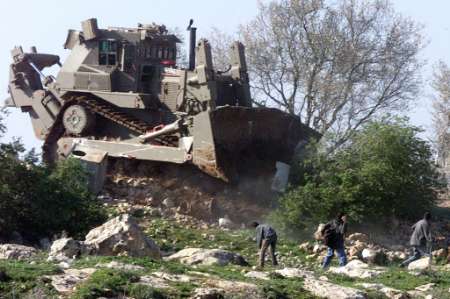
Neve Gordon. Guardian. 30/07/07. A battle is being waged in the Israeli courts against anarchists who help Palestinian villagers. One of the most remarkable qualities of these young Israeli anarchists is their subversive use of their own privilege, employing it not for self-interested social, economic or political gain - as most people do - but rather in order to stand up to power. The anarchists, in other words, exploit the privilege that comes with their Jewish identity and use it as a strategic asset against the brutal policies of the Jewish state.
As Jewish activists they are well aware that the Israeli military behaves very differently when Israeli Jews are present during a protest in the West Bank and that the level of violence, while still severe, is much less intense. Indeed, according to Israeli soldiers the military has more stringent open fire regulations for demonstrations in which non-Palestinians participate. So when a village's public committee decides to carry out non-violent protests against the occupying power, the anarchists mingle with the demonstrating villagers, thus becoming a human shield for all of those Palestinians who have chosen to follow the path of Mahatma Gandhi and Martin Luther King.
Even though the anarchists are frequently beaten and arrested, they do not desist. To date, about 10 Palestinians have been killed in demonstrations against the separation barrier and thousands have been wounded, a number that would no doubt have been much greater had it not been for the fearless dedication of the anarchists.
As Jewish activists they are well aware that the Israeli military behaves very differently when Israeli Jews are present during a protest in the West Bank and that the level of violence, while still severe, is much less intense. Indeed, according to Israeli soldiers the military has more stringent open fire regulations for demonstrations in which non-Palestinians participate. So when a village's public committee decides to carry out non-violent protests against the occupying power, the anarchists mingle with the demonstrating villagers, thus becoming a human shield for all of those Palestinians who have chosen to follow the path of Mahatma Gandhi and Martin Luther King.
Even though the anarchists are frequently beaten and arrested, they do not desist. To date, about 10 Palestinians have been killed in demonstrations against the separation barrier and thousands have been wounded, a number that would no doubt have been much greater had it not been for the fearless dedication of the anarchists.
MK: Monthly grant for Holocaust survivors a 'mockery'
Barak Ravid, Haaretz Correspondent. 30/07/07. Chairwoman of the Knesset lobby for Holocaust survivors, Labor MK Colette Avital, condemned on Monday the monthly allowance the government has decided to grant 120,000 survivors. The decision allocates survivors some NIS 1,000 [€ 169.031; US$ 231.214] in its first year of its implementation, which comes about to about NIS 83 monthly [€ 14.0301; US$ 19.1943]. Avital called the decision a "mockery." The benefit will be extended to 120,000 survivors over the age of 70 who receive old age allowances. Each person can expect to receive NIS 83 per month in the first year, a sum which will increase gradually each year. "We are correcting a 60-year-old blight," Olmert said of the decision. "Holocaust survivors living in Israel are entitled to live respectably without reaching a situation in which it is beyond their means to enjoy a hot meal".
Haaretz full text
israel.jpost.com.30/07/07. "Scorn for the poor and salt in the eyes of Holocaust survivors," Colette Avital said of Prime Minister Ehud Olmert's decision on giving additional monetary aid to survivors, Israel Radio reported Monday. There are some 260,000 Holocaust survivors in Israel today, one third of whom live below the poverty line. Many suffer from physical and emotional ailments, loneliness and depression, and a lack of family and social support systems. This is an aging population, with 10,000 of its members requiring welfare assistance.
The Siege of Gaza

Amassi Ghazi, the owner of a failing export business, with some of the checks from customers that have bounced.
Andrew Lee Butters/Gaza City. TIME. 28/07/07. I spent Thursday talking to other business owners -- pragmatic, apolitical people -- who uniformly blamed Israel, the United States and Fatah for the destruction of the Gazan economy. In fact, after years of living with the gangsterism and warlordism that plagued Gaza while it was run by Fatah officials, most are happy with the Hamas takeover. "I blame Fatah and Abu Mazen because they made us live in garbage," said the owner of the largest factory in Gaza, which makes cookies and ice cream, but which is now almost totally shut. "They never wanted to see anyone else prosper. They just wanted to live on top, through corruption."
The business owners pointed out that not only joblessness and poverty pushing average people towards extremism, but they also said that the Israeli embargo was destroying the only class of Palestinians who still looked favorably towards Israel: them. Most of them speak Hebrew, have -- or used to have -- Israeli clients, partners, and friends, and most had once looked forward to the day when there would be no trade barriers at all for an independent Palestine at peace with Israel. "The majority of Gazans do not like Israel'" said Amassi Ghazi, the chairman of a company that imports building materials. "Until now only the private sector had good relations with Israel. So please open the border before you loose the last sector, and all Gaza will be enemies of Israel."
Bringing In The Sheaves
 Refreshments after the harvesting at Al Jabari home
Esther Kern. Christian Peacemaker Teams. 29/07/07
Gleaning on the hillside,
Gleaning 'ore the plains,
Working for the Master
Among the golden grain
The words of this familiar hymn reverberate through my mind each time I go to harvest by hand, stalks of golden grass on the hillside of a farm nestled between two settlements just outside of Hebron. The 'master' and legal owner of this coveted piece of land is a Palestinian farmer. Yet he cannot till the fertile soil, nor bring his flock of thirty goats to graze on the land, for fear of violence and harassment from nearby settlers. The unattended grape vines lie blackened and gnarled upon the ground. The fields are strewn with plastic bottles, diapers, and paper, carelessly tossed away by passers by. Weeds and thistles grow with abandon.
Not only is the Palestinian farmer prevented from working on his land, but he has been shot at, his children physically assaulted, and he has been arrested on erroneous charges and heavily fined.
The settlers have constructed a tent synagogue on the property. For easy access between the two nearby settlements, the Israeli settlers have built a brick sidewalk and steps through the middle of the property. Street lights line the walkway. So what is wrong with this picture?
The farmer has taken his legal claim to the Israeli high court, which ruled in his favor, and ordered the synagogue, sidewalks and steps to be demolished. The tent was torn down, but rebuilt within several days, and the settler activity continues as before. The farmer can only go onto his land under the protection of groups of international human rights workers and Christian Peacemaker Team members, which happens on a regular basis every Friday evening. Each time, he is challenged by the Israeli Police to provide documents to prove that he is the legal owner of the land. Each time, there is a heavy presence of Israeli police and military with an assortment of weapons and military vehicles which necessarily keep the settlers at bay. In spite of this, one settler attacked and injured two human rights workers on the evening of July 27, an act for which the Israeli police arrested him, and for which plenty of evidence was captured on film.
"Gleaning on the hillside" conjures up images of a peaceful and productive land, hardworking farmers, and one of right relationships. The reality is one of confrontation, violence, and bloodshed. What is wrong with this picture?
The settlers have constructed a tent synagogue on the property. For easy access between the two nearby settlements, the Israeli settlers have built a brick sidewalk and steps through the middle of the property. Street lights line the walkway. So what is wrong with this picture?
The farmer has taken his legal claim to the Israeli high court, which ruled in his favor, and ordered the synagogue, sidewalks and steps to be demolished. The tent was torn down, but rebuilt within several days, and the settler activity continues as before. The farmer can only go onto his land under the protection of groups of international human rights workers and Christian Peacemaker Team members, which happens on a regular basis every Friday evening. Each time, he is challenged by the Israeli Police to provide documents to prove that he is the legal owner of the land. Each time, there is a heavy presence of Israeli police and military with an assortment of weapons and military vehicles which necessarily keep the settlers at bay. In spite of this, one settler attacked and injured two human rights workers on the evening of July 27, an act for which the Israeli police arrested him, and for which plenty of evidence was captured on film.
"Gleaning on the hillside" conjures up images of a peaceful and productive land, hardworking farmers, and one of right relationships. The reality is one of confrontation, violence, and bloodshed. What is wrong with this picture?
For photos of actions on Al Jaberi land see: http://www.cpt.
Christian Peacemaker Teams is an ecumenical initiative to support violence reduction efforts around the world. To learn more about CPT's peacemaking work, visit our website www.cpt.org Photos of our projects are at www.cpt.org/gallery A map of the center of Hebron is at http://www.reliefwe
 Tent, used as synagogue, erected by settlers on Jaberi property
Wakseh: il tracollo del nazionalismo palestinese
Ronny Shaked. ISRAELE.net. 30/07/07. Abu Mazen continua a ripetere gli stessi mantra: uno stato palestinese indipendente con Gerusalemme capitale, il diritto al ritorno, la rimozione degli insediamenti. In realtà, non è molto più che il governatore della Muqata, il palazzo presidenziale a Ramallah. Il governo designato da Abu Mazen abbonda di ministri del turismo, dei trasporti, dell’agricoltura e altri importanti dicasteri. Ma è tutto virtuale. I palestinesi nei territori chiamano quello di Salem Fayyad “il governo degli stipendi”. In effetti il Tesoro palestinese ha abbastanza soldi per pagare gli stipendi per molti mesi a venire. Il mondo occidentale, che vede il nemico nell’estremismo islamico, segue ciecamente le dichiarazioni di Abu Mazen e continua a passare grosse somme di denaro. E Abu Mazen manda soldi a Gaza, contribuendo a stabilizzare la situazione sotto Hamas.
Muhammad, di Jabaliya, ci dice che non gli importa chi paga il suo stipendio, se Abu Mazen, Hamas, l’Iran o Israele. Per lui, l’unica cosa che conta è che i soldi arrivino e gli permettano di comprare da mangiare ai suoi figli.
Intanto il potere di Hamas a Gaza si stabilizza, in parte grazie ai soldi che Israele ha trasferito ad Abu Mazen che a sua volta versa soldi a più di 100.000 abitanti di Gaza sotto forma di stipendi mensili. Hamas si sta muovendo con accortezza. Legge e ordine tendono a imporsi, non si vedono più tutte quelle armi per le strade a parte quelle in mano alle forze “governative”, e non si vedono faide di clan. Persino le bancarelle del mercato in Piazza Palestina sono state rimosse e il traffico fluisce. L’introduzione dell’islam da parte del regime viene attuata in modo graduale, ma costante e con determinazione. Anche Hamas non manca di mezzi finanziari, e riempie le tasche dei suoi nuovi sostenitori con assistenza e aiuti.
Gli abitanti di Gaza si sono abituati a Hamas e non sentono la mancanza dei corrotti funzionari di Fatah. Più di ogni altra nazione, i palestinesi sono capaci di adattarsi rapidamente a mutate circostanze. Uno dei leader della generazione di transizione di ciò che resta di Fatah, e che preferisce restare anonimo, ci dice con grande tristezza: “La Wakseh ci ha ributtato indietro di cinquant’anni. La speranza nazionale è perduta. Questi sono giorni di lutto”.
Muhammad, di Jabaliya, ci dice che non gli importa chi paga il suo stipendio, se Abu Mazen, Hamas, l’Iran o Israele. Per lui, l’unica cosa che conta è che i soldi arrivino e gli permettano di comprare da mangiare ai suoi figli.
Intanto il potere di Hamas a Gaza si stabilizza, in parte grazie ai soldi che Israele ha trasferito ad Abu Mazen che a sua volta versa soldi a più di 100.000 abitanti di Gaza sotto forma di stipendi mensili. Hamas si sta muovendo con accortezza. Legge e ordine tendono a imporsi, non si vedono più tutte quelle armi per le strade a parte quelle in mano alle forze “governative”, e non si vedono faide di clan. Persino le bancarelle del mercato in Piazza Palestina sono state rimosse e il traffico fluisce. L’introduzione dell’islam da parte del regime viene attuata in modo graduale, ma costante e con determinazione. Anche Hamas non manca di mezzi finanziari, e riempie le tasche dei suoi nuovi sostenitori con assistenza e aiuti.
Gli abitanti di Gaza si sono abituati a Hamas e non sentono la mancanza dei corrotti funzionari di Fatah. Più di ogni altra nazione, i palestinesi sono capaci di adattarsi rapidamente a mutate circostanze. Uno dei leader della generazione di transizione di ciò che resta di Fatah, e che preferisce restare anonimo, ci dice con grande tristezza: “La Wakseh ci ha ributtato indietro di cinquant’anni. La speranza nazionale è perduta. Questi sono giorni di lutto”.
testo integrale (Da: YnetNews, 27.07.07)
Hamas rejects plan

Ezzedeen Alqassam Bridages Information Office. 29/07/07. The foreign ministry of Hamas government stated its objection Sunday to the Palestinian Authority-negotiated plan to return Palestinians stranded in
Meanwhile, at a meeting in the city of
To date at least 29 people have died while stranded on the Egyptian side of Rafah crossing. Approximately 6,000 Palestinian residents of the Gaza Strip have been marooned there since fighting between Hamas and Fatah caused Zionist and Egyptian authorities to close the crossing in mid June.
Iscriviti a:
Post (Atom)