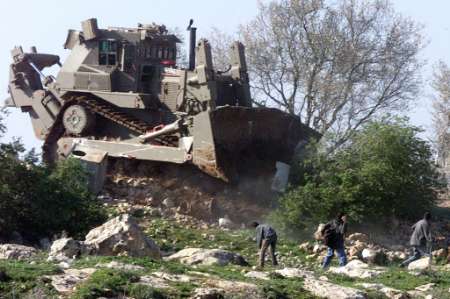
Neve Gordon. Guardian. 30/07/07. A battle is being waged in the Israeli courts against anarchists who help Palestinian villagers. One of the most remarkable qualities of these young Israeli anarchists is their subversive use of their own privilege, employing it not for self-interested social, economic or political gain - as most people do - but rather in order to stand up to power. The anarchists, in other words, exploit the privilege that comes with their Jewish identity and use it as a strategic asset against the brutal policies of the Jewish state.
As Jewish activists they are well aware that the Israeli military behaves very differently when Israeli Jews are present during a protest in the West Bank and that the level of violence, while still severe, is much less intense. Indeed, according to Israeli soldiers the military has more stringent open fire regulations for demonstrations in which non-Palestinians participate. So when a village's public committee decides to carry out non-violent protests against the occupying power, the anarchists mingle with the demonstrating villagers, thus becoming a human shield for all of those Palestinians who have chosen to follow the path of Mahatma Gandhi and Martin Luther King.
Even though the anarchists are frequently beaten and arrested, they do not desist. To date, about 10 Palestinians have been killed in demonstrations against the separation barrier and thousands have been wounded, a number that would no doubt have been much greater had it not been for the fearless dedication of the anarchists.
lunedì 30 luglio 2007


MK: Monthly grant for Holocaust survivors a 'mockery'
Barak Ravid, Haaretz Correspondent. 30/07/07. Chairwoman of the Knesset lobby for Holocaust survivors, Labor MK Colette Avital, condemned on Monday the monthly allowance the government has decided to grant 120,000 survivors. The decision allocates survivors some NIS 1,000 [€ 169.031; US$ 231.214] in its first year of its implementation, which comes about to about NIS 83 monthly [€ 14.0301; US$ 19.1943]. Avital called the decision a "mockery." The benefit will be extended to 120,000 survivors over the age of 70 who receive old age allowances. Each person can expect to receive NIS 83 per month in the first year, a sum which will increase gradually each year. "We are correcting a 60-year-old blight," Olmert said of the decision. "Holocaust survivors living in Israel are entitled to live respectably without reaching a situation in which it is beyond their means to enjoy a hot meal".
Haaretz full text
israel.jpost.com.30/07/07. "Scorn for the poor and salt in the eyes of Holocaust survivors," Colette Avital said of Prime Minister Ehud Olmert's decision on giving additional monetary aid to survivors, Israel Radio reported Monday. There are some 260,000 Holocaust survivors in Israel today, one third of whom live below the poverty line. Many suffer from physical and emotional ailments, loneliness and depression, and a lack of family and social support systems. This is an aging population, with 10,000 of its members requiring welfare assistance.
The Siege of Gaza

Amassi Ghazi, the owner of a failing export business, with some of the checks from customers that have bounced.
Andrew Lee Butters/Gaza City. TIME. 28/07/07. I spent Thursday talking to other business owners -- pragmatic, apolitical people -- who uniformly blamed Israel, the United States and Fatah for the destruction of the Gazan economy. In fact, after years of living with the gangsterism and warlordism that plagued Gaza while it was run by Fatah officials, most are happy with the Hamas takeover. "I blame Fatah and Abu Mazen because they made us live in garbage," said the owner of the largest factory in Gaza, which makes cookies and ice cream, but which is now almost totally shut. "They never wanted to see anyone else prosper. They just wanted to live on top, through corruption."
The business owners pointed out that not only joblessness and poverty pushing average people towards extremism, but they also said that the Israeli embargo was destroying the only class of Palestinians who still looked favorably towards Israel: them. Most of them speak Hebrew, have -- or used to have -- Israeli clients, partners, and friends, and most had once looked forward to the day when there would be no trade barriers at all for an independent Palestine at peace with Israel. "The majority of Gazans do not like Israel'" said Amassi Ghazi, the chairman of a company that imports building materials. "Until now only the private sector had good relations with Israel. So please open the border before you loose the last sector, and all Gaza will be enemies of Israel."
Bringing In The Sheaves
 Refreshments after the harvesting at Al Jabari home
Esther Kern. Christian Peacemaker Teams. 29/07/07
Gleaning on the hillside,
Gleaning 'ore the plains,
Working for the Master
Among the golden grain
The words of this familiar hymn reverberate through my mind each time I go to harvest by hand, stalks of golden grass on the hillside of a farm nestled between two settlements just outside of Hebron. The 'master' and legal owner of this coveted piece of land is a Palestinian farmer. Yet he cannot till the fertile soil, nor bring his flock of thirty goats to graze on the land, for fear of violence and harassment from nearby settlers. The unattended grape vines lie blackened and gnarled upon the ground. The fields are strewn with plastic bottles, diapers, and paper, carelessly tossed away by passers by. Weeds and thistles grow with abandon.
Not only is the Palestinian farmer prevented from working on his land, but he has been shot at, his children physically assaulted, and he has been arrested on erroneous charges and heavily fined.
The settlers have constructed a tent synagogue on the property. For easy access between the two nearby settlements, the Israeli settlers have built a brick sidewalk and steps through the middle of the property. Street lights line the walkway. So what is wrong with this picture?
The farmer has taken his legal claim to the Israeli high court, which ruled in his favor, and ordered the synagogue, sidewalks and steps to be demolished. The tent was torn down, but rebuilt within several days, and the settler activity continues as before. The farmer can only go onto his land under the protection of groups of international human rights workers and Christian Peacemaker Team members, which happens on a regular basis every Friday evening. Each time, he is challenged by the Israeli Police to provide documents to prove that he is the legal owner of the land. Each time, there is a heavy presence of Israeli police and military with an assortment of weapons and military vehicles which necessarily keep the settlers at bay. In spite of this, one settler attacked and injured two human rights workers on the evening of July 27, an act for which the Israeli police arrested him, and for which plenty of evidence was captured on film.
"Gleaning on the hillside" conjures up images of a peaceful and productive land, hardworking farmers, and one of right relationships. The reality is one of confrontation, violence, and bloodshed. What is wrong with this picture?
The settlers have constructed a tent synagogue on the property. For easy access between the two nearby settlements, the Israeli settlers have built a brick sidewalk and steps through the middle of the property. Street lights line the walkway. So what is wrong with this picture?
The farmer has taken his legal claim to the Israeli high court, which ruled in his favor, and ordered the synagogue, sidewalks and steps to be demolished. The tent was torn down, but rebuilt within several days, and the settler activity continues as before. The farmer can only go onto his land under the protection of groups of international human rights workers and Christian Peacemaker Team members, which happens on a regular basis every Friday evening. Each time, he is challenged by the Israeli Police to provide documents to prove that he is the legal owner of the land. Each time, there is a heavy presence of Israeli police and military with an assortment of weapons and military vehicles which necessarily keep the settlers at bay. In spite of this, one settler attacked and injured two human rights workers on the evening of July 27, an act for which the Israeli police arrested him, and for which plenty of evidence was captured on film.
"Gleaning on the hillside" conjures up images of a peaceful and productive land, hardworking farmers, and one of right relationships. The reality is one of confrontation, violence, and bloodshed. What is wrong with this picture?
For photos of actions on Al Jaberi land see: http://www.cpt.
Christian Peacemaker Teams is an ecumenical initiative to support violence reduction efforts around the world. To learn more about CPT's peacemaking work, visit our website www.cpt.org Photos of our projects are at www.cpt.org/gallery A map of the center of Hebron is at http://www.reliefwe
 Tent, used as synagogue, erected by settlers on Jaberi property
Wakseh: il tracollo del nazionalismo palestinese
Ronny Shaked. ISRAELE.net. 30/07/07. Abu Mazen continua a ripetere gli stessi mantra: uno stato palestinese indipendente con Gerusalemme capitale, il diritto al ritorno, la rimozione degli insediamenti. In realtà, non è molto più che il governatore della Muqata, il palazzo presidenziale a Ramallah. Il governo designato da Abu Mazen abbonda di ministri del turismo, dei trasporti, dell’agricoltura e altri importanti dicasteri. Ma è tutto virtuale. I palestinesi nei territori chiamano quello di Salem Fayyad “il governo degli stipendi”. In effetti il Tesoro palestinese ha abbastanza soldi per pagare gli stipendi per molti mesi a venire. Il mondo occidentale, che vede il nemico nell’estremismo islamico, segue ciecamente le dichiarazioni di Abu Mazen e continua a passare grosse somme di denaro. E Abu Mazen manda soldi a Gaza, contribuendo a stabilizzare la situazione sotto Hamas.
Muhammad, di Jabaliya, ci dice che non gli importa chi paga il suo stipendio, se Abu Mazen, Hamas, l’Iran o Israele. Per lui, l’unica cosa che conta è che i soldi arrivino e gli permettano di comprare da mangiare ai suoi figli.
Intanto il potere di Hamas a Gaza si stabilizza, in parte grazie ai soldi che Israele ha trasferito ad Abu Mazen che a sua volta versa soldi a più di 100.000 abitanti di Gaza sotto forma di stipendi mensili. Hamas si sta muovendo con accortezza. Legge e ordine tendono a imporsi, non si vedono più tutte quelle armi per le strade a parte quelle in mano alle forze “governative”, e non si vedono faide di clan. Persino le bancarelle del mercato in Piazza Palestina sono state rimosse e il traffico fluisce. L’introduzione dell’islam da parte del regime viene attuata in modo graduale, ma costante e con determinazione. Anche Hamas non manca di mezzi finanziari, e riempie le tasche dei suoi nuovi sostenitori con assistenza e aiuti.
Gli abitanti di Gaza si sono abituati a Hamas e non sentono la mancanza dei corrotti funzionari di Fatah. Più di ogni altra nazione, i palestinesi sono capaci di adattarsi rapidamente a mutate circostanze. Uno dei leader della generazione di transizione di ciò che resta di Fatah, e che preferisce restare anonimo, ci dice con grande tristezza: “La Wakseh ci ha ributtato indietro di cinquant’anni. La speranza nazionale è perduta. Questi sono giorni di lutto”.
Muhammad, di Jabaliya, ci dice che non gli importa chi paga il suo stipendio, se Abu Mazen, Hamas, l’Iran o Israele. Per lui, l’unica cosa che conta è che i soldi arrivino e gli permettano di comprare da mangiare ai suoi figli.
Intanto il potere di Hamas a Gaza si stabilizza, in parte grazie ai soldi che Israele ha trasferito ad Abu Mazen che a sua volta versa soldi a più di 100.000 abitanti di Gaza sotto forma di stipendi mensili. Hamas si sta muovendo con accortezza. Legge e ordine tendono a imporsi, non si vedono più tutte quelle armi per le strade a parte quelle in mano alle forze “governative”, e non si vedono faide di clan. Persino le bancarelle del mercato in Piazza Palestina sono state rimosse e il traffico fluisce. L’introduzione dell’islam da parte del regime viene attuata in modo graduale, ma costante e con determinazione. Anche Hamas non manca di mezzi finanziari, e riempie le tasche dei suoi nuovi sostenitori con assistenza e aiuti.
Gli abitanti di Gaza si sono abituati a Hamas e non sentono la mancanza dei corrotti funzionari di Fatah. Più di ogni altra nazione, i palestinesi sono capaci di adattarsi rapidamente a mutate circostanze. Uno dei leader della generazione di transizione di ciò che resta di Fatah, e che preferisce restare anonimo, ci dice con grande tristezza: “La Wakseh ci ha ributtato indietro di cinquant’anni. La speranza nazionale è perduta. Questi sono giorni di lutto”.
testo integrale (Da: YnetNews, 27.07.07)
Hamas rejects plan

Ezzedeen Alqassam Bridages Information Office. 29/07/07. The foreign ministry of Hamas government stated its objection Sunday to the Palestinian Authority-negotiated plan to return Palestinians stranded in
Meanwhile, at a meeting in the city of
To date at least 29 people have died while stranded on the Egyptian side of Rafah crossing. Approximately 6,000 Palestinian residents of the Gaza Strip have been marooned there since fighting between Hamas and Fatah caused Zionist and Egyptian authorities to close the crossing in mid June.
Stato Semita Ebraico e Stato Semita Palestinese
Rosario Amico Roxas. Il Dialogo. 27/07/07. Il peggior Occidente guerrafondaio alimenta le divergenze per continuare ad essere l’arbitro ultimo della contesa in Palestina. I diritti che il pontefice sostiene per il popolo ebraico non possono essere che reciproci, validi anche per i Palestinesi. Israele deve diventare uno STATO SEMITA EBRAICO, confederato con lo STATO SEMITA PALESTINESE; questo il senso della dichiarazione di quanti sostengono che Israele deve scomparire dalla carta geografica; deve scomparire come avanguardia armata del peggior Occidente, per ri-diventare una nazione medioorientale, semita, in pace e in armonia con i fratelli palestinesi-semiti.
domenica 29 luglio 2007
Barghuothi: Israeli claims concerning the peace initiative are simply deceiving

IMEMC Staff. 28/07/07. Dr. Mustafa Al-Barghuothi the general secretary of the Palestinian National Initiative faction confirmed today that the Israeli allegations of the peace initiative are simply deceiving, "just another way of by passing the final status of peace negotiations with the Palestinians". His statements came during a conference held in the southern West Bank city of Bethlehem on Saturday. Dr. Al-Barghuothi added that the Israeli talk about pulling out from 90% of the West Bank is false due to status of the current geopolitical map. Israel is planning to pull out from 90% of the 50% of the West Bank left over after constructing the wall, and annexing major illegal Israeli settlements to Israel also excluding Jerusalem and the Jordanian Valley.
The Palestinian official said that no Palestinian will accept the creation of a Palestinian state without sovereignty over Jerusalem as the capital of Palestine. He also reiterated the hazards of creating a Palestinian temporary state, without the dismantling of all illegal Israeli settlements in the West Bank in addition to the Israeli withdrawal of all the lands it occupied in 1967. The new Israeli peace plan according to Al-Barghuothi is meant to disrupt the idea of an independent Palestinian state turning it to cantons, following example of the South African apartheid regime.
Al-Barghuothi pointed out that Bush was convening an international meeting and not an international peace conference, highlighting the most serious campaign statements made by Bush and Olmert in an attempt to separate the Palestinian state on the final issue. This will mean converting a fully sovereign Palestinian state into a state within temporary boarders.
Dr. Al-Barghuothi explained that the Salvation Initiative which was initiated by his political faction, along with the Popular Front for the Liberation of Palestine is an initiative aimed at escaping from the political crisis the Palestinians are facing. He also added that there is a great danger threatening the Palestinian future due to the state of segregation and infighting in the political Palestinian arena.
Finally Dr. Al-Barghuothi warned of the risks the Palestinian nation is facing on a daily basis. He claims this is due to the Israeli army's continuous attacks and the deterioration in the level of livelihood which the Palestinian nation is facing. He also emphasizes the importance of the unifying role that the PFLP and his own political faction, the Palestinian National Initiative is doing to put an end to the internal Palestinian power struggle.
Al-Barghuothi pointed out that Bush was convening an international meeting and not an international peace conference, highlighting the most serious campaign statements made by Bush and Olmert in an attempt to separate the Palestinian state on the final issue. This will mean converting a fully sovereign Palestinian state into a state within temporary boarders.
Dr. Al-Barghuothi explained that the Salvation Initiative which was initiated by his political faction, along with the Popular Front for the Liberation of Palestine is an initiative aimed at escaping from the political crisis the Palestinians are facing. He also added that there is a great danger threatening the Palestinian future due to the state of segregation and infighting in the political Palestinian arena.
Finally Dr. Al-Barghuothi warned of the risks the Palestinian nation is facing on a daily basis. He claims this is due to the Israeli army's continuous attacks and the deterioration in the level of livelihood which the Palestinian nation is facing. He also emphasizes the importance of the unifying role that the PFLP and his own political faction, the Palestinian National Initiative is doing to put an end to the internal Palestinian power struggle.
Translated by Ghassan Bannoura – IMEMC News Room
Blair of Arabia
From The Economist print edition. 26/07/07. Nothing about the latest diplomacy is plain. None of those involved—Mr Olmert, Mr Abbas, moderate Arab leaders, George Bush and even Mr Blair—seems likely yet to have the will or the courage to tackle the explosive issues (the division of Jerusalem, the removal of Jewish settlements in the West Bank, redrawing borders or addressing the refugee question) that have prevented a lasting peace before. Welcome, Mr Blair, to the snake pit.
Tony Blair has been in the job for less than a month since retiring as Britain's prime minister, and is already feeling the slashes of the sword. The first swipe came from Frank-Walter Steinmeier, Germany's foreign minister, who complained that Mr Blair had been appointed behind closed doors by America without consulting the so-called quartet—the club of America, Russia, the European Union and the UN—that Mr Blair is now supposed to represent.
Then came an “open letter” from ten of Europe's Mediterranean countries, which said his mandate, to help build the institutions of a future Palestinian state, was too limited. Mr Blair, they said, should tear up the quartet's old “road map” and seek an all-inclusive peace agreement between Israel and the Palestinians.
The Americans, though, insist that Mr Blair's authority will not extend to high diplomacy. They will lead the way along the “political track”, says Condoleezza Rice, the secretary of state. Italy told Mr Blair not to isolate Hamas, the Islamist movement that rules the Gaza Strip, but Israel says that is precisely what he must do. Merely by taking the job, Mr Blair has stepped on the toes of all the other Middle East envoys, not least Michael Williams, the UN envoy, and Javier Solana, the EU's foreign-policy supremo. His first foray to the Middle East as envoy this week—with a staff of two, no permanent office and relying on the help of British diplomats [...]
Turning Palestine's Most Valuable Natural Resource into a Political Tool. Gaza was a Gas for Blair
Arthur Nelsen. Counterunch. 27/07/07. On April 29, two weeks before fighting flared in Gaza, Yossi Maiman, co-owner of the Israeli gas company EMG, claimed that in 2004, while he was in talks to join the project, it was revealed to him that shares in it were being held in trust for two confidential partners: Mohammed Rashid and Martin Schlaff. BG denied the claims but they were damaging. Schlaff is a millionaire who was investigated on charges of attempting to bribe Ariel Sharon in 2006. Mohammed Rashid is a former director general of the Palestine Investment Fund and erstwhile "mentor" and ally to the now-exiled Gazan warlord Mohammed Dahlan. Conflicts Forum website described Rashid as a sometime advisor to the US and "an essential part of America's programme to undermine Hamas". Yossi Maiman is reportedly a former employee of the Mossad. So is Shabtai Shavit, the CEO of his company who was condemned by Israel's attorney general in 2004 for using his intelligence connections to advance EMG's interests in the Gaza gas fields [...]
The Gaza maritime field is estimated to contain between 35-40bn cubic metres--or one trillion cubic feet--of gas. In the words of the British Foreign Office, it is "by far the most valuable Palestinian natural resource" and revenues from its output are usually estimated at $4bn. For this reason, Ariel Sharon always opposed its development, claiming that monies raised might be used to arm Israel's enemies.
In the summer of 2005, when Sharon was focused on "disengagement" from Gaza, BG signed a memorandum with the Egyptian company EGAS to sell the gas there. But the deal was scuppered a year later, when Tony Blair intervened at the last minute to plead the Israeli government's case to BG, allegedly following a request from Ehud Olmert [...]
Ever sensitive to popular anger at the exploitation of Palestine's national treasure, one of Hamas's first demands after seizing power in Gaza was for a renegotiation of the BG contract. Ziad Thatha, the Hamas economic minister, had previously denounced the deal as "an act of theft" and modern-day Balfour Declaration, that "sells Palestinian gas to the Zionist occupation".
His words might have been a response to the circumvention of the Gaza Strip in the deal, which will pipe gas directly onshore to Ashkelon in Israel.full text
Arthur Neslen is a journalist working in Tel Aviv. The first Jewish employee of Aljazeera.net and a four-year veteran of the BBC, Neslen has contributed to numerous periodicals over the years, including The Guardian, The Observer, The Independent and Red Pepper. His first book, Occupied Minds: A journey through the Israeli psyche, was recently published by Pluto Press.
Les Etats-Unis vont augmenter de 25 % leur aide militaire à Israël
LEMONDE.FR avec AFP. 29/07/07. Ehoud Olmert a annoncé dimanche 29 juillet que les Etats-Unis allaient augmenter de 25 % leur aide militaire et de défense à Israël, pour la porter à plus de 3 milliards de dollars par an, durant les dix prochaines années."Cette aide marque une amélioration considérable et extrêmement importante et constitue un élément très important de la sécurité d'Israël", a salué le premier ministre israélien. Cette année, l'Etat hébreu a reçu 2,4 milliards de dollars d'aide militaire américaine, dont les trois quarts servent à l'achat d'armes à des sociétés américaines, le reste finançant des achats d'équipements militaires auprès de firmes israéliennes.
Security fallout worsens for Fatah
AL Jazeera.net, 27/07/07. Dahlan is believed to be one of the richest people in the Palestinian territories with much of his wealth accrued through Palestinian Authority monopolies such as oil and cement [Palestinian PM's family's cement firm "helping build Israel's wall"]. He is now in Yugoslavia also receiving medical treatment and Hamas have welcomed his resignation and called it the "beginning of the purification of Fatah's ranks".
Dahlan is believed to be one of the richest people in the Palestinian territories with much of his wealth accrued through Palestinian Authority monopolies such as oil and cement. He is now in Yugoslavia also receiving medical treatment and Hamas have welcomed his resignation and called it the "beginning of the purification of Fatah's ranks". The faction's security forces in the Gaza Strip were riven by nepotism, infiltrated by hostile agents and contained recruits motivated by simply making a living rather than political conviction.
M. O.: ACCORDO ISRAELE-EGITTO, 6. 000 PALESTINESI TORNANO A GAZA
(AGI/AFP) - Al-Arish (Egitto) , 28 lug. - Il valico di Rafah fu chiuso il 9 giugno scorso. Da allora migliaia di palestinesi si trovarono a vivere in una sorta di "terra di nessuno". Ventinove tra loro sono morti per le condizioni disastrose di sopravvivenza. Oltre seimila palestinesi potranno finalmente tornare a Gaza. Israele ed Egitto hanno trovato un accordo per il rientro delle famiglie bloccate dalla chiusura del valico di Rafah decisa dopo la presa militare del potere da parte di Hamas. I primi cento partiranno alla volta della Striscia domani: da Al-Arish, 50 chilometri a ovest di Rafah, saranno trasferiti nei Territori.
"Entreranno a Gaza attraverso aree del confine israelo-egiziano, L'Autorita' nazionale palestinese li mettera' sui bus e li portera' a Gaza", ha detto il ministro per le questioni relative ai detenuti, Ashraf Ajrami. Secondo quanto riportato dal quotidiano israeliano "Haaretz", i palestinesi torneranno attraverso il valico di Eretz. (AGI)
"Entreranno a Gaza attraverso aree del confine israelo-egiziano, L'Autorita' nazionale palestinese li mettera' sui bus e li portera' a Gaza", ha detto il ministro per le questioni relative ai detenuti, Ashraf Ajrami. Secondo quanto riportato dal quotidiano israeliano "Haaretz", i palestinesi torneranno attraverso il valico di Eretz. (AGI)
Reflection: Fear or forgiveness?
Jan Benvie, CPT, 29/07/07. "I know what it is like to be powerless to forgive. That is why I would never say to someone, 'You must forgive.' . I can only say: however much we have been wronged, however justified our hatred, if we cherish it, it will poison us. . we must pray for the power to forgive, for it is in forgiving our enemies that we are healed." (Dr Sheila Cassidy who was tortured in Chile, during the Pinochet regime)
A few weeks ago, a Non Governmental Organization (NGO) that provides psychological help to people in Hebron Old City, contacted us. They asked if we could accompany a Palestinian woman and her children on a visit to her parent's home. A house where Israeli settlers live lies between her home and that of her parent's. She is afraid to walk there alone.
We have spoken to some of the Palestinian families in the area and they too believe that the settlers would attack them if they walk alone on the street. Their fear is palpable.
Every Saturday settlers and those we refer to as 'settler visitors' tour the Old City souq. There was a small Jewish community here in Hebron until riots in 1929. Although many Muslim families saved their Jewish neighbors, the Arab rioters killed sixty seven Jews. The British, who ruled Palestine at that time, forcibly evacuated the Jewish survivors. On Saturday the 'tour' comes through the Old City souq, with a heavily armed military escort, visiting the sites related to the pre-1929 community.
We have spoken to some of the visitors and they believe that the 'Arabs' would attack them if it were not for their armed guard. Their fear is palpable.
Here in Hebron we speak with Israeli soldiers, settlers and visitors, and with Palestinian residents and visitors. There is a great deal of fear, anger and distrust, that is deeply and genuinely felt.
A few days ago, I listened to an exchange, in English, between an Israeli soldier and a Palestinian man. Each was recounting the wrongs that had been done to their community by the other. Each was justifying the wrongs that their community had done.
As I listened to the exchange, I was reminded of the words of Edward Said, a Palestinian born writer, who spoke of the Palestinians being "the victims of the victims." For Said it was important that both communities acknowledged the suffering of the other.
Like Sheila Cassidy I would never say to someone "You must forgive", but like her I believe in the healing power of forgiveness. Here in Hebron I meet children, Palestinian and Israeli, who throw stones and swear at strangers, because they perceive them as the 'other'. Here in Hebron I see two communities who live in fear of and hatred for the 'other'.
I hope, pray and work for the spirit of understanding and forgiveness to enter into the hearts of the people of Hebron. Only then can they begin on a journey to peace.
Christian Peacemaker Teams is an ecumenical initiative to support violence reduction efforts around the world. To learn more about CPT's peacemaking work, visit our website www.cpt.org Photos of our projects are at www.cpt.org/
We have spoken to some of the Palestinian families in the area and they too believe that the settlers would attack them if they walk alone on the street. Their fear is palpable.
Every Saturday settlers and those we refer to as 'settler visitors' tour the Old City souq. There was a small Jewish community here in Hebron until riots in 1929. Although many Muslim families saved their Jewish neighbors, the Arab rioters killed sixty seven Jews. The British, who ruled Palestine at that time, forcibly evacuated the Jewish survivors. On Saturday the 'tour' comes through the Old City souq, with a heavily armed military escort, visiting the sites related to the pre-1929 community.
We have spoken to some of the visitors and they believe that the 'Arabs' would attack them if it were not for their armed guard. Their fear is palpable.
Here in Hebron we speak with Israeli soldiers, settlers and visitors, and with Palestinian residents and visitors. There is a great deal of fear, anger and distrust, that is deeply and genuinely felt.
A few days ago, I listened to an exchange, in English, between an Israeli soldier and a Palestinian man. Each was recounting the wrongs that had been done to their community by the other. Each was justifying the wrongs that their community had done.
As I listened to the exchange, I was reminded of the words of Edward Said, a Palestinian born writer, who spoke of the Palestinians being "the victims of the victims." For Said it was important that both communities acknowledged the suffering of the other.
Like Sheila Cassidy I would never say to someone "You must forgive", but like her I believe in the healing power of forgiveness. Here in Hebron I meet children, Palestinian and Israeli, who throw stones and swear at strangers, because they perceive them as the 'other'. Here in Hebron I see two communities who live in fear of and hatred for the 'other'.
I hope, pray and work for the spirit of understanding and forgiveness to enter into the hearts of the people of Hebron. Only then can they begin on a journey to peace.
Christian Peacemaker Teams is an ecumenical initiative to support violence reduction efforts around the world. To learn more about CPT's peacemaking work, visit our website www.cpt.org Photos of our projects are at www.cpt.org/
Iscriviti a:
Post (Atom)