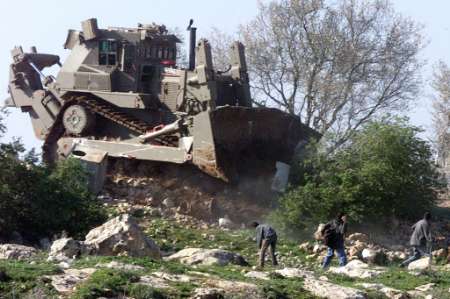
Rosario Amico Roxas. Il Dialogo. 27/07/07. Il peggior Occidente guerrafondaio alimenta le divergenze per continuare ad essere l’arbitro ultimo della contesa in Palestina. I diritti che il pontefice sostiene per il popolo ebraico non possono essere che reciproci, validi anche per i Palestinesi. Israele deve diventare uno STATO SEMITA EBRAICO, confederato con lo STATO SEMITA PALESTINESE; questo il senso della dichiarazione di quanti sostengono che Israele deve scomparire dalla carta geografica; deve scomparire come avanguardia armata del peggior Occidente, per ri-diventare una nazione medioorientale, semita, in pace e in armonia con i fratelli palestinesi-semiti.
lunedì 30 luglio 2007


domenica 29 luglio 2007
Barghuothi: Israeli claims concerning the peace initiative are simply deceiving

IMEMC Staff. 28/07/07. Dr. Mustafa Al-Barghuothi the general secretary of the Palestinian National Initiative faction confirmed today that the Israeli allegations of the peace initiative are simply deceiving, "just another way of by passing the final status of peace negotiations with the Palestinians". His statements came during a conference held in the southern West Bank city of Bethlehem on Saturday. Dr. Al-Barghuothi added that the Israeli talk about pulling out from 90% of the West Bank is false due to status of the current geopolitical map. Israel is planning to pull out from 90% of the 50% of the West Bank left over after constructing the wall, and annexing major illegal Israeli settlements to Israel also excluding Jerusalem and the Jordanian Valley.
The Palestinian official said that no Palestinian will accept the creation of a Palestinian state without sovereignty over Jerusalem as the capital of Palestine. He also reiterated the hazards of creating a Palestinian temporary state, without the dismantling of all illegal Israeli settlements in the West Bank in addition to the Israeli withdrawal of all the lands it occupied in 1967. The new Israeli peace plan according to Al-Barghuothi is meant to disrupt the idea of an independent Palestinian state turning it to cantons, following example of the South African apartheid regime.
Al-Barghuothi pointed out that Bush was convening an international meeting and not an international peace conference, highlighting the most serious campaign statements made by Bush and Olmert in an attempt to separate the Palestinian state on the final issue. This will mean converting a fully sovereign Palestinian state into a state within temporary boarders.
Dr. Al-Barghuothi explained that the Salvation Initiative which was initiated by his political faction, along with the Popular Front for the Liberation of Palestine is an initiative aimed at escaping from the political crisis the Palestinians are facing. He also added that there is a great danger threatening the Palestinian future due to the state of segregation and infighting in the political Palestinian arena.
Finally Dr. Al-Barghuothi warned of the risks the Palestinian nation is facing on a daily basis. He claims this is due to the Israeli army's continuous attacks and the deterioration in the level of livelihood which the Palestinian nation is facing. He also emphasizes the importance of the unifying role that the PFLP and his own political faction, the Palestinian National Initiative is doing to put an end to the internal Palestinian power struggle.
Al-Barghuothi pointed out that Bush was convening an international meeting and not an international peace conference, highlighting the most serious campaign statements made by Bush and Olmert in an attempt to separate the Palestinian state on the final issue. This will mean converting a fully sovereign Palestinian state into a state within temporary boarders.
Dr. Al-Barghuothi explained that the Salvation Initiative which was initiated by his political faction, along with the Popular Front for the Liberation of Palestine is an initiative aimed at escaping from the political crisis the Palestinians are facing. He also added that there is a great danger threatening the Palestinian future due to the state of segregation and infighting in the political Palestinian arena.
Finally Dr. Al-Barghuothi warned of the risks the Palestinian nation is facing on a daily basis. He claims this is due to the Israeli army's continuous attacks and the deterioration in the level of livelihood which the Palestinian nation is facing. He also emphasizes the importance of the unifying role that the PFLP and his own political faction, the Palestinian National Initiative is doing to put an end to the internal Palestinian power struggle.
Translated by Ghassan Bannoura – IMEMC News Room
Blair of Arabia
From The Economist print edition. 26/07/07. Nothing about the latest diplomacy is plain. None of those involved—Mr Olmert, Mr Abbas, moderate Arab leaders, George Bush and even Mr Blair—seems likely yet to have the will or the courage to tackle the explosive issues (the division of Jerusalem, the removal of Jewish settlements in the West Bank, redrawing borders or addressing the refugee question) that have prevented a lasting peace before. Welcome, Mr Blair, to the snake pit.
Tony Blair has been in the job for less than a month since retiring as Britain's prime minister, and is already feeling the slashes of the sword. The first swipe came from Frank-Walter Steinmeier, Germany's foreign minister, who complained that Mr Blair had been appointed behind closed doors by America without consulting the so-called quartet—the club of America, Russia, the European Union and the UN—that Mr Blair is now supposed to represent.
Then came an “open letter” from ten of Europe's Mediterranean countries, which said his mandate, to help build the institutions of a future Palestinian state, was too limited. Mr Blair, they said, should tear up the quartet's old “road map” and seek an all-inclusive peace agreement between Israel and the Palestinians.
The Americans, though, insist that Mr Blair's authority will not extend to high diplomacy. They will lead the way along the “political track”, says Condoleezza Rice, the secretary of state. Italy told Mr Blair not to isolate Hamas, the Islamist movement that rules the Gaza Strip, but Israel says that is precisely what he must do. Merely by taking the job, Mr Blair has stepped on the toes of all the other Middle East envoys, not least Michael Williams, the UN envoy, and Javier Solana, the EU's foreign-policy supremo. His first foray to the Middle East as envoy this week—with a staff of two, no permanent office and relying on the help of British diplomats [...]
Turning Palestine's Most Valuable Natural Resource into a Political Tool. Gaza was a Gas for Blair
Arthur Nelsen. Counterunch. 27/07/07. On April 29, two weeks before fighting flared in Gaza, Yossi Maiman, co-owner of the Israeli gas company EMG, claimed that in 2004, while he was in talks to join the project, it was revealed to him that shares in it were being held in trust for two confidential partners: Mohammed Rashid and Martin Schlaff. BG denied the claims but they were damaging. Schlaff is a millionaire who was investigated on charges of attempting to bribe Ariel Sharon in 2006. Mohammed Rashid is a former director general of the Palestine Investment Fund and erstwhile "mentor" and ally to the now-exiled Gazan warlord Mohammed Dahlan. Conflicts Forum website described Rashid as a sometime advisor to the US and "an essential part of America's programme to undermine Hamas". Yossi Maiman is reportedly a former employee of the Mossad. So is Shabtai Shavit, the CEO of his company who was condemned by Israel's attorney general in 2004 for using his intelligence connections to advance EMG's interests in the Gaza gas fields [...]
The Gaza maritime field is estimated to contain between 35-40bn cubic metres--or one trillion cubic feet--of gas. In the words of the British Foreign Office, it is "by far the most valuable Palestinian natural resource" and revenues from its output are usually estimated at $4bn. For this reason, Ariel Sharon always opposed its development, claiming that monies raised might be used to arm Israel's enemies.
In the summer of 2005, when Sharon was focused on "disengagement" from Gaza, BG signed a memorandum with the Egyptian company EGAS to sell the gas there. But the deal was scuppered a year later, when Tony Blair intervened at the last minute to plead the Israeli government's case to BG, allegedly following a request from Ehud Olmert [...]
Ever sensitive to popular anger at the exploitation of Palestine's national treasure, one of Hamas's first demands after seizing power in Gaza was for a renegotiation of the BG contract. Ziad Thatha, the Hamas economic minister, had previously denounced the deal as "an act of theft" and modern-day Balfour Declaration, that "sells Palestinian gas to the Zionist occupation".
His words might have been a response to the circumvention of the Gaza Strip in the deal, which will pipe gas directly onshore to Ashkelon in Israel.full text
Arthur Neslen is a journalist working in Tel Aviv. The first Jewish employee of Aljazeera.net and a four-year veteran of the BBC, Neslen has contributed to numerous periodicals over the years, including The Guardian, The Observer, The Independent and Red Pepper. His first book, Occupied Minds: A journey through the Israeli psyche, was recently published by Pluto Press.
Les Etats-Unis vont augmenter de 25 % leur aide militaire à Israël
LEMONDE.FR avec AFP. 29/07/07. Ehoud Olmert a annoncé dimanche 29 juillet que les Etats-Unis allaient augmenter de 25 % leur aide militaire et de défense à Israël, pour la porter à plus de 3 milliards de dollars par an, durant les dix prochaines années."Cette aide marque une amélioration considérable et extrêmement importante et constitue un élément très important de la sécurité d'Israël", a salué le premier ministre israélien. Cette année, l'Etat hébreu a reçu 2,4 milliards de dollars d'aide militaire américaine, dont les trois quarts servent à l'achat d'armes à des sociétés américaines, le reste finançant des achats d'équipements militaires auprès de firmes israéliennes.
Security fallout worsens for Fatah
AL Jazeera.net, 27/07/07. Dahlan is believed to be one of the richest people in the Palestinian territories with much of his wealth accrued through Palestinian Authority monopolies such as oil and cement [Palestinian PM's family's cement firm "helping build Israel's wall"]. He is now in Yugoslavia also receiving medical treatment and Hamas have welcomed his resignation and called it the "beginning of the purification of Fatah's ranks".
Dahlan is believed to be one of the richest people in the Palestinian territories with much of his wealth accrued through Palestinian Authority monopolies such as oil and cement. He is now in Yugoslavia also receiving medical treatment and Hamas have welcomed his resignation and called it the "beginning of the purification of Fatah's ranks". The faction's security forces in the Gaza Strip were riven by nepotism, infiltrated by hostile agents and contained recruits motivated by simply making a living rather than political conviction.
M. O.: ACCORDO ISRAELE-EGITTO, 6. 000 PALESTINESI TORNANO A GAZA
(AGI/AFP) - Al-Arish (Egitto) , 28 lug. - Il valico di Rafah fu chiuso il 9 giugno scorso. Da allora migliaia di palestinesi si trovarono a vivere in una sorta di "terra di nessuno". Ventinove tra loro sono morti per le condizioni disastrose di sopravvivenza. Oltre seimila palestinesi potranno finalmente tornare a Gaza. Israele ed Egitto hanno trovato un accordo per il rientro delle famiglie bloccate dalla chiusura del valico di Rafah decisa dopo la presa militare del potere da parte di Hamas. I primi cento partiranno alla volta della Striscia domani: da Al-Arish, 50 chilometri a ovest di Rafah, saranno trasferiti nei Territori.
"Entreranno a Gaza attraverso aree del confine israelo-egiziano, L'Autorita' nazionale palestinese li mettera' sui bus e li portera' a Gaza", ha detto il ministro per le questioni relative ai detenuti, Ashraf Ajrami. Secondo quanto riportato dal quotidiano israeliano "Haaretz", i palestinesi torneranno attraverso il valico di Eretz. (AGI)
"Entreranno a Gaza attraverso aree del confine israelo-egiziano, L'Autorita' nazionale palestinese li mettera' sui bus e li portera' a Gaza", ha detto il ministro per le questioni relative ai detenuti, Ashraf Ajrami. Secondo quanto riportato dal quotidiano israeliano "Haaretz", i palestinesi torneranno attraverso il valico di Eretz. (AGI)
Reflection: Fear or forgiveness?
Jan Benvie, CPT, 29/07/07. "I know what it is like to be powerless to forgive. That is why I would never say to someone, 'You must forgive.' . I can only say: however much we have been wronged, however justified our hatred, if we cherish it, it will poison us. . we must pray for the power to forgive, for it is in forgiving our enemies that we are healed." (Dr Sheila Cassidy who was tortured in Chile, during the Pinochet regime)
A few weeks ago, a Non Governmental Organization (NGO) that provides psychological help to people in Hebron Old City, contacted us. They asked if we could accompany a Palestinian woman and her children on a visit to her parent's home. A house where Israeli settlers live lies between her home and that of her parent's. She is afraid to walk there alone.
We have spoken to some of the Palestinian families in the area and they too believe that the settlers would attack them if they walk alone on the street. Their fear is palpable.
Every Saturday settlers and those we refer to as 'settler visitors' tour the Old City souq. There was a small Jewish community here in Hebron until riots in 1929. Although many Muslim families saved their Jewish neighbors, the Arab rioters killed sixty seven Jews. The British, who ruled Palestine at that time, forcibly evacuated the Jewish survivors. On Saturday the 'tour' comes through the Old City souq, with a heavily armed military escort, visiting the sites related to the pre-1929 community.
We have spoken to some of the visitors and they believe that the 'Arabs' would attack them if it were not for their armed guard. Their fear is palpable.
Here in Hebron we speak with Israeli soldiers, settlers and visitors, and with Palestinian residents and visitors. There is a great deal of fear, anger and distrust, that is deeply and genuinely felt.
A few days ago, I listened to an exchange, in English, between an Israeli soldier and a Palestinian man. Each was recounting the wrongs that had been done to their community by the other. Each was justifying the wrongs that their community had done.
As I listened to the exchange, I was reminded of the words of Edward Said, a Palestinian born writer, who spoke of the Palestinians being "the victims of the victims." For Said it was important that both communities acknowledged the suffering of the other.
Like Sheila Cassidy I would never say to someone "You must forgive", but like her I believe in the healing power of forgiveness. Here in Hebron I meet children, Palestinian and Israeli, who throw stones and swear at strangers, because they perceive them as the 'other'. Here in Hebron I see two communities who live in fear of and hatred for the 'other'.
I hope, pray and work for the spirit of understanding and forgiveness to enter into the hearts of the people of Hebron. Only then can they begin on a journey to peace.
Christian Peacemaker Teams is an ecumenical initiative to support violence reduction efforts around the world. To learn more about CPT's peacemaking work, visit our website www.cpt.org Photos of our projects are at www.cpt.org/
We have spoken to some of the Palestinian families in the area and they too believe that the settlers would attack them if they walk alone on the street. Their fear is palpable.
Every Saturday settlers and those we refer to as 'settler visitors' tour the Old City souq. There was a small Jewish community here in Hebron until riots in 1929. Although many Muslim families saved their Jewish neighbors, the Arab rioters killed sixty seven Jews. The British, who ruled Palestine at that time, forcibly evacuated the Jewish survivors. On Saturday the 'tour' comes through the Old City souq, with a heavily armed military escort, visiting the sites related to the pre-1929 community.
We have spoken to some of the visitors and they believe that the 'Arabs' would attack them if it were not for their armed guard. Their fear is palpable.
Here in Hebron we speak with Israeli soldiers, settlers and visitors, and with Palestinian residents and visitors. There is a great deal of fear, anger and distrust, that is deeply and genuinely felt.
A few days ago, I listened to an exchange, in English, between an Israeli soldier and a Palestinian man. Each was recounting the wrongs that had been done to their community by the other. Each was justifying the wrongs that their community had done.
As I listened to the exchange, I was reminded of the words of Edward Said, a Palestinian born writer, who spoke of the Palestinians being "the victims of the victims." For Said it was important that both communities acknowledged the suffering of the other.
Like Sheila Cassidy I would never say to someone "You must forgive", but like her I believe in the healing power of forgiveness. Here in Hebron I meet children, Palestinian and Israeli, who throw stones and swear at strangers, because they perceive them as the 'other'. Here in Hebron I see two communities who live in fear of and hatred for the 'other'.
I hope, pray and work for the spirit of understanding and forgiveness to enter into the hearts of the people of Hebron. Only then can they begin on a journey to peace.
Christian Peacemaker Teams is an ecumenical initiative to support violence reduction efforts around the world. To learn more about CPT's peacemaking work, visit our website www.cpt.org Photos of our projects are at www.cpt.org/
sabato 28 luglio 2007
Olmert apre al leader palestinese: pronto a cedere [più tardi... dopo... quando si potrà... se... ] il 90% [del 50%] dei Territori
Gian Micalessin. Il Giornale. 26/07/07. Dell’esatta definizione dei confini, delle zone di Gerusalemme destinate a diventare capitale del nuovo Stato, della questione dei profughi si discuterà soltanto alla fine. Prima di affrontare gli scogli negoziali Olmert vuole negoziare con Abbas le caratteristiche dello Stato palestinese, la sua natura istituzionale, la sua economia e i suoi accordi doganali con Israele. Più avanti, i due discuteranno una definizione di massima delle frontiere, gli scambi di territori per compensare le colonie della Cisgiordania rimaste israeliane, le soluzioni per garantire la contiguità territoriale attraverso la costruzione di un tunnel sotterraneo tra Gaza e la Cisgiordania.............
Bilin: Soldiers show no restraint towards Peaceful Demonstrators
ISM. 28/07/07. Approximately 300 international, Palestinian and Israeli non-violent demonstrators came together for the 129th Bilin demonstration against the illegal Apartheid wall. The demonstrators came from all backgrounds and included children as young as five through to women, men and elderly internationals, Israelis and Palestinians.
The demonstration took a different route than usual and entered the olive groves from the far left hand side through a small road close to the wall. Upon entering the Olive groves, the soldiers almost immediately began firing tear gas canisters and sound grenades at the demonstrators who were peacefully walking towards the Apartheid wall. Despite demonstrators being hundreds of meters away from the Wall and not posing any threat to the soldiers or the Wall itself the soldiers used severe aggression without just cause. Demonstrators made significant attempts to avoid the tear gas however due to the direction of the wind, many of the demonstrators were severely affected by the gas, including one international male who required attention by the Palestinian Red Crescent.
Despite initial attempts by the soldiers to disperse the demonstrators, the non-violent activists persevered in getting their message across that the Apartheid wall must fall and that the people of Bilin and the internationals say No to the Occupation. The peaceful demonstrators faced rubber bullets being fired seemingly without reason and in a completely indiscriminate manner, as well as tear gas canisters directly at demonstrators. It was only through great fortune that there were no reports of serious injury as a consequence.
Due to the heat of the day and the excessive use of tear gas, fires were started within the Olive groves. Unfortunately due to the direction of the wind, a large fire took hold in a section of the groves and approximately ten Olive trees were severely burned and damaged. Demonstrators were keen to preserve the trees however the fire was too strong for them to overcome and they had to retreat.
Wadi Rahul: Second Settlement Attempt
International Solidarity Movement. July 25th, 2007. Palestinians, International Human Rights Workers and Israelis recently went to the village of Wadi Rahul, which is near Bethlehem, to document a number of Israeli settlers that intended to initiate a new illegal settlement on a hill beyond the Efrata Settlement on Palestinian land.

It is understood that this was their second attempt and on this occasion they have sought to assemble a large number of people through the internet, inviting people throughout Israel and the settlements. We received information of the hour and the place of where they would leave, on foot since the police organized numerous “check-points” to intercept them. However the Settlers had sufficient information to avoid these meaningless preventative measures and were able to access the land.
Towards 16:30 we divided into two groups to be able to observe from two farmers homes which hill the Settlers wished to occupy. It is understood that one of the farmers had been notified by the Israeli Occupation Forces (IOF) not to leave his property after 5pm.

During the previous evening, the army and the police had implemented a gate along the road the Settlers wished to take. During the day this particular road had been filled with police and military vehicles, the number of which increased significantly during the build up to the event.
Towards five in the afternoon, it was possible to see hundreds of Settlers begin marching towards the land they wished to occupy. They obviously hadn’t been dissuaded by the checkpoints or gates and had found suitable alternative routes to enable them to get to their chosen site.
Shortly after, they appeared in a cultivated field, still walking. They formed a row and passed across a field in the direction of the hill they wished to occupy. They appeared to be walking in the middle of the fields to avoid interception by the police or the army.

In the other location where activists were based to help protect Palestinians, it was also reported that Settlers had thrown rocks at the property and there had been an attempt to detain someone, however they were later released without harm.
Originally we maintained our observation of events from the roof of the Palestinian home, however we moved to the outside of the house close to where the Settlers were passing to ensure they didn’t act unnecessarily aggressive.
Whilst the Settlers trespassed onto Palestinian land, a few Settlers attempted to converse with the Palestinians however this was very much limited to stating that the Palestinains should leave as, “it is not their land”. A further Settler claimed that the land had been given to the Jews by God.
The march continued toward the hill, where the police and the army were expecting them. At this point the Settlers scattered in many directions and the security forces were incapable of preventing the Settlers from passing around them to continue their march. It is worth noting that the soldiers made little effort to use the “crowd control” devices they tend to employ at Bil’in, on their own people. ie. sound grenades or tear gas.
Among the participants there were people with backpacks and what appeared to be camping equipment, indicating the Settlers were likely to remain in place. It’s difficult to determine the exact number of Settlers that participated in this event due to the numbers being so dispersed across the hills, however it is estimated there were approximately 600 Settlers.
The police managed to stop the march from passing before it arrived at the second hill which was on slightly higher ground. When an activist approached to see what was happening, it could be seen that many of the Settlers were beginning to return and had begun to leave the area.
A number of buses appeared to remove the demonstrators from the land however many chose to leave on foot.
Later HRWs returned to the house with the Palestinians, and we remained there to be able to cover possible aggressions later that evening by any remaining Settlers.
Until well into the night, until at least 1am, many bus trips were made to remove the remaining Settlers from the area. There was a large military presence maintained and a significant attempt to remove determined Settlers who wished to stay on the Palestinian land.
There were many groups of people patrolling the area through the night, causing great anxiety among the Palestinians (in the house we were in, all the family watched from the balcony, and they only felt comfortable enough to sleep when three more internationals arrived.)
Throughout the night, soldiers, Settlers and Police continued to move throughout the surrounding fields, sometimes using flares to determine positions of each other and settlers.
Even in the morning it was still possible to see Settlers remaining in the fields from the previous day.
Brown to appoint his own Middle East envoy
Ian Black, middle East editor. Guardian. 28/07/07. Gordon Brown is to appoint his own Middle East envoy, opening up the possibility of a clash with the work of Tony Blair, who is now representing the international "Quartet" - the US, EU, UN and Russia. Michael Williams, currently a special coordinator for the regional peace process for the UN secretary general, Ban Ki-moon, is expected to be confirmed in the job next week, the Guardian has learned. Mr Williams, 58, a former BBC journalist, worked for the UN in Cambodia and the Balkans, and as an adviser to Robin Cook and Jack Straw in the Foreign Office. Details of the appointment are still being finalised, but his move to Downing Street suggests that the prime minister is keen to develop his own policy for the Middle East, despite his predecessor's new high-profile role for the Quartet. Mr Brown told Mr Ban in London earlier this month that he wanted Mr Williams to fill the post formerly occupied by Lord Levy. The Palestinians and other Arabs will be pleased with the news and hoping that the prime minister will develop a distinct approach that is less influenced by both Washington and Jerusalem. Lord Levy, a leading figure in the UK Jewish community and a Labour party donor, was widely seen as being too close to Israel's view of the conflict. A key issue is whether to engage with the Palestinian Islamist movement Hamas, currently being shunned on the grounds that it has not formally renounced violence, recognised Israel or accepted previous peace agreements.
Olmert Competes with the Arabs
Maher Othman. Al-Hayat. 27/07/07. Olmert, as a student of his predecessor Ariel Sharon, understands that there is no need to embarrass any party that pushes for a peaceful settlement to the Arab-Israeli conflict - particularly if this party happens to be the United States. He understands that Israel can accept any reasonable peace settlement in principle, and then proceed to render it meaningless by adding conditions and amendments. This was the tactic used by Sharon when he built his wall under the pretext of preventing the entry of suicide bombers to Israel, only to follow it up with a massive program of colonial expansion in the West Bank. Olmert learned to make all the right noises following U.S. overtures for a peace deal and then proceed to dismantle and sabotage these overtures before they could lead to a genuine settlement. This is precisely what Sharon did when he ostensibly embraced the American Road Map for peace and then set about clipping its wings and rendering it meaningless - eventually using it to advance Israeli interests. Meanwhile, instead of lobbying the United States and meeting the pressure of pro-Israeli groups with pressure of their own, the Arab governments continue to chase shadows.
full text
The siege on the Gaza Strip
B'Tselem. 26/07/07. Since 12 June 2007, Israel has prohibited almost completely movement through this main artery, or through the other crossings under its control. Reports issued by OCHA and the Palestinian Trade Organization (Paltrade) in cooperation with the World Bank show that exports from Gaza stopped completely, and that, except for the supply of necessities to meet humanitarian and basic food needs (such as flour, sugar, oil, rice, and salt), imports into the Strip also ceased. Gazan industry is based on enterprises ninety-five percent of which rely on the importation of raw materials. Eighty percent of these enterprises need machines and replacement parts, which are imported, to operate. During the siege, raw materials have not entered Gaza, so eighty percent of the enterprises have had to close down operations. The remaining enterprises are operating at sixty-percent capacity. More than 1,300 shipping containers of imported products intended for Gaza are stuck in Israel , forcing importers to pay storage costs and late fees, and bear the heavy loss of expensive perishable goods. In the construction sector, building has stopped, or been delayed, primarily because of the lack of raw materials. The total economic losses during the first month of the siege alone are estimated at 20.6 million dollars. In this period, 3,190 businesses closed temporarily and 65,800 workers, who support 450,000 dependants, lost their job. As each day of siege passes, more business shut down and more Gazans find themselves without a means of livelihood. Media reports indicate that the Israeli authorities and the head of the Palestinian Authority oppose opening the crossing to enable residents to enter Gaza from Egypt , apparently out of fear that Hamas would be strengthened by the uncontrolled entry of thousands of activists. B'Tselem calls on all the relevant parties to reach an arrangement that will bring an end to the suffering of the people trapped on both sides of the crossings. All the parties are obligated to respect the human rights of the residents of Gaza and are forbidden to turn them into hostages in the power struggle being waged among them.
In June 2007, Hamas took over power in the Gaza Strip. Since then, the area has been under siege. Following Hamas's takeover, Israel changed the movement arrangements at the five Gaza border-crossing points under its control (Erez, Karni, Nahal Oz, Sufa, and Kerem Shalom), and, except for exceptional cases, again did not permit movement of people or goods between Israel and Gaza . Karni Crossing, "the lifeblood of the Gaza Strip," through which the great majority of goods enters and leaves Gaza , ceased to operate almost completely. As a result, many branches of commerce have been disrupted and the economic crisis in the Gaza Strip has grown.
Rafah Crossing, the only Gaza crossing that is not run by Israel and the only one that is not under its direct control, has not been open since 9 June 2007 [see below]. Some 6,000 Gazans who were in Egypt at the time it was closed have been unable to return to their homes and are in severe distress. The closing of the crossing also denies Gazans any possibility of going abroad, even for urgent humanitarian purposes, such as medical treatment.
The more the siege continues, the greater the harm to the residents and their ability to meet their basic needs. Therefore, B'Tselem calls on all the parties in charge of managing the crossing points to take immediate action to open the crossings and prevent a humanitarian tragedy.
The economic siege on Gaza and its consequences
The foreign trade of Gaza is conducted almost solely with Israel or via Israeli ports. Israel controls the air space and territorial waters of Gaza, and does not allow Palestinians to build an airport or seaport. Rafah Crossing has a terminal for the crossing of goods. However, even when the terminal is open, goods are not allowed to pass through, this in accordance with the Israeli-Palestinian Agreement on Movement and Access of November 2005 ( AMA). The movement of exports through Rafah Crossing is of secondary importance, at best, given that the vast majority of exports are intended for marketing in Israel . Thus, all the goods entering Gaza and almost all the goods leaving it must move via the crossings between Gaza and Israel .
As mentioned above, almost all the movement of goods to and from Gaza passes through Karni Crossing. Under the Crossings Agreement, Israel undertook, among other things, to enable the orderly and continuous movement of goods though the crossing, and clear goals were set regarding the scope of activity at the crossing. Even before Hamas seized control of the Gaza Strip, Israel did not meet this undertaking. Movement of goods through the crossing was conducted at a pace far too slow to allow for effective foreign trade.
The situation is much worse now. Since 12 June 2007, Israel has prohibited almost completely movement through this main artery, or through the other crossings under its control. Reports issued by OCHA and the Palestinian Trade Organization (Paltrade) in cooperation with the World Bank show that exports from Gaza stopped completely, and that, except for the supply of necessities to meet humanitarian and basic food needs (such as flour, sugar, oil, rice, and salt), imports into the Strip also ceased.
These measures have had a disastrous effect. As described in another report of Paltrade, Gazan industry is based on enterprises ninety-five percent of which rely on the importation of raw materials. Eighty percent of these enterprises need machines and replacement parts, which are imported, to operate. During the siege, raw materials have not entered Gaza , so eighty percent of the enterprises have had to close down operations. The remaining enterprises are operating at sixty-percent capacity. More than 1,300 shipping containers of imported products intended for Gaza are stuck in Israel , forcing importers to pay storage costs and late fees, and bear the heavy loss of expensive perishable goods. In the construction sector, building has stopped, or been delayed, primarily because of the lack of raw materials. The total economic losses during the first month of the siege alone are estimated at 20.6 million dollars. In this period, 3,190 businesses closed temporarily and 65,800 workers, who support 450,000 dependants, lost their job. As each day of siege passes, more business shut down and more Gazans find themselves without a means of livelihood.
Israel argues that the sweeping restrictions are "needed for security and result from the lack of coordination with the Palestinians." It cannot be denied that within Gaza there are indeed entities which pose a threat to the security of citizens of Israel and that the present leadership in the Gaza Strip is responsible for some of these threats. The Israeli authorities have the right and indeed the duty to protect Israeli citizens from these threats. However, in doing so, they are not permitted to ignore the rights and needs of the civilian population of the Gaza Strip. Because it holds effective control of Gaza 's foreign trade, Israel has a legal obligation to ensure that any harm to residents of the Gaza Strip resulting from the restrictions it has placed on movement at the border crossings it controls do not exceed the minimum necessary to realize the legitimate security purpose for which they were instituted. Imposition of the protracted economic siege that forces on Gazans a life of poverty and want is inconsistent with this duty.
Alternatives to the siege should be found that will enable the crossing of goods also in the present circumstances. The security threats in the Gaza Strip are nothing new, and ways have been found to cope with them in the past without completely stopping the movement of goods to and from Gaza . The same must be done now.
Regarding the claim of lack of coordination with the Palestinians, both the Palestinian leadership and the Israeli leadership must find a way to arrange passage through the border crossings and to prevent an economic crisis in Gaza , with all the human suffering such a crisis entails. However, even if the Palestinian leadership fails to meet its obligations on this point, that failure does not permit Israel to leave the civilian population of Gaza in distress, and it must do everything it can to find a solution, such as working through an intermediary, to bring the economic siege to an end.
Closing of Rafah Crossing and its consequences
Given that Gaza has no airport or seaport, and inasmuch as Israel controls all the other crossing points, Rafah Crossing is the only gateway through which Gazans can go abroad, and for this reason the crossing is of such great importance.
In the Crossings Agreement, the two sides agreed that the crossing would be operated by the Palestinian Authority, in cooperation with Egypt and under Israeli supervision by means of video cameras and monitoring of the lists of travelers. To ensure compliance with the agreement, it was agreed that observers on behalf of the European Union would be posted at the crossing. The two sides gave the observers supervisory powers and agreed that the crossing would not be opened unless the observers were present. Since 9 June, the observers have not been present at the crossing, and nobody is allowed to cross. As a result, many Gazans find themselves in great distress.
As noted above, some 6,000 Gazans who had left the Strip and were in Egypt when Hamas took control of the Strip have been unable to return to their homes and unite with their families. Many of them do not have the means to finance their continued stay in Egypt and lack proper housing accommodations, food, and medicines. Some, who were ill, have died while trapped on the other side of the border. An unknown number of Gazans are stuck elsewhere in the world. Residents wanting to leave Gaza for Egypt or elsewhere, including chronic patients and injured persons badly needing medical treatment unavailable in Gaza , remain imprisoned inside the Strip.
The persons and entities controlling the activity at the crossing – the head of the Palestinian Authority, Hamas , Israel , Egypt , and the European Union to some extent – are responsible for this situation and must find a solution to the problem. Media reports indicate that the Israeli authorities and the head of the Palestinian Authority oppose opening the crossing to enable residents to enter Gaza from Egypt , apparently out of fear that Hamas would be strengthened by the uncontrolled entry of thousands of activists. Egypt refuses to open the crossing without Israel 's consent and in the absence of the European observers. A proposal whereby Israel would open the Kerem Shalom crossing to ease the suffering was rejected by the Hamas leadership in the Strip.
Iscriviti a:
Post (Atom)