The shortage exists for two primary reasons. One, Mekorot's policy in the West Bank has always been based on flagrant discrimination against Palestinians and in favor of settlers. Whereas most Palestinian villages connected only to Mekorot pipelines constantly suffer a shortage, the settlements consume unlimited amounts of water for their household and urban needs, as is customary in most towns and villages inside Israel . Furthermore, where Palestinian villages and settlements are connected to the same pipeline, Mekorot reduces the supply of water in Palestinian communities in the summertime in order to meet the increased need in the settlements. Residents of Yatta and villages nearby, for example, receive water through the same pipeline that Mekorot uses to supply the Pnei Hever settlement.
The other reason is the sharp increase in illegal tapping into the pipelines by Palestinian farmers. In Bani Na'im, for example, these thefts accounted for almost all the water supplied to the village. Most of the tapping is done in Area C, where Israel is responsible, under the Oslo agreements, for law enforcement. Unlike the policy Israel adopts regarding offenses against Israelis in Area C, security officials have done little to stop the thefts of water and prosecute the lawbreakers. B'Tselem's research indicates that, on several occasions, Palestinian police officials in the Hebron District requested the Civil Administration to coordinate the entry of Palestinian police to Area C to deal with the private tapping into the water lines, but were refused.
In light of the severe water shortage, many municipalities and local councils in Hebron District have had to divide their communities into areas and ration out water on an alternating basis. In a-Samu'a, for example, water is provided to households only three days a month. In Yatta, every household receives water for one day out of every two weeks.
It should be mentioned that, in addition to the villages suffering from a reduction in water supply during the summer, Hebron District has some 90 small villages, housing 40,000 people, that are not connected to any water network and suffer water shortage on a permanent basis.
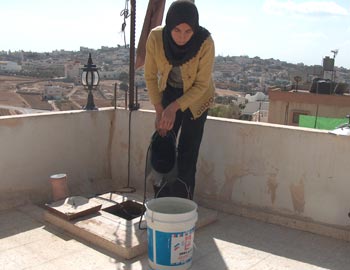
Drawing water from a pit to collect rainwater in a-Dhahiriyah. Photo: Musa Abu Hashhash, B'Tselem., 29 October 2007
The shortage of piped water forces the residents to buy from private dealers, who deliver the water in tankers. Water supplied through the pipelines ranges from 3-5 shekels per cubic meter, whereas the private dealers charge 15-30 shekels, depending on the supplier and the location of the village. Given that more than 40% of West Bank residents live under the poverty line and that 23% of the work force is unemployed, private purchasing of water has become a heavy financial burden for much of the population. Furthermore, families that are too poor to buy water privately use unsupervised sources such as springs and agricultural wells, which are at high risk of contamination.
The water shortage in the West Bank stems in part from the unfair distribution of water sources shared by Israel and the Palestinians. One of these sources is the Mountain Aquifer, which comprises a few underground water basins located on both sides of the Israel-West Bank border. Although the Mountain Aquifer is the sole source of water for residents of the West Bank, Israel uses about 80% of it (most inside Israel itself), with the Palestinians getting the remaining 20%. Under the Oslo agreements, the Palestinian Authority is not allowed to drill new wells without Israel 's consent, even in Area A, the responsibility for which was handed over to the PA.
This unjust distribution of the shared water sources and Mekorot's discriminatory policy in the West Bank are two of the main reasons for the great disparity in water consumption between Israelis (including settlers) and West Bank Palestinians. Average Israeli household and urban water consumption is 280 liters a day per person, while among Palestinians, water consumption for the same purposes amounts to 65 liters a day per person. The World Health Organization recommends 100 liters a day per person for household and urban use.