Visualizzazione post con etichetta B'Tselem. Mostra tutti i post

martedì 6 novembre 2007

Water Crisis 28.10.07: Severe water shortage in Hebron District

B'Tselem. Since the summer began, tens of thousands of Palestinians in the Hebron District have been suffering one of the worst shortages of water for household needs in recent years. The shortage is particularly felt in villages that are connected, directly or indirectly, to Mekorot (the Israeli water company) pipelines. These villages include Bani Na'im (20,000 residents), Yatta (45,000), a-Dhahiriyah (30,000), and a-Samu'a (20,000).

The shortage exists for two primary reasons. One, Mekorot's policy in the West Bank has always been based on flagrant discrimination against Palestinians and in favor of settlers. Whereas most Palestinian villages connected only to Mekorot pipelines constantly suffer a shortage, the settlements consume unlimited amounts of water for their household and urban needs, as is customary in most towns and villages inside Israel . Furthermore, where Palestinian villages and settlements are connected to the same pipeline, Mekorot reduces the supply of water in Palestinian communities in the summertime in order to meet the increased need in the settlements. Residents of Yatta and villages nearby, for example, receive water through the same pipeline that Mekorot uses to supply the Pnei Hever settlement.

The other reason is the sharp increase in illegal tapping into the pipelines by Palestinian farmers. In Bani Na'im, for example, these thefts accounted for almost all the water supplied to the village. Most of the tapping is done in Area C, where Israel is responsible, under the Oslo agreements, for law enforcement. Unlike the policy Israel adopts regarding offenses against Israelis in Area C, security officials have done little to stop the thefts of water and prosecute the lawbreakers. B'Tselem's research indicates that, on several occasions, Palestinian police officials in the Hebron District requested the Civil Administration to coordinate the entry of Palestinian police to Area C to deal with the private tapping into the water lines, but were refused.

In light of the severe water shortage, many municipalities and local councils in Hebron District have had to divide their communities into areas and ration out water on an alternating basis. In a-Samu'a, for example, water is provided to households only three days a month. In Yatta, every household receives water for one day out of every two weeks.

It should be mentioned that, in addition to the villages suffering from a reduction in water supply during the summer, Hebron District has some 90 small villages, housing 40,000 people, that are not connected to any water network and suffer water shortage on a permanent basis.

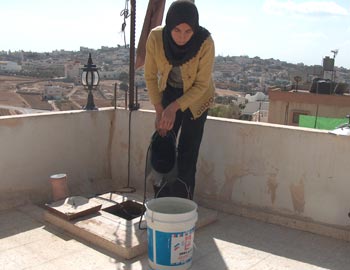
Drawing water from a pit to collect rainwater in a-Dhahiriyah. Photo: Musa Abu Hashhash, B'Tselem., 29 October 2007

The shortage of piped water forces the residents to buy from private dealers, who deliver the water in tankers. Water supplied through the pipelines ranges from 3-5 shekels per cubic meter, whereas the private dealers charge 15-30 shekels, depending on the supplier and the location of the village. Given that more than 40% of West Bank residents live under the poverty line and that 23% of the work force is unemployed, private purchasing of water has become a heavy financial burden for much of the population. Furthermore, families that are too poor to buy water privately use unsupervised sources such as springs and agricultural wells, which are at high risk of contamination.

The water shortage in the West Bank stems in part from the unfair distribution of water sources shared by Israel and the Palestinians. One of these sources is the Mountain Aquifer, which comprises a few underground water basins located on both sides of the Israel-West Bank border. Although the Mountain Aquifer is the sole source of water for residents of the West Bank, Israel uses about 80% of it (most inside Israel itself), with the Palestinians getting the remaining 20%. Under the Oslo agreements, the Palestinian Authority is not allowed to drill new wells without Israel 's consent, even in Area A, the responsibility for which was handed over to the PA.

This unjust distribution of the shared water sources and Mekorot's discriminatory policy in the West Bank are two of the main reasons for the great disparity in water consumption between Israelis (including settlers) and West Bank Palestinians. Average Israeli household and urban water consumption is 280 liters a day per person, while among Palestinians, water consumption for the same purposes amounts to 65 liters a day per person. The World Health Organization recommends 100 liters a day per person for household and urban use.

venerdì 26 ottobre 2007

Palestinian cancer patient denied entry from Gaza into Israel for hospital care

Donald Macintyre in Jerusalem, The Independent, 26.10.07. A 21-year-old cancer patient in urgent need of specialist treatment was stopped from entering Israel from Gaza despite securing prior permission from the Israeli military to cross the border. The incident, the latest in a series which the Israeli group Physicians for Human Rights (PHR) claims is part of a tough new policy by the domestic intelligence agency Shin Bet towards seriously ill patients from Gaza seeking treatment in Israel, came as Israel separately stepped up its response to the firing of Qassam rockets by Gaza militants. The patient turned back from Erez on Monday. Mahmud Kamal Abu Taha, was sent back to hospital in Khan Yunis after waiting two-and-a-half hours in an ambulance at the Erez crossing while he was receiving oxygen and on an intravenous drip. Shin Bet agents also arrested his father at the crossing even though he had also been told he had permission to accompany his son to a hospital in Tel Aviv.

In testimony to the Israeli human rights group B'Tselem, the patient's brother Hani, 34, explained that his brother had lost about a quarter of his body weight, prompting fears for his life after 75 centimetres of his small intestine had been removed when doctors had found a cancerous growth.

He added that, unable to eat, his brother had been fed with four to six doses a day of vitamin solution but that the dosage had been reduced to one because the hospital was suffering a shortage of the solution. He said that specialists decided to transfer him to Tel Hashomer hospital in Israel. He added: "Mahmud is melting away in front of our eyes like a candle."

martedì 23 ottobre 2007

Sharp rise in Israeli violence around the new settlement in Hebron


Soldiers and settlers
inside the new settlement's building


B'Tselem,19.10.07. On 19 March 2007, a new settlement was established, in the heart of the a-Ras Palestinian neighborhood. In the months that have passed since then, despite the decision of the Defense Minister at the time to evacuate the settlement, the settlement has grown. Recently, the settlement was connected to the electricity grid, and construction and renovation work is taking place at the site. Since the settlement has been established, the harm to the Palestinian residents has increased and they have suffered further infringement of their human rights. Palestinians suffer both from the settlers and from Israeli security forces who have been assigned protect the settlement.

Researchers from B'Tselem and the Association for Civil Rights found that establishment of the settlement and the failure to evacuate it, have led, for example, to the following:

  • Extensive abuse and violence by settlers in the new settlement, carried out in front of the eyes of members of the security forces;
  • Abuse and violence by security forces posted on or near the new settlement;
  • Increased prohibitions on movement enforced by Israeli security forces.
Failure to enforce the law on violent settlers

During the course of the first six months of the new settlement, B'Tselem and ACRI documented scores of cases in which settlers attacked Palestinians in the area. The attacks include beatings, blocking of passage, destruction of property, throwing of stones and eggs, hurling of refuse, glass bottles, and bottles full of urine, urinating from the settlement structure onto the street, spitting, threats, and curses.

Settlers attack residents of the Palestinian neighborhood daily, in the light of day and in front of large numbers of soldiers and police who protect the settlement. The army set up a position on the roof of the settlement building and a checkpoint on the road nearby, so it is impossible for an attack to occur in this area that is not within the eyesight of security forces. But, as is the case in the neighborhoods in Hebron 's city center where Israeli settlements have been established, the soldiers and police who witness attacks fail to take sufficient action to stop the attacks and enforce the law. At times, they do nothing. In many instances, Palestinians who sought the aid of security forces standing at the site of the attack were told that their only duty was to protect the settlers.

Harm by Israeli security forces

Violence against Palestinians by soldiers and police is nothing unusual in the City Center . With the establishment of the new settlement, more security forces were assigned to the area, and with it came an increase in harassment, degrading treatment, and violence by security forces against Palestinians living in the a-Ras neighborhood. B'Tselem and ACRI documented many such incidents in the past six months. The violence has included beatings with rifles or hands, frightening Palestinians by firing blanks or by threatening live gunfire, destruction and theft of property, blocking of passage, and swearing and making racist comments.

One serious incident that was documented took place on 22 March 2007, only three days after the settlement was founded. Police severely beat S'adi J'abri, 18, a resident of Hebron , and then handed him over to soldiers who, along with a settler, continued to beat him. In his testimony to B'Tselem, J'abri related:

  • I walked home with my friend… Border Policemen didn't let us cross by the house that the settlers took control of. I insisted that we pass. One of the policemen told me, “Come so I can let you pass.” He took me behind a Border Police jeep. There were three Border Police officers and two soldiers in the jeep… They put me against the back of the jeep and the three soldiers beat me. One of them hit me in the right hand with his rifle butt. Another one kicked me in the left leg. One of them grabbed my hand and slammed the jeep's door on it. Then a Border Police officer pushed me against the door, causing my head, in the area by my right ear, to hit it. One of the Border Police officers called to the two soldiers and told them, “Take him further away.” They took me closer to the house, about ten meters from the jeep, and gave me a few karate chops in the stomach and all over my body. While they did that, a settler came from al-J'abri's house and kicked me in the leg. The assault lasted about forty minutes. Then a solider ordered me to go back to where I came from, and did not let me cross. I got home at eight o'clock. The beating left me dizzy and exhausted.

Restrictions on movement

The army contends that following the establishment of the new settlement, the original prohibitions in the area remained intact, and that it did not impose additional restrictions on Palestinian movement. The reality is different: the army established a new checkpoint in the a-Ras neighborhood, near the new settlement. The checkpoint is staffed around the clock, and many of the Palestinians wanting to cross are checked. Some of them, primarily young men, are delayed time and again. Also, the army has prohibited Palestinians from passing along the road by the mosque near the new settlement. It has installed a permanent gate and an observation tower alongside the gate.

The new restrictions on Palestinians in a-Ras are in addition to the prohibition on Palestinian vehicles using the Qiryat Arba road, a north-south artery that passes through the neighborhood. This prohibition has been in place since the beginning of the second intifada, in September 2000.

Conclusion

The settlement that was recently established in the a-Ras neighborhood has made the lives of its Palestinian residents, who lived under harsh conditions previously, intolerable. In recent months, Palestinian living in houses near the new settlement have built wire fences and walls to prevent settlers from invading their homes and to protect their families from stone- and bottle-throwing. Also, many residents have stopped parking their cars near the settlement, fearing the cars will be damaged by settlers or security forces.

In other neighborhoods in the city center in which settlements have been built, the infringement on their human rights forced many Palestinian residents and merchants to move out of the area. There is concern that if the attacks and harm continues in the a-Ras neighborhood, residents will be left with no option but to abandon the neighborhood. As the restrictions on movement in the area increase, the greater the harm to the entire city, given that the new settlement in the a-Ras neighborhood completes territorial contiguity of settlement points from Qiryat Arba in the east to the Tel Rumeida settlement in the west.

Israel must immediately remove the settlers from the building, regardless of the issue of whether they purchased it or not .

Related links

Peace Now Report, Occupation of Palestinian property in Hebron by settlers – 9/8/07
The New Settlement – "The Disputed House" – The settlers occupied this house in March 2007, claiming to have purchased the property. The Police have already announced that the investigation revealed that some of the documents had been forged, the previous Minister of Defense announced that even if this were to be a valid purchase, he was not approving it – but the settlers continue to live in the house, renovating it and turning it into long-term permanent housing, and the Army continues to guard them at the new posts that were constructed for that purpose. Last week, a permanent security gate was installed in order to inspect Palestinians.

Amanda White, Hebron Settlers, Media Monitor Network
Jewish settlers in Hebron claim they have history on their side, smh.com
Ray HaCohen, Hebron City of Terror, antiwar.com
Ali Waked,
Report: Rise in settlers' violence in Hebron, ynetnews
Hebron settlers to face eviction, BBC
Joshua Brilliant, UPI Correspondent, Hebron Settlers Spread Out

domenica 7 ottobre 2007

Mohammed al-Dura lives on

Gideon Levy, Haaretz, 07/10/07. All of these are tasteless questions [of who killed al-Dura] designed to divert attention from the truly important issues: According to data collected by human rights group B'Tselem, Israel is responsible for killing more than 850 Palestinian children and teenagers since al-Dura was killed, including 92 in the past year alone. Last October, we killed 31 children in Gaza. If Israel were really interested in improving its "public relations," it would embrace the al-Dura family instead of all the foolish investigations. It would provide compensation to the family and show the world that it is truly and sincerely sorry about the death of one child. But even if there is some doubt, it is certain that the IDF has killed and is killing children. So this ridiculous focus on who killed al-Dura, a question that will never be resolved, is no more than a tempest in a putrid teapot. There should be a tempest, a great and mighty one, but one focused on an entirely different issue: Why is the IDF continuing to kill children at such a frightening pace, and why doesn't Israel take responsibility for this and compensate the families of those killed? But no one is conducting "investigations" about this.


The concern Israel demonstrates for the fate of one Palestinian boy touches the heart: Again, note what a fuss is being made about the case of the killing of Mohammed al-Dura. Our heart is impervious to the fate of other children who have been killed. Just little Mohammed continues to haunt us. But the question of who killed al-Dura is not important. And maybe he is even alive, as some eccentrics claim. Perhaps he committed suicide, as the strange investigations are liable to suggest.

All of these are tasteless questions designed to divert attention from the truly important issues: According to data collected by human rights group B'Tselem, Israel is responsible for killing more than 850 Palestinian children and teenagers since al-Dura was killed, including 92 in the past year alone. Last October, we killed 31 children in Gaza. This is what should have raised a storm and not the measurements by the former head of the Israel Defense Forces' Southern Command, Yom Tov Samiyeh, aimed at proving that his soldiers did not kill al-Dura, or the "investigations" by the physicist Nahum Shahaf. In an eccentric obsession, Shahaf has devoted the past years to this affair, after previously having also obtained "amazing material" on the murder of Yitzhak Rabin.

Al-Dura refuses to step down from the stage because he has become an icon of the Palestinian struggle and a symbol of Israeli brutality. A thousand Nahum Shahafs will not succeed in blurring the unequivocal fact that a scandalous killing of children is taking place in the territories.

Even if the director of the Government Press Office, Danny Seaman, is right in determining that the film made by the reliable and experienced French journalist Charles Enderlin was "staged," and even if he succeeds in clearing Israel from responsibility for this killing, what will we say about the other children who have been killed? That their killing was also "staged?" That the IDF did not kill them through carelessness and contempt for their lives; by being trigger-happy and even acting with premeditation? If Israel were really interested in improving its "public relations," it would embrace the al-Dura family instead of all the foolish investigations. It would provide compensation to the family and show the world that it is truly and sincerely sorry about the death of one child.

The question of who killed al-Dura is like the question of what Joseph Trumpeldor mumbled before his death. The myth in both cases is already stronger than any investigation. Al-Dura became a symbol because his killing was documented on videotape. All the other hundreds of children were killed without cameras present, so no one is interested in their fate. If there had been a camera in Bushara Barjis' room in the Jenin refugee camp while she was studying for a pre-matriculation test, we would have a film showing an IDF sniper firing a bullet at her head. If there had been a photographer near Jamal Jabaji from the Askar camp, we would see soldiers emerging from an armored jeep and aiming their weapons at the head of a child who threw stones at them. But these children did not become symbols; there are no stamps bearing their portraits, no streets named after them and no songs composed for them as with al-Dura because they were not filmed at the time of their deaths.

Al-Dura became a symbol because every struggle needs a symbol, a shrine for the masses of dead and the anonymous heroes. The assumption that the IDF soldiers firing at Palestinians at the Netzarim junction killed the boy cradled in his father's arms exactly seven years ago is the most reasonable one. As far as we can remember, there has been no other case in which Palestinians fired at the IDF and hit a Palestinian child.

But even if there is some doubt, it is certain that the IDF has killed and is killing children. So this ridiculous focus on who killed al-Dura, a question that will never be resolved, is no more than a tempest in a putrid teapot. There should be a tempest, a great and mighty one, but one focused on an entirely different issue: Why is the IDF continuing to kill children at such a frightening pace, and why doesn't Israel take responsibility for this and compensate the families of those killed? But no one is conducting "investigations" about this.


giovedì 4 ottobre 2007

Al Mezan Calls for an Impartial Investigation in the Murder Ad-Dura in 2000


Al Mezan, 04.10.07. The Israeli Government Press Office (GPO) claimed yesterday that the video of the murder of the Muhammad Jamal Al-Dura on 30 September 2000 was staged by a cameraman in Gaza. The scene of the killing of the then 11-year-old boy was one of the most moving scenes ever broadcast during the Al Aqsa Intifada; which had started three days before the incident.

The video shows Ad-Dura and his father trying to take cover behind a concrete block while the father trying to protect his son as the Israeli Occupation Forces (IOF) opened fire directly at them. The child was killed and the father was moderately injured in this incident. The video shows the child and the father in a desperate situation while neither of them posed any danger on the IOF. The video was broadcast by France 2 TV, and provoked strong condemnation by official and popular levels worldwide at the time.

Based on the GPO's allegations, Israel stripped the credentials of the two journalists who took the footage. The decision was approved, and therefore accepted, by Israel's Prime Minister Office Legal Advisor. The GPO claims that IOF does not bear responsibility for killing the child.

Nevertheless, according to the information and evidences collected by Al Mezan from the field rebut the GPO's allegations. Al Mezan had availed its evidences to an international fact-finding-mission in 2000. The mission encompassed the UN independent expert Professor John Dugard and fifteen experts. Al Mezan invited eyewitnesses and other presented other evidences to the mission, which investigated the perpetration of multiple crimes by IOF in this incident. IOF also targeted an ambulance that tried to help Ad-Dura and his father and killed its driver; 48-year-old Fayiz Saleem Al-Bilbissy.

domenica 16 settembre 2007

Qalqiliya, Extensive destruction of houses and gross humiliation of residents, Demolition for alleged Military Purpose

B'Tselem The Israeli Information Center for Human Rights in the Occupied Territories

Around four o'clock in the morning of 29 August 2007, a large contingent of soldiers, accompanied by bulldozers, entered the Naqar neighborhood of Qalqiliya. According to the media, the soldiers had come to arrest members of Hamas's military wing whom Israeli intelligence indicated were in the area. The forces encircled one of the sections of the neighborhood and around seven o'clock began to call to the occupants to leave their homes. Some of the soldiers took control of two houses, removed their occupants. Later, these residences were used to detain and question residents.

As soon as the occupants left their homes, the soldiers forced the men to undress to their underpants in public, in front of the women and children. Some of the men told B'Tselem that they were compelled, for inspection purposes, to remove their underpants as well, this too in front of everyone. Two residents who refused to undress told B'Tselem that the soldiers beat them severely. Male soldiers, using metal detectors, also checked the women.

In his testimony to B'Tselem, Muhammad Di'ab, 57, who has eight children, described his humiliation:

During the evacuation, one of the soldiers in the jeep called out on to me on a loudspeaker to take off all my clothes and turn around in front of the soldiers to make sure that I wasn't carrying anything… I asked the soldiers to let me keep my underpants on, but they insisted. I had to lower my underpants in front of my daughters and women from the neighborhood. I felt deeply insulted and it offended my dignity. What they did was beastly, arbitrary, and immoral. It was also disgraceful, this by soldiers who claim they maintain law and order and are humane. After I lowered my underpants, the soldiers allowed my son and I to put them back on.

The soldiers led the occupants to the houses they had taken control of, where they were questioned by the Israel Security Agency. The houses were about 50-70 meters away, a distance that the men walked dressed only in their underpants. Testimonies given to B'Tselem indicate that some of the mail residents were not allowed to dress until the troops left the city that evening, and were interrogated while in their underclothes. When the army's action ended, all the occupants were released.

After the soldiers removed the occupants from their homes, the soldiers continued to call out to everyone to come outside, assuming that the wanted persons were still hiding in the houses. When nobody else came out, the bulldozers began to demolish the houses in the encircled section of the neighborhood. Within a few hours, the bulldozer demolished seven housing units, which were home to forty-eight persons, seventeen children among them. Five housing units (a two-story building and three houses) were completely demolished, and two other houses were partially demolished, making them uninhabitable. None of the occupants were allowed to remove anything from the houses before they were demolished.

Hana'a Qab'a, 42, a mother of six, described the event to B'Tselem:

I saw the bulldozers demolish my house in front of my eyes. It was very painful. All my dreams died in that one moment. My whole house was demolished: three rooms, kitchen, bathroom, living room, and all the contents. I fainted. My sister-in-law called for help. When I opened my eyes, I saw three male soldiers and one female soldier standing around me. The female soldier checked my pulse and asked me to breathe. I asked that I be taken to hospital for medical treatment, but they didn't let me.

It was later learned that the soldiers had faulty information: nobody was found in the houses that were demolished.

During the demolitions, a few young men threw stones and petrol bombs at the soldiers, who then opened fire with "rubber" bullets and tear gas, wounding about thirty young men. The troops left the city at seven in the evening.

Legal analysis

During the action in Qalqiliya, the soldiers flagrantly breached a fundamental principal of international humanitarian law, enshrined in Article 27 of the Fourth Geneva Convention:

Protected persons [the local civilian population in occupied territory] are entitled, in all circumstances, to respect for their persons, their honor, their family rights, their religious convictions and practices, and their manners and customs. They shall at all times be humanely treated, and shall be protected especially against all acts of violence or threats thereof and against insults and public curiosity.

Even if undressing the males was done as part of an inspection and resulted from legitimate security considerations, primarily the concern that the men had weapons on their bodies, the obligation to respect the honor of the protected persons required the soldiers to conduct the examination in as modest a way as possible under the circumstances, and certainly not in front of a large group of people. Furthermore, no legitimate security consideration can justify keeping the men in their underpants after the check for weapons had been completed, especially during the walk along the street and during the ISA interrogation.

The laws of occupation under international humanitarian law also protect the local population's property. The relevant provision, Article 53 of the Fourth Geneva Convention, which prohibits the occupier to destroy property in occupied territory, makes an exception "where such destruction is rendered absolutely necessary by military operations." The wording of the exception and the interpretation given it over the years indicate that the exception is very narrow and that destruction of property is hard to justify: the destruction must do more than contribute to the success of a military operation, it must be "absolutely necessary" in terms of the military operation.

As the official commentary of the International Committee of the Red Cross points out regarding this article, the occupier, in relying on this exception, must "try to interpret the clause in a reasonable manner in comparing the military advantages to be gained with the damage done." This obligation also applies under other provisions of international humanitarian law and under Israeli administrative law.

Even if the action in Qalqiliya amounts to a "military operation," within the meaning of this term in Article 53, in this case there is reason to believe that the destruction was not "absolutely necessary." There is concern about a number of points: a. whether the intelligence that wanted persons were hiding in the houses that were evacuated was sufficiently certain to warrant such an extreme action; b. whether reasonable, less harmful alternative means were considered to force the wanted persons, who were believed to be inside, to surrender; c. whether the huge damage to the residents' property clearly exceeded the anticipated gain from arresting the wanted persons.

In any event, the occupier has the burden of proving that the destruction was indeed "absolutely necessary." The military authorities have not related to the action at all. Furthermore, the army's Website, which updates its readers on almost every security matter taking place in the Occupied Territories , makes no mention of any action in Qalqiliya on the 29 th of August.

B'Tselem wrote to the Judge Advocate General, demanding that he order a Military Police investigation into the incident, particular in respect of the severe humiliation of the occupants who were removed from their homes, some of whom were beaten, and regarding the destruction of private property in breach of international humanitarian law. In its letter, B'Tselem also demanded that the Judge Advocate General order that the residents, who were not guilty of any wrongdoing, be compensated for their losses.

domenica 9 settembre 2007

Israeli settlements in Hebron make life nearly impossible, Palestinians say

IRIN, 09/09/07. HEBRON, 9 September 2007 - Israeli policy in Hebron city centre has led thousands of Palestinians to leave their homes and some 1,829 businesses have been shut down since 1994, a report by the Israeli human rights organisations B'Tselem and the Association for Civil Rights has charged.

Entitled Ghost Town, reflecting the two groups' opinion of what has befallen the once vibrant centre of Hebron, the report surveys Palestinian life in the divided city.

"Israel's policy severely impacts thousands of Palestinians by violating the right to life, liberty, personal safety, freedom of movement, health, and property, among other rights," said the report.

"The limitations on movement and commerce in the city of Hebron are the 'necessary minimum' needed to provide protection to Israeli Defence Force soldiers and residents of the Jewish community in Hebron," the Israeli military said in response to Ghost Town.
''Israel's policy severely impacts thousands of Palestinians by violating the right to life, liberty, personal safety, freedom of movement, health, and property, among other rights.''

According to an agreement reached in 1997 between the Palestine Liberation Organisation and Israel, Hebron was divided into two sections. H1, about 80 percent of the city, fell under the control of the Palestinian Authority, while Israel maintained control over H2, which contained significant parts of the commercial centre as well as the Israeli settlements, considered illegal under international law.

Ghost Town cited one Palestinian woman as saying that violence and a feeling of isolation, as well as restrictions on movement, had forced her family, reluctantly, to leave for H1.

"We were frightened and felt we were in a dangerous situation. It was impossible for us to continue living in [our] apartment," Na'imah Ahmad said, adding that most of her neighbours had done the same.

OCHA report

The economy in H2, where 35,000 Palestinians and only 800 Israeli settlers live, is almost totally destroyed. A new report by the UN Office for the Coordination of Humanitarian Affairs (OCHA), released on 30 August, said that eight out of 10 Palestinian adults in the old city of H2 are unemployed and an estimated 75 percent live below the poverty line.

The average monthly income per household in the area is about US$160 while the average for the West Bank is $405, the OCHA report, entitled The Humanitarian Impact of Israeli Infrastructure in the West Bank, said, quoting Palestinian Authority statistics.

The International Committee of the Red Cross distributes basic food parcels to some 1,750 families in H2, to help ease the dire situation.

Restrictions on Palestinians

Hebron is unique, with the exception of East Jerusalem which Israel illegally annexed in 1967, in that the settlements there are located in the heart of a Palestinian city (OCHA’s report refers to "the insertion of settlers into the heart of a densely populated Palestinian city”).

The security of 800 settlers has led the Israeli military to impose harsh restrictions on the 35,000 Palestinians living in H2. An additional 115,000 Palestinian live in H1, making Hebron the second largest city in the West Bank and arguably the most volatile.

Photo: Shabtai Gold/IRIN
An Israeli checkpoint between the H1 and H2 sectors of Hebron city in the West Bank

Many of the harshest restrictions began after an Israeli settler murdered 29 Palestinian worshippers in 1994. The Israeli military reacted by limiting Palestinian movement in H2. These restrictions were intensified after the start of the Palestinian uprising, or intifada, in September 2000. Militant Palestinian groups targeted Israeli soldiers and settlers in the city.

In large sections of H2 Palestinians are forbidden to drive cars. In other areas they cannot open shops. In some cases, like Shuhada Street, a main thoroughfare, and on nearby roads, Palestinian movement of any kind is essentially forbidden and the street's closed shop fronts are all that are left of a once vibrant area.

The restrictions on movement have a direct impact on health. Palestinians say the movement of ambulances must be coordinated in advance, which is not possible in emergency situations.

"At 2am my wife, who was pregnant, started to bleed a lot. We had to go by foot to the 'Aliyah government hospital, about half a kilometre away," Taysir Aby 'Ayeshe said. She lost the baby.

Violence

"The settler violence here is constant," said Hashem al-Azzeh, a registered Palestinian refugee, who lives in H2. He and his family have been repeatedly attacked, he said.

According to Ghost Town, Israeli soldiers and police seldom intervene to stop violence against Palestinians, and violent settlers are rarely brought to justice.

The military has set up posts inside about 20 Palestinian buildings, sometimes taking over the entire residence. Their camouflage netting is visible on top of many homes.

Furthermore, Israeli security officers are also occasionally involved in violence against Palestinians.

Photo: Shabtai Gold/IRIN
On Shuhada Street, a main thoroughfare in Hebron, Palestinian movement of any kind is essentially forbidden and the street's closed shop fronts are all that are left of a once vibrant area

"Last winter, a soldier on the roof broke out in hysterical laughter and threw sand and stones at me while I was standing outside the house," Bahija Sharabati told B'tselem in 2006. She also cited abuses by settlers.

"We have already filed dozens of complaints to the Israeli police, but nothing has changed," the mother of six said.

Other residents said settlers had shot at them.

The Abu 'Aisha family in H2, after repeated harassment by settlers, built a cage around their home. By living behind a tough metal web they at least do not have to worry about their windows being broken.

The Israeli police denied claims that it closes the majority of cases of violence without a proper investigation. It said many times the alleged victims do not file complaints making it difficult to follow through on those cases.

© IRIN. All rights reserved. More humanitarian news and analysis: http://www.irinnews.org

This item comes via IRIN, the humanitarian news and analysis service of the UN Office for the Coordination of Humanitarian Affairs. The opinions expressed do not necessarily reflect those of the United Nations or its Member States.

domenica 26 agosto 2007

Palestine since Gaza 'disengagement'

Jake Hess, ZNet, 24/08/07. This month marks the two-year anniversary of Israel's 'disengagement' from the Gaza Strip. Professor Alan Dershowitz of Harvard Law School wrote the following in September, 2005: "Israel's successful evacuation of the Gaza Strip demonstrates the desire and ability of the Israeli government to make and implement tough decisions necessary for a pragmatic peace based on a two-state solution."[1]

Dershowitz is right. Although his article misrepresents the Israeli government's intentions as benign, the Gaza 'disengagement' can only be understood as the first step in Israel's long-term objective of imposing what they call a 'two-state solution' on the Palestinians. Many analysts sympathetic to the Palestinian cause have written, correctly, that the Gaza withdrawal has coincided with settlement expansion in the West Bank. Few, however, define the political endgame Israel is moving toward.

The purpose of this article is to outline, briefly, the long-term objectives of the 'disengagement', to show how they've been implemented in the West Bank during last couple of years, and to describe current conditions in Gaza. Doing so can help provide a framework for interpreting the recent and upcoming diplomatic summits in the region, including the renewed talk of moving toward a final settlement.[2]

Ephraim Sneh, a member of the Israeli Labor Party who has held several senior posts in the Israeli military and government, has summarized the purposes of the 'disengagement' plan. "The goal is to perpetuate Israeli control in most of the West Bank, and to repel any internal or external pressure for a different political solution," he writes. When the construction projects are complete, "The Palestinians will be left with seven enclaves connected by special highways for their use", and Israel will be left in control of eighty percent of historic Palestine.[3] The enclaves created by the Wall and settlements will, if the Sharonists have their way, form the basis of a Palestinian "state".

Sneh's calculations jibe with Sharon's past announcements that he would tolerate a Palestinian "state" on 42% of the West Bank.[4] (The 42% figure is most likely based on the percentage of land Palestinians were given full or partial control over during the Oslo years). In December 2004, Zalman Shoval, then a senior advisor to Sharon, told The Boston Globe that "Sharon wants to wait until the [West Bank Wall] is completed" before negotiations on Palestinian independence can begin. "That way, [the Wall] would be more or less a line of reference for negotiations on the final border" of a Palestinian state, consisting of half the West Bank.[5]

Ehud Olmert, the current Israeli Prime Minister, has said that he is committed to the same goals as his predecessor, including use of the Wall to designate Israel's "final borders."[6] If the government views the borders as permanent for Israel, of course, then they must also be permanent for their Palestinian neighbors and any future "state".

This is a useful backdrop against which to interpret current Israeli activities in the West Bank.

Presently, some 450,000 Israeli settlers live in the West Bank.[7] Since the Gaza 'disengagement', their overall population has continued to expand some three times as fast as that of cities in Israel proper.[8] In the first half of 2005, the year the 'disengagement' was carried out, "there was a twenty-eight percent increase in settlement housing starts compared to the same period in 2004", according to the Israeli Central Bureau of Statistics.[9] The leading Israeli newspaper, Ha'aretz, recently reported on a "population boom" in non-East Jerusalem settlements, resulting in a 5.45% growth rate for the colonies in 2006.[10] Currently, three thousand new housing units are under construction in the West Bank.[11]

The two major documents driving Likud/Kadima settlement policy, to which Olmert is an heir, have historically been the Drobless Plan and the Sharon Plan. Both define the objective of settlements as to incorporate Palestinian land into Israel and to defeat the possibility of viable Palestinian statehood by fragmenting the West Bank into isolated chunks. According to the Drobless Plan, "The best and most effective way to remove any shred of doubt regarding [Israel's] intention to hold Judea and Samaria [i.e., the West Bank] forever is a rapid settlement drive in these areas."[12]

As Minister of Agriculture in the first Likud government, in 1977, Ariel Sharon said of the settlements: "We have to physically dominate the entire West Bank….We have to establish wedges of Israeli/Jewish settlement between centers of concentrations of Arabs on either side of the green line [i.e., the border between the West Bank and Israel]... And we have to make physically impossible the creation of any territorial contiguity on the part of the Palestinians."[13]

In a recent report, Amnesty International writes: "By building a network of settlements and a network of 'bypass' roads around all the Palestinian towns and villages, Israel has removed the possibility of Palestinian territorial contiguity in the West Bank…and ensured effective control of the entire [area] – and of the lives of more than two million Palestinians who live there." This is part of what they describe as "Israel's policy of dividing the Occupied Palestinian Territories into disconnected and non-viable fragments", which "continues to be implemented at a growing pace."[14]

In a major May 2002 report on Israeli settlement policy, "Land Grab", the Israeli human rights organization B'Tselem writes: "The drastic change that Israel has made in the map of the West Bank prevents any real possibility for the establishment of an independent, viable Palestinian state as part of the Palestinians' right to self-determination" (p.133).

Perhaps the most dangerous aspect of the Wall, from the standpoint of Palestinian survival, is its path around greater Jerusalem. Under the projected route, Human Rights Watch argues, the last remaining land corridor connecting the northern and southern West Bank – an area known as "E-1" – will be surrounded and effectively annexed to Israel, thus cutting the West Bank into two pieces.[15] East Jerusalem – the historic center of Palestinian economic, cultural, and social life – will be isolated and virtually inaccessible from the rest of the West Bank, resulting in immeasurable hardship for Palestinians as a result.[16]

The Israeli settlement monitoring organization Peace Now has also strongly argued against building settlements in E-1, for similar reasons. They agree that doing so would cut the West Bank in half, and "sever access to East Jerusalem for Palestinians in the West Bank, and sever access to the West Bank for Palestinian residents of East Jerusalem." "Both of these situations", they write, "are antithetical to the achievement of any real, durable peace agreement and the establishment of a viable, contiguous Palestinian state". They assert that "No serious analyst would support" the assumption that "Israeli-Palestinian peace and a two-state solution are possible without East Jerusalem being contiguous with and part of a Palestinian state."[17] Although the Israeli government has not yet begun construction of settlements in E-1, they certainly intend to surround the area with the Wall,[18] so the effects will be the same.

B'Tselem contends: "The construction of the Separation Barrier is the final step in the almost-completely isolation of East Jerusalem. It finalizes the division of the West Bank into easily controlled portions, and renders social, commercial and family life untenable for Palestinians in Jerusalem and its environs", dealing a "further blow to any chance of resolving the conflict through negotiations and agreement."[19]

Israel is currently building a road which is said to ensure territorial contiguity for Palestinian after completion of the Wall. Yet, even Martin Indyk – a former AIPAC employee and one-time senior advisor to the Clinton administration – argues that Israel should give E-1 to the Palestinians. "E-1 is a critical issue in maintaining the territorial integrity and contiguity of the West Bank with East Jerusalem – it's the only place where it's possible to do that", he recently told the New York Times.[20]

Meanwhile, two years after the 'disengagement', Gaza is "under the effective control of Israel" as a "sealed-off, imprisoned, and occupied territory", in the words of the UN's Special Rapporteur on human rights in Palestine.[21]

According to the Israeli human rights group B'Tselem, Israel controls Gaza's "air and sea space, movement between Gaza and the West Bank (also via neighboring countries), the population registry, family unification, and the crossing of goods to and from Gaza…Also, residents of Gaza rely solely on Israel for its supply of fuel, electricity, and gas."[22]

Gisha: Legal Center for Freedom of Movement, an Israeli organization, asserts that "Israeli control over the lives of Gaza residents remains constant", including the ability to control all imports and exports by virtue of its ability to "close all crossings into Gaza".[23] Put simply, Gaza is still occupied, and Israel therefore retains obligations to its residents under the Hague Regulations and Fourth Geneva Convention, Gisha says. Human Rights Watch agrees: "Under international humanitarian law, Gaza remains occupied, and Israel retains its responsibilities for the welfare of Gaza residents."[24]

Given these facts, it's tempting to say that nothing's changed in Gaza since the 'disengagement'. Yet, things have changed; by many indicators, the humanitarian situation there is worse than it has ever been. The disaster has emerged as a consequence of Israel's withholding of tax revenues to the PA, the boycott of the same institution by international governments, and the imposition of increased movement restrictions in the occupied territories.

Human Rights Watch writes that, in 2006, "The closure of Gaza was more complete than at any time since the outbreak of the intifada in 2000, with the Rafah international border, Erez crossing, and other crossings into Israel designed for the transport of goods closed entirely or opened only irregularly, with disastrous effects on Gazan exports and imports."[25]

Amnesty International writes: "The extent of the blockade imposed on the Gaza Strip for most of 2006 has been unprecedented…the long blockade of [Karni commercial crossing] halted the export of Palestinian goods, causing waste of perishable agricultural exports and a loss of markets for these and other exports. The blockade resulted in the closure of 920 small factories, which in December 2005 employed 25,500 workers, as they were no longer able to export their products."[26]

According to Gisha, Israel's "administrative control of civilian life has intensified since the completion of Israel's disengagement plan", and "Israeli actions since September 2005…have contributed to an economic and humanitarian crisis in Gaza not seen in the 38 years of Israeli control that preceded the withdrawal of permanent ground troops."[27]

The UN refugee agency working in Occupied Palestine, UNRWA, describes Gaza as "locked down and imprisoned", as "closure of the crossing points for commercial and construction goods…has reached unprecedented levels." The "conditions of siege imposed on Gaza and the ongoing fragmentation of the West Bank are destroying the fabric of Palestinian society". As a result, "Living conditions in Palestinian areas are now deplorable, slumping to levels unseen since 1967. Every aspect of life has been affected; the entire Palestinian population is suffering. The majority are now dependent on food and cash handouts."[28]

Recently, a senior official of the UNRWA warned that, as a consequence of Israeli-imposed closures, "Gaza risks becoming a virtually one hundred percent aid dependent, closed down and isolated community within a matter of months, or even weeks, if the present regime of closure continues",[29] while the World Bank has warned that the territory is in danger of an "irreversible" economic collapse.[30]

As a consequence of what B'Tselem has called a "protracted economic siege that forces on Gazans a life of poverty and want", [31] eighty percent of Gaza's factories have closed down, while the territory's "local private sector, identified by international mediators as the well-spring of Palestinian economic recovery and thereby hopes for peace, faces terminal decline", the Financial Times reports.[32]

Oxfam writes that, as a consequence of the financial boycott of the PA, "the number of Palestinians living in poverty has jumped by 30%, essential services are facing meltdown, and previously unknown levels of factional violence plague Palestinian streets." The number of Palestinians living in deep poverty, on less than 50 cents a day, "nearly doubled in 2006 to 1 million".[33] According to the UNRWA, 87.7% of households in Gaza, and 55.6% in the West Bank, live in poverty.[34] The UN has reported that half the Palestinians in the Occupied Territories are starving, or in danger of starving.[35]

Israeli military attacks, like the siege off Gaza, have intensified since 'disengagement'. "Both air and artillery shelling increased throughout the year after the withdrawal," according to the Palestinian human rights group Al-Haq.[36] The UNRWA has reported "daily shelling, ground incursions and air operations" into Gaza as part of the "Summer Rains" operation, "causing widespread damage and leading to high numbers of civilian casualties."[37] Following 'disengagement', B'Tselem writes, "Israel increased its attacks on armed Palestinian activists, killing many bystanders in the process."[38]

These killings are part of what Physicians for Human Rights (Israel) describes as "Israel's policy of terrorizing the civilian population" of Gaza, including "the deliberate and conscious killing of civilians."[39]

Israel and its apologists defend these attacks on "security" grounds. Yet, according to Human Rights Watch, there were fewer Palestinian suicide attacks in 2006 than any year since the al-Aqsa intifada began in September 2000. Two Israelis died from the much-publicized qassam missiles launched from Gaza.[40] And although the number of Israelis killed by Palestinians diminished by half, the number of Palestinians killed by Israel tripled, according to Amnesty International.[41] In all, according to B'Tselem, Israel killed 660 Palestinians, and Palestinians killed 23 Israelis, in 2006.[42]

So, two years after the Gaza 'disengagement', this is the tragic reality in Occupied Palestine. Although the Israeli government is attempting to move toward some kind of a 'two state solution', the "pragmatic peace" envisioned by Dershowitz is a long way off.

Jake Hess is a graduate student at Brown University. He welcomes feedback at JakeRHess@gmail.com

Sources

[1] Alan Dershowitz, "This time, peace may be the real thing", Chicago Tribune, September 09, 2005.

[2] See, for example, Samuel Sockol, "Olmert, Abbas, Hold 'Promising' Talks Ahead of Proposed Summit", Washington Post, August 07, 2007.

[3] Ephraim Sneh, "Sharon's plan will perpetuate war", Ha'aretz, October 11, 2004.

[4] Ari Shavit, "Sharon is Sharon is Sharon", Ha'aretz, April 12, 2001.

[5] Dan Ephron and Farah Stockman, "Bush camp cautious on post-Arafat support", The Boston Globe, December 19, 2004 .

[6] Greg Myre, "Olmert Outlines Plans for Israel's Borders", The New York Times, March 10, 2006 .

[7] Amnesty International, "Israel and the Occupied Territories", annual report 2007.

[8] John Dugard, "Report of the Special Rapporteur on the situation of human rights in the Palestinian territories occupied since 1967", UN Office for the Coordination of Humanitarian Affairs, January 29, 2007, para. 32.

[9] Cited by Human Rights Watch in "Israel: Expanding Settlements in the Occupied Palestinian Territories", December 27, 2005.

[10] Nadav Shragai, "Ultra-Orthodox Jews deliver a population boom to the West Bank", Ha'aretz online, August 14, 2007 . See also Peace Now, "Summary- Peace Now Settlement/Outpost Report 2006", February 21 2007. Neither report deals with settlements in East Jerusalem.

[11] Tovah Lazaroff, "Peace Now: Israel is building 3,000 new homes in West Bank", The Jerusalem Post, February 22, 2007.

[12] Quoted by B'Tselem in "Land Grab: Israel's Settlement Policy in the West Bank", May 2002, p. 14. B'Tselem cites: Matitiyahu Drobless, "The Settlement in Judea and Samaria – Strategy, Policy and Program" (in Hebrew), World Zionist Organization, September 1980.

[13] Quoted by Geoffrey Aronson (Director of Research and Publications at the renowned Foundation for Middle East Peace, as well as Editor of its indispensable "Report on Israeli Settlements in the Occupied Territories"), " Sharon's New Map", FMEP, June 19, 2002.

[14] Amnesty International, "Enduring Occupation: Palestinians under siege in the West Bank", June 2007, pgs. 20 and 32.

[15] Human Rights Watch, "Israel/Occupied Palestinian Territories", annual report 2006.

[16] See UN Office for the Coordination of Humanitarian Affairs, "Three Years Later: The Humanitarian Impact of the Barrier Since the International Court of Justice Opinion", July 09, 2007; UNOCHA, "The Humanitarian Impact of the West Bank Barrier on Palestinian Communities: East Jerusalem", June 2007; Human Rights Watch, "Israel: Expanding Settlements in the Occupied Palestinian Territories", December 27, 2005; and Chris McGreal, "Secret British document accuses Israel; FO paper says international laws are being violated and peace jeopardized", The Guardian, November 25, 2005.

[17] Peace Now, "Settlement in Focus: What is E-1?", May 2005.

[18] Maps of the Wall around Jerusalem are available here: (go to page 9) and here:

[19] B'Tselem, "A Wall in Jerusalem: Obstacles to Human Rights in the Holy City", Summer 2006, pgs. 29, 31.

[20] Steven Erlanger, "A Segregated Road in an Already Divided land", The New York Times, August 11, 2007.

[21] Dugard, ibid.

[22] B'Tselem, "The Gaza Strip after disengagement."

[23] Gisha, "Disengaged Occupiers: The Legal Status of Gaza", January 2007. Also see Amnesty International, "Enduring Occupation: Palestinians under siege in the West Bank", June 2007, pg. 31.

[24] Human Rights Watch, "Israel/Occupied Palestinian Territories", annual report 2006. Also see HRW's 2007 annual report entry on "Israel/Occupied Palestinian Territories" (January 2007).

[25] Human Rights Watch, annual report, January 2007.

[26] Amnesty International, "Israel and the Occupied Territories: Road to Nowhere", December 2006.

[27] Gisha, ibid.

[28] UNRWA, "Emergency Appeal 2007".

[29] UNRWA, "Press Statement by Filippio Grandi, Deputy Commissioner General, UNRWA", Gaza City , August 09, 2007.

[30] "World Bank: Gaza Strip may face 'irreversible' economic collapse", Reuters/Ha'aretz, July 12, 2007.

[31] B'Tselem, "The siege on the Gaza Strip", July 26, 2007.

[32] Harvey Morris, "Industry in Gaza Strip near collapse", Financial Times, August 03, 2007.

[33] Oxfam, "Poverty in Palestine: the human cost of the financial boycott", April 13, 2007, pgs. 1, 3.

[34] UNRWA, "Emergency Appeal 2007", p. 8.

[35] Donald Macintyre, "Half of Palestinians in West Bank and Gaza malnourished", The Independent, February 22, 2007 .

[36] Al-Haq, "One Year after the 'Disengagement': Gaza still Occupied and under Attack", p. 2.

[37] UNRWA, "Emergency Appeal 2007", p. 11.

[38] B'Tselem, "The Gaza Strip after disengagement".

[39] PHR-Israel, "Report: Harm to Children in Gaza", November 08, 2006, pgs. 2, 3.

[40] Human Rights Watch, annual report, 2007, p. 5.

[41] Amnesty International, "Israel and The Occupied Territories", Report 2007.

[42] B'Tselem, "683 people killed in the conflict in 2006", December 28, 2006.
sabato 28 luglio 2007

The siege on the Gaza Strip

B'Tselem. 26/07/07. Since 12 June 2007, Israel has prohibited almost completely movement through this main artery, or through the other crossings under its control. Reports issued by OCHA and the Palestinian Trade Organization (Paltrade) in cooperation with the World Bank show that exports from Gaza stopped completely, and that, except for the supply of necessities to meet humanitarian and basic food needs (such as flour, sugar, oil, rice, and salt), imports into the Strip also ceased. Gazan industry is based on enterprises ninety-five percent of which rely on the importation of raw materials. Eighty percent of these enterprises need machines and replacement parts, which are imported, to operate. During the siege, raw materials have not entered Gaza, so eighty percent of the enterprises have had to close down operations. The remaining enterprises are operating at sixty-percent capacity. More than 1,300 shipping containers of imported products intended for Gaza are stuck in Israel , forcing importers to pay storage costs and late fees, and bear the heavy loss of expensive perishable goods. In the construction sector, building has stopped, or been delayed, primarily because of the lack of raw materials. The total economic losses during the first month of the siege alone are estimated at 20.6 million dollars. In this period, 3,190 businesses closed temporarily and 65,800 workers, who support 450,000 dependants, lost their job. As each day of siege passes, more business shut down and more Gazans find themselves without a means of livelihood. Media reports indicate that the Israeli authorities and the head of the Palestinian Authority oppose opening the crossing to enable residents to enter Gaza from Egypt , apparently out of fear that Hamas would be strengthened by the uncontrolled entry of thousands of activists. B'Tselem calls on all the relevant parties to reach an arrangement that will bring an end to the suffering of the people trapped on both sides of the crossings. All the parties are obligated to respect the human rights of the residents of Gaza and are forbidden to turn them into hostages in the power struggle being waged among them.

In June 2007, Hamas took over power in the Gaza Strip. Since then, the area has been under siege. Following Hamas's takeover, Israel changed the movement arrangements at the five Gaza border-crossing points under its control (Erez, Karni, Nahal Oz, Sufa, and Kerem Shalom), and, except for exceptional cases, again did not permit movement of people or goods between Israel and Gaza . Karni Crossing, "the lifeblood of the Gaza Strip," through which the great majority of goods enters and leaves Gaza , ceased to operate almost completely. As a result, many branches of commerce have been disrupted and the economic crisis in the Gaza Strip has grown.

Rafah Crossing, the only Gaza crossing that is not run by Israel and the only one that is not under its direct control, has not been open since 9 June 2007 [see below]. Some 6,000 Gazans who were in Egypt at the time it was closed have been unable to return to their homes and are in severe distress. The closing of the crossing also denies Gazans any possibility of going abroad, even for urgent humanitarian purposes, such as medical treatment.

The more the siege continues, the greater the harm to the residents and their ability to meet their basic needs. Therefore, B'Tselem calls on all the parties in charge of managing the crossing points to take immediate action to open the crossings and prevent a humanitarian tragedy.

The economic siege on Gaza and its consequences

The foreign trade of Gaza is conducted almost solely with Israel or via Israeli ports. Israel controls the air space and territorial waters of Gaza, and does not allow Palestinians to build an airport or seaport. Rafah Crossing has a terminal for the crossing of goods. However, even when the terminal is open, goods are not allowed to pass through, this in accordance with the Israeli-Palestinian Agreement on Movement and Access of November 2005 ( AMA). The movement of exports through Rafah Crossing is of secondary importance, at best, given that the vast majority of exports are intended for marketing in Israel . Thus, all the goods entering Gaza and almost all the goods leaving it must move via the crossings between Gaza and Israel .

As mentioned above, almost all the movement of goods to and from Gaza passes through Karni Crossing. Under the Crossings Agreement, Israel undertook, among other things, to enable the orderly and continuous movement of goods though the crossing, and clear goals were set regarding the scope of activity at the crossing. Even before Hamas seized control of the Gaza Strip, Israel did not meet this undertaking. Movement of goods through the crossing was conducted at a pace far too slow to allow for effective foreign trade.

The situation is much worse now. Since 12 June 2007, Israel has prohibited almost completely movement through this main artery, or through the other crossings under its control. Reports issued by OCHA and the Palestinian Trade Organization (Paltrade) in cooperation with the World Bank show that exports from Gaza stopped completely, and that, except for the supply of necessities to meet humanitarian and basic food needs (such as flour, sugar, oil, rice, and salt), imports into the Strip also ceased.

These measures have had a disastrous effect. As described in another report of Paltrade, Gazan industry is based on enterprises ninety-five percent of which rely on the importation of raw materials. Eighty percent of these enterprises need machines and replacement parts, which are imported, to operate. During the siege, raw materials have not entered Gaza , so eighty percent of the enterprises have had to close down operations. The remaining enterprises are operating at sixty-percent capacity. More than 1,300 shipping containers of imported products intended for Gaza are stuck in Israel , forcing importers to pay storage costs and late fees, and bear the heavy loss of expensive perishable goods. In the construction sector, building has stopped, or been delayed, primarily because of the lack of raw materials. The total economic losses during the first month of the siege alone are estimated at 20.6 million dollars. In this period, 3,190 businesses closed temporarily and 65,800 workers, who support 450,000 dependants, lost their job. As each day of siege passes, more business shut down and more Gazans find themselves without a means of livelihood.

Israel argues that the sweeping restrictions are "needed for security and result from the lack of coordination with the Palestinians." It cannot be denied that within Gaza there are indeed entities which pose a threat to the security of citizens of Israel and that the present leadership in the Gaza Strip is responsible for some of these threats. The Israeli authorities have the right and indeed the duty to protect Israeli citizens from these threats. However, in doing so, they are not permitted to ignore the rights and needs of the civilian population of the Gaza Strip. Because it holds effective control of Gaza 's foreign trade, Israel has a legal obligation to ensure that any harm to residents of the Gaza Strip resulting from the restrictions it has placed on movement at the border crossings it controls do not exceed the minimum necessary to realize the legitimate security purpose for which they were instituted. Imposition of the protracted economic siege that forces on Gazans a life of poverty and want is inconsistent with this duty.

Alternatives to the siege should be found that will enable the crossing of goods also in the present circumstances. The security threats in the Gaza Strip are nothing new, and ways have been found to cope with them in the past without completely stopping the movement of goods to and from Gaza . The same must be done now.

Regarding the claim of lack of coordination with the Palestinians, both the Palestinian leadership and the Israeli leadership must find a way to arrange passage through the border crossings and to prevent an economic crisis in Gaza , with all the human suffering such a crisis entails. However, even if the Palestinian leadership fails to meet its obligations on this point, that failure does not permit Israel to leave the civilian population of Gaza in distress, and it must do everything it can to find a solution, such as working through an intermediary, to bring the economic siege to an end.

Closing of Rafah Crossing and its consequences

Given that Gaza has no airport or seaport, and inasmuch as Israel controls all the other crossing points, Rafah Crossing is the only gateway through which Gazans can go abroad, and for this reason the crossing is of such great importance.

In the Crossings Agreement, the two sides agreed that the crossing would be operated by the Palestinian Authority, in cooperation with Egypt and under Israeli supervision by means of video cameras and monitoring of the lists of travelers. To ensure compliance with the agreement, it was agreed that observers on behalf of the European Union would be posted at the crossing. The two sides gave the observers supervisory powers and agreed that the crossing would not be opened unless the observers were present. Since 9 June, the observers have not been present at the crossing, and nobody is allowed to cross. As a result, many Gazans find themselves in great distress.

As noted above, some 6,000 Gazans who had left the Strip and were in Egypt when Hamas took control of the Strip have been unable to return to their homes and unite with their families. Many of them do not have the means to finance their continued stay in Egypt and lack proper housing accommodations, food, and medicines. Some, who were ill, have died while trapped on the other side of the border. An unknown number of Gazans are stuck elsewhere in the world. Residents wanting to leave Gaza for Egypt or elsewhere, including chronic patients and injured persons badly needing medical treatment unavailable in Gaza , remain imprisoned inside the Strip.

The persons and entities controlling the activity at the crossing – the head of the Palestinian Authority, Hamas , Israel , Egypt , and the European Union to some extent – are responsible for this situation and must find a solution to the problem. Media reports indicate that the Israeli authorities and the head of the Palestinian Authority oppose opening the crossing to enable residents to enter Gaza from Egypt , apparently out of fear that Hamas would be strengthened by the uncontrolled entry of thousands of activists. Egypt refuses to open the crossing without Israel 's consent and in the absence of the European observers. A proposal whereby Israel would open the Kerem Shalom crossing to ease the suffering was rejected by the Hamas leadership in the Strip.