Visualizzazione post con etichetta Homesh. Mostra tutti i post

lunedì 1 ottobre 2007

The Morning After: IDF, Police Evacuate 5 Activists' Outposts


Settlers Star of David at Ma'alot Halhul
Tzvi Ben Gedalyahu

Hana Levi Julian. (IsraelNN.com). 19 Tishrei 5768, October 1, '07. After a chilly night in the hills of Judea and Samaria, dozens of activists awoke to find themselves being evicted from the sites where they hope to build new Jewish communities in the near future.

Hundreds of Jews had spent Sunday night celebrating the holiday of Sukkot on the breezy hilltops, where sparks of light twinkling in the inky darkness were the only signs of other Jewish communities already well-established in the areas.

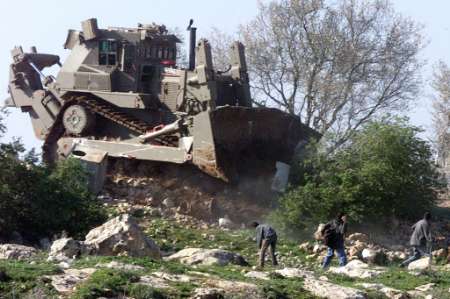
Although determined to stay, activists at two of the sites were removed by IDF soldiers and police in the early morning light. However, some of the activists fled to nearby vineyards to escape evacuation.

Police swooped down on the dozens of people who camped out in Judea at Ma’alot Halhul in the Judean Hills south of Hevron, evicting them by 8:00 a.m.

One young woman activist said that five black-suited police officers tried to force them off the site Sunday night, but that the activists far outnumbered them. The police later returned with reinforcements and wrecked two sukkot that had been erected, but no serious violence took place. One soldier told IsraelNN.com, "Most of us support you."

Those who stayed overnight at Nofei Hashmonaim, in the Binyamin district, were taken out of the area by police in two groups. One was dropped off at the nearby community of Gamzu and the other was taken to roads leading to Jerusalem.

Activists at three other sites – Harchivi near Elon Moreh, Shvut Ami near Kedumim and Givat HaEitam on the outskirts of Efrat--were joined by supporters from nearby communities as they prayed the morning service. IDF soldiers and police officers were making preparations to carry out evictions there as well.

The ascent to the sites of the five hoped-for communities was carried out Sunday with smiles and song as activists celebrated Sukkot, when holiday booths are built as a reminder of the clouds of glory that protected the Jews in the desert on their way to the Promised Land.

Chief Rabbi Shlomo Riskin led hundreds of Efrat residents to the site of Givat Eitam (Eitam Hill), earmarked to become the city’s newest neighborhood. The site is located within the city limits at the northern edge of Efrat and is intended to connect the eastern and western parts of Gush Etzion.

Another group of activists marched to Shvut Ami (“the return of my people”), to be built in western Samaria, and more hiked their way to to the hilltop of Harhivi (meaning “expand”, based on the passage in Isaiah 54: “Expand the place of thy tent… for thou shalt break forth both right and left”), located in eastern Samaria.

Those who marched to the sites included dozens of children under age 12 and hundreds of teens. “But there were many adults in their 30’s, 40’s and 50’s,” said one activist. “Some were in their 70's.”

Plans are still on for Tuesday’s march to Homesh, one of the four northern Samarian towns destroyed during the Disengagement of 2005.

The organizers have made no secret of their plans to rebuild the town, and have made dozens of ascents to the area over the past several months. MK Aryeh Eldad (National Union) called on the Defense and Public Security Ministers to instruct the police and army to permit and protect the marchers.

Tzvi Ben Gedalyahu and Hillel Fendel contributed to this story

Pioneers on Their Way to 5 New Towns

Hillel Fendel, IsraelNationalNews, 30.09.07 18 Tishrei 5768. All eyes are on the clock, with 1:30 PM set as H-hour for the ascent to five new hilltop outposts in Judea and Samaria. Clashes with soldiers and police are expected. As of 12 noon Sunday, a group of idealistic youths was already climbing the hilltop near Kiryat Arba set to be named Maalot Halhoul. Near Hashmonaim, in western Binyamin, hundreds of people are making their way to a site they wish to build as the community of Nofei Hashmonaim, just ten kilometers east of Ben Gurion International Airport. The army has declared the area a closed military zone, and is out in force to prevent the Jews from arriving.

In Efrat, Rabbi Shlomo Riskin and hundreds of townspeople are set to gather at 1 PM, preparing to march to the site of Eitam Hill, in the northern end of the city. The organizers say the hill, which connects eastern and western Gush Etzion, "belongs to Efrat, but is being stolen from us by the political [partition] fence. Handing it over to the Arab enemy will endanger all of Gush Etzion and Jerusalem."

Similar attempts to create new Jewish towns are underway in western Shomron, near Kedumim, at a site to be called Shvut Ami ("the return of my nation"), and in eastern Shomron, near Elon Moreh, at a hilltop already named Harhivi (meaning "Expand," based on Isaiah 54: "Expand the place of thy tent... for thou shalt break forth both right and left").

"It would seem that the Israel Defense Forces would be interested in defending Israeli interests," one of the leading organizers, Datit Yitzchaki, told Arutz-7, "and would allow us to build these new towns. Instead, the Olmert government makes plans to turn over these areas to our enemy - repeating the mistakes of the Disengagement and similarly endangering hundreds of thousands more Israelis - and gives political orders to the army to stop us."

Asked what the pioneers are bringing with them to the sites, Yitzchaki said, "They are bringing what they need to remain out in the fields or hills for 24 hours. It depends on how violent the army is going to be. We don't think the army will be able to stay in the area in such force for 24 hours - so we'll wait them out if we have to. We have time. As the motto goes, the Nation of Israel does not fear a long trek."

Three planners of the new Hashmonaim community were arrested in a Wednesday morning raid. The police also confiscated from their homes items such as orange hats (orange being the color of the Land of Israel movement), bumper stickers and T-shirts promoting settlement in Yesha. The most common slogan: "Eretz Yisrael (Land of Israel) - We Continue With Our Heads Held High."

For more information on the plans to start the new Jewish towns, click here.

Some 20 rabbis of Gust Etzion have signed a proclamation in favor of the attempts to build the new towns. The rabbis state that the next step in settling the Land of Israel - "a commandment that is equal to all the others in the Torah" - is now to "build the hilltops, whose construction and development are being held up for various strange reasons stemming primarily from the weakness of our leadership, and also from a failure to see the reality religiously, politically and demographically."

Plans are also underway to march to Homesh, one of the four Shomron towns destroyed during the Disengagement of 2005. The organizers have made no secret of their plans to rebuild the town, and have made dozens of ascents to the area over the past several months. MK Aryeh Eldad (National Union) called on the Defense and Public Security Ministers to instruct the police and army to permit and protect the marchers.

lunedì 23 luglio 2007

'Homesh First' Declares Victory

Peace Now's activists demontrating opposite the new settlement in Hebron


Hillel Fendel. IsraelNationalNews.com. 23/07/07. The army says it prevented the planned ascent to the ruins of the Jewish community of Homesh in Samaria, 18 miles east of Netanya, but hundreds of pioneers made their way up at night. They built a water tower and the beginnings of a makeshift synagogue. The security forces are planning ways to remove the hundreds, and destroy the makeshift structures. "The event has been successful, and continues." So states a recorded announcement from the headquarters of Homesh First, the grassroots organization dedicated to rebuilding the destroyed town of Homesh. Homesh was one of four Jewish communities in Northern Samaria razed by Ariel Sharon's Disengagement plan two years ago, but its residents have never given up the idea of rebuilding it.

An estimated 2,000 to 3,000 people have tried to make their way by foot to Homesh since Sunday morning. Many of them were stopped at several blockades set up by the army along the way, and many others were forcibly removed after reaching the ruins.

The pioneers reported that one person was knocked unconscious during the eviction, and five others were injured by security forces in violence reminiscent of Amona. Nearly a year and a half ago, hundreds of youths required hospital treatment after police used excessive violence to remove them from a hilltop in Amona in order to enable the razing of nine Jewish houses.

Limor Sohn Har-Melekh, from the Homesh First task force, announced Sunday night, "Army and police spokespersons say they have defeated us, but the fact is that more people are marching towards Homesh right now than this morning... The police were very violent, breaking cameras, using clubs, and pushing people from terraces. But our spirit is so strong that people who are taken down right away try to come back up..."

In addition to the many hundreds of youth who participated, several families planning to live in Homesh were removed from the hilltop in the afternoon hours, while others who were on the scenic hilltop ran away. The army bused some of them to Rosh HaAyin and there dropped them off, and took the others to nearby Kedumim.

Several dozen youths were attacked by Arabs from a nearby village, and the security forces intervened.

MK Aryeh Eldad (National Union), who moved to Homesh three months before its destruction in 2005, also took part in the ascent on Sunday. This, after initially being told that even his Knesset Member privileges would not suffice to allow him passage to the area. "The manhunt that the Border Guard policemen are waging after the youths who have come to rebuild Homesh," he said, "will not break the spirit of those who still believe that the Land of Israel belongs to the Jewish People and not the Arabs."

Organizers were very happy at the way the event was developing. "This is a rolling event, not a one-time thing," they said, "and it is not yet over. This is our climactic moment in the struggle for Homesh. It began last week when we pulled a good trick in announcing that Tuesday's planned ascent would not take place - while ever since then, hundreds have made their way up."

"The point is to show the Prime Minister that we are not planning to ever give up the plan to return and rebuild Homesh. We have changed the rules of the game, and the government is unable to deal with the great amounts of people that keep coming here."

The first ascent to Homesh took place seven months ago, on Chanukah, when 1,000 people evaded army checkpoints and lit holiday candles there. A few months later, shortly before Passover, 3,000 people attempted to settle the site, but were thrown out after three days. A month later, on Independence Day, 20,000 people marched to Homesh, in an event permitted at the last moment by the security forces. On June 12, thousands made their way to Homesh in a government-authorized visit, marking the 40th anniversary of the liberation of the area, and of all of Judea and Samaria.